
Catalogue Search | MBRL


Are you sure you want to remove the book from the shelf?

{{itemTitle}}
694
result(s) for
"Russisch."
Sort by:

Why Do They Kill Our People?
This book is a collection of stories from witnesses and victims of Russian war atrocities that occurred in Ukraine during the full-scale Russian invasion that started in 2022. It contains first-hand stories of killings, illegal detentions, torture, and heavy bombardments of the civilian settlements carried out the Russian military during the invasion of Ukraine. It also contains stories of evacuation, losing loved ones, and the heroism of soldiers and paramedics. This book will give you the human dimension of the war, reflected in the stories of real people.
eBook

The librarian
A collection of books, written by unpopular Soviet-era novelist Gromov, have incredible mystical powers. When Alexei inherits these as part of an uncle's estate, he has no idea of the power they hold and what a group of readers will do to possess them.
Book

Nationalstereotype im Kulturvergleich: Deutschland im niederländischen und russischen Fremdsprachenunterricht an Schulen und Universitäten
Stereotypes, prejudices, hostile images and clichés are different forms of self-images and images of others. This paper establishes stereotypes as a scalable concept to distinguish them from other forms of fixed attributions. It features a comparison of national stereotypes about Germany, the Germans and the German language from a Dutch and Russian perspective and discusses the use of stereotypes in foreign language teaching, which are aimed at culturally reflective learning.
Journal Article


Reanalysis in Adult Heritage Language
The reported study presents and analyzes the comprehension of relative clauses in child and adult speakers of Russian, comparing monolingual controls with Russian heritage speakers (HSs) who are English-dominant. Monolingual and bilingual children demonstrate full adultlike mastery of relative clauses. Adult HSs, however, are significantly different from the monolingual adult controls and from the child HS group. This divergent performance indicates that the adult heritage grammar is not a product of the fossilization of child language. Instead, it suggests that forms existing in the baseline undergo gradual attrition over the life span of a HS. This result is consistent with observations on narrative structure in child and adult HSs (Polinsky, 2008b). Evidence from word order facts suggests that relative clause reanalysis in adult HSs cannot be attributed to transfer from English. (Verlag, adapt.).
Journal Article

Still waters run deep : young women's writing from Russia
Frank, unsparing, and varied stories by women in their twenties and thirties reveal the evolution of women's consciousness in Russia through two decades of violent social upheaval-- including the dramatic monologue of a teenage girl who grew up in an orphanage; an escape to the Altai Mountains and the mysterious local rites and lore; the seamy side of Siberian business and a young man's failure to get to grips with it; the tricky backstage life of a provincial theater; the private life of a wealthy family which mirrors the social stratification in Russian society today.
Book

The Conflict in Ukraine
Ukraine has long been a country rent by linguistic differences, ethnic strife and divided political loyalties. This book provides the crucial historical background for understanding the conflict in Ukraine. It also looks beyond the appearance of ethnic strife to the conflict's deeper causes, the clash of different political models and concepts of citizenship.
eBook

Inside the rainbow : Russian children's literature 1920-1935 : beautiful books, terrible times
\"Inside the Rainbow reprints for the first time in English a unique compendium of Soviet picture books from the 1920 and 1930s--a highpoint in the history of children's literature. In the dark and dangerous world of revolutionary Petrograd, a group of Russian poets and artists, among the greatest of the century, came together to create a new kind of book for children about to enter a Brave New World. ... These artists and writers dreamed of endless possibilities in a new world where children and grown-ups alike would be free from the bitterness of ignorance. For a time, when children's publications still escaped the scourge of state censorship, their books became a last haven for learning, poetic irony, burlesque and laughter. In this book 250 brilliant examples of illustration and design are complemented by some wonderful translations of poems and stories as well as texts from the victims, criminals and witnesses to the Russian revolution\"--Page 4 of cover.
Book
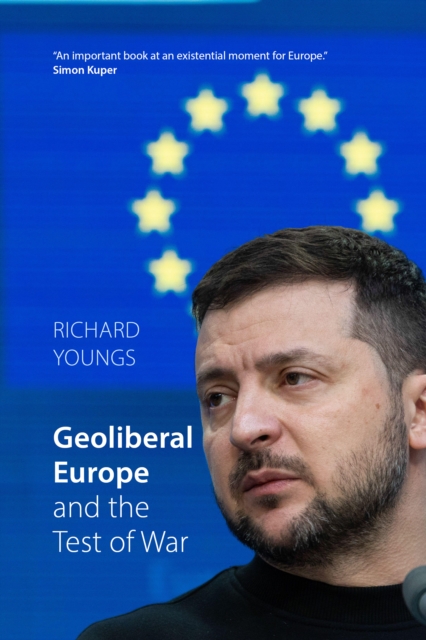
Geoliberal Europe and the Test of War
Russia's invasion of Ukraine has pushed Europe into a new strategic era. The knock-on effects of the war have combined to open a period of reordering across the European continent. European governments and the European Union collectively have begun to fashion policies for this shift, recognizing this to be a pivotal historical moment. Richard Youngs unpacks the different dynamics that have come to characterize European policies in the wake of the war: the nature of EU integration, geopolitical power, defence priorities, European borders, liberal values, the green transition and economic sovereignty. The book looks to the future and outlines the issues and choices with which European governments still need to grapple. Youngs develops the notion of geoliberalism as a way of addressing these challenges and guiding European governments and the EU into the fragile order taking shape in the shadow of Ukraine's war.
eBook