
Catalogue Search | MBRL


Are you sure you want to remove the book from the shelf?

{{itemTitle}}
23
result(s) for
"Satire Classical influences."
Sort by:


African American writers and classical tradition
Constraints on freedom, education, and individual dignity have always been fundamental in determining who is able to write, when, and where. Considering the singular experience of the African American writer, William W. Cook and James Tatum here argue that African American literature did not develop apart from canonical Western literary traditions but instead grew out of those literatures, even as it adapted and transformed the cultural traditions and religions of Africa and the African diaspora along the way. Tracing the interaction between African American writers and the literatures of ancient Greece and Rome, from the time of slavery and its aftermath to the civil rights era and on into the present, the authors offer a sustained and lively discussion of the life and work of Phillis Wheatley, Frederick Douglass, Ralph Ellison, and Rita Dove, among other highly acclaimed poets, novelists, and scholars. Assembling this brilliant and diverse group of African American writers at a moment when our understanding of classical literature is ripe for change, the authors paint an unforgettable portrait of our own reception of “classic” writing, especially as it was inflected by American racial politics.
eBook

Rethinking the other in antiquity
Prevalent among classicists today is the notion that Greeks, Romans, and Jews enhanced their own self-perception by contrasting themselves with the so-called Other--Egyptians, Phoenicians, Ethiopians, Gauls, and other foreigners--frequently through hostile stereotypes, distortions, and caricature. In this provocative book, Erich Gruen demonstrates how the ancients found connections rather than contrasts, how they expressed admiration for the achievements and principles of other societies, and how they discerned--and even invented--kinship relations and shared roots with diverse peoples.
Gruen shows how the ancients incorporated the traditions of foreign nations, and imagined blood ties and associations with distant cultures through myth, legend, and fictive histories. He looks at a host of creative tales, including those describing the founding of Thebes by the Phoenician Cadmus, Rome's embrace of Trojan and Arcadian origins, and Abraham as ancestor to the Spartans. Gruen gives in-depth readings of major texts by Aeschylus, Herodotus, Xenophon, Plutarch, Julius Caesar, Tacitus, and others, in addition to portions of the Hebrew Bible, revealing how they offer richly nuanced portraits of the alien that go well beyond stereotypes and caricature.
Providing extraordinary insight into the ancient world, this controversial book explores how ancient attitudes toward the Other often expressed mutuality and connection, and not simply contrast and alienation.
eBook

Excess and the Mean in Early Modern English Literature
This book examines how English writers from the Elizabethan period to the Restoration transformed and contested the ancient ideal of the virtuous mean. As early modern authors learned at grammar school and university, Aristotle and other classical thinkers praised \"golden means\" balanced between extremes: courage, for example, as opposed to cowardice or recklessness. By uncovering the enormous variety of English responses to this ethical doctrine, Joshua Scodel revises our understanding of the vital interaction between classical thought and early modern literary culture.
Scodel argues that English authors used the ancient schema of means and extremes in innovative and contentious ways hitherto ignored by scholars. Through close readings of diverse writers and genres, he shows that conflicting representations of means and extremes figured prominently in the emergence of a self-consciously modern English culture. Donne, for example, reshaped the classical mean to promote individual freedom, while Bacon held extremism necessary for human empowerment. Imagining a modern rival to ancient Rome, georgics from Spenser to Cowley exhorted England to embody the mean or lauded extreme paths to national greatness. Drinking poetry from Jonson to Rochester expressed opposing visions of convivial moderation and drunken excess, while erotic writing from Sidney to Dryden and Behn pitted extreme passion against the traditional mean of conjugal moderation. Challenging his predecessors in various genres, Milton celebrated golden means of restrained pleasure and self-respect. Throughout this groundbreaking study, Scodel suggests how early modern treatments of means and extremes resonate in present-day cultural debates.
eBook
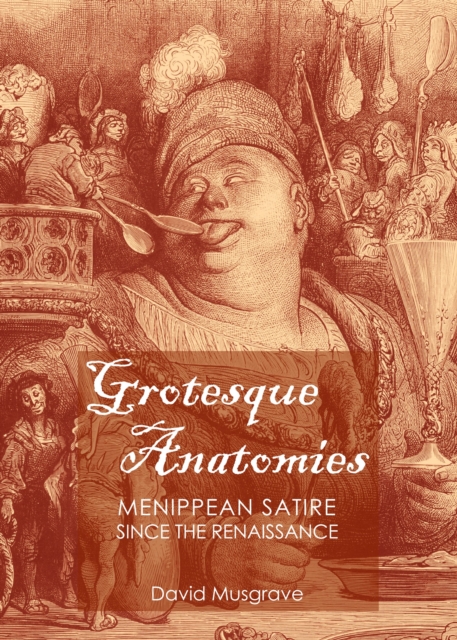
Grotesque anatomies : Menippean satire since the Renaissance
Grotesque Anatomies is a study of Menippean satire in English since the Renaissance. It consists of revisionist, close readings of canonical works such as Eliots The Waste Land and Popes Dunciad among others, and investigates how identifying them as Menippean satires changes our understanding of them. The initial chapter offers a comprehensive account of the form from antiquity to the present day, identifying its bifurcated development in the shorter form (Seneca-Lucian-Julian) and the long.
eBook

JUVENAL 5.104
This paper draws on Juvenal's intertextual relationship with comedy to solve a textual crux involving fish-names. The monograph by Ferriss-Hill will no doubt warn scholarship away from the treatment of Roman satire's intertextuality with Old Comedy for a time. Yet, Greek comedy's influence on Roman satire is far from exhausted, and this paper will show that this influence goes more widely, and more deeply, than is usually seen. In time, one might hope for a renewed monographic treatment of the subject.
Journal Article

Dickens, Miscellanies, and classical traditions of Satire
Nevertheless, it must occasionally be permissible to glance upstream as well as down, and try to understand Dickens's aesthetic and ethical development as a writer in terms of those he acknowledged and navigated amongst as forerunners: in this case well-established exponents of classical traditions of literary attack and reform. Dickens's \"small Latin and less Greke\" as a schoolboy is, in this respect, irrelevant, because such traditions were so widely diffused in Regency, Georgian and Victorian print culture, partly though the periodical press, but also through the warp and weft of parliamentary rhetoric, which of course, Dickens himself was as responsible as anyone for weaving into text during the 1830s.
Journal Article

Brill's companion to the reception of Aristophanes
Brill's Companion to the Reception of Aristophanes provides a substantive account of the reception of Aristophanes (c. 446-386 BC) from Antiquity to the present. Aristophanes was the renowned master of Old Attic Comedy, a dramatic genre defined by its topical satire, high poetry, frank speech, and obscenity. Since their initial production in classical Athens, his comedies have fascinated, inspired, and repelled critics, readers, translators, and performers. The book includes seventeen chapters that explore the ways in which the plays of Aristophanes have been understood, appropriated, adapted, translated, taught, and staged. Careful attention has been given to critical moments of reception across temporal, linguistic, cultural, and national boundaries.
eBook

Authenticity, Complaint, and the Russianness of American Jewish Literature
Bernard Malamud, Saul Bellow, Philip Roth, and their critics embraced the notion that their work displayed an affinity to Russian and Yiddish literature, especially to the work of Fyodor Dostoevsky, Nikolai Gogol, and Sholem Aleichem. Like these writers, the prominent American Jewish writers of the 1960s were understood as producing writing that emerged from their authentic, often negative emotions, work that voiced complaints. I first describe this generation's playful claiming of a Russian and Jewish genealogy, their definition of the Russian and Yiddish writers as a collective worthy of copying. I then use close readings of six passages to evaluate the American writers' assertions about their influence by the Russian and Yiddish ones. I compare the inset oral and written complaints in Roth and Bellow with those in Gogol, Dostoevsky, and Sholem Aleichem, both acknowledging their striking formal similarities and distinguishing the comic, satirically presented literary complaints of prerevolutionary Russia from the potentially more therapeutically oriented—albeit still satirical—literary complaints of postwar America. Finally, I look outside the literary texts to understand why it was appealing to 1960s American writers to think of themselves as influenced by prerevolutionary Russian and Yiddish verbal art. This article situates the American Jewish writers and their critics in an aural environment where Russian and Yiddish sounds were increasingly available in entertainment and where they were associated with authenticity and political opposition. In spite of the formal parallels among the American Jewish, Russian, and Yiddish literary complaints, and in spite of Roth and Bellow representing themselves compellingly as imitators, I argue that they need to be understood instead in their own national and temporal communicative context.
Journal Article

Victorian Classical Burlesques
The Victorian classical burlesque was a popular theatrical genre of the mid-19th century. It parodied ancient tragedies with music, melodrama, pastiche, merciless satire and gender reversal. Immensely popular in its day, the genre was also intensely metatheatrical and carries significance for reception studies, the role and perception of women in Victorian society and the culture of artistic censorship. This anthology contains the annotated text of four major classical burlesques:Antigone Travestie(1845) by Edward L. Blanchard,Medea; or, the Best of Mothers with a Brute of a Husband(1856) by Robert Brough,Alcestis; the Original Strong-Minded Woman(1850) andElectra in a New Electric Light(1859) by Francis Talfourd. The cultural and textual annotations highlight the changes made to the scripts from the manuscripts sent to the Lord Chamberlain's office and, by explaining the topical allusions and satire, elucidate elements of the burlesques' popular cultural milieu. An in-depth critical introduction discusses the historical contexts of the plays' premieres and unveils the cultural processes behind the reception of the myths and original tragedies. As the burlesques combined spectacular effects with allusions to contemporary affairs, ambivalent and provocative attitudes to women, the plays represent an essential tool for reading the social history of the era.
eBook