
Catalogue Search | MBRL


Are you sure you want to remove the book from the shelf?

{{itemTitle}}
167
result(s) for
"Science Study and teaching (Middle school) Activity programs."
Sort by:

Building your project portfolio with science research projects
\"A book for middle school students about building project portfolios using science research projects\"-- Provided by publisher.
Book

How Students Learn
How Students Learn: Science in the Classroom builds on the discoveries detailed in the best-selling How People Learn . Now these findings are presented in a way that teachers can use immediately, to revitalize their work in the classroom for even greater effectiveness.
Organized for utility, the book explores how the principles of learning can be applied in science at three levels: elementary, middle, and high school. Leading educators explain in detail how they developed successful curricula and teaching approaches, presenting strategies that serve as models for curriculum development and classroom instruction. Their recounting of personal teaching experiences lends strength and warmth to this volume.
This book discusses how to build straightforward science experiments into true understanding of scientific principles. It also features illustrated suggestions for classroom activities.
eBook

Captivate, activate, and invigorate the student brain in science and math, grades 6-12
John Almarode and Ann Miller provide numerous strategies and a model for developing engaging science and math lessons and units that captivate students, activate prior knowledge, and invigorate student interest by making lessons rigorous and relevant.
eBook

Teaching the Common Core Math Standards with Hands-On Activities, Grades 6-8
Helpful advice for teaching Common Core Math Standards to middle-school students
The new Common Core State Standards for Mathematics have been formulated to provide students with instruction that will help them acquire a thorough knowledge of math at their grade level, which will in turn enable them to move on to higher mathematics with competence and confidence. Hands-on Activities for Teaching the Common Core Math Standards is designed to help teachers instruct their students so that they will better understand and apply the skills outlined in the Standards.
This important resource also gives teachers a wealth of tools and activities that can encourage students to think critically, use mathematical reasoning, and employ various problem-solving strategies.
* Filled with activities that will help students gain an understanding of math concepts and skills correlated to the Common Core State Math Standards
* Offers guidance for helping students apply their understanding of math concepts and skills, develop proficiency in calculations, and learn to think abstractly
* Describes ways to get students to collaborate with other students, utilize technology, communicate ideas about math both orally and in writing, and gain an appreciation of the significance of mathematics to real life
This practical and easy-to-use resource will help teachers give students the foundation they need for success in higher mathematics.
eBook
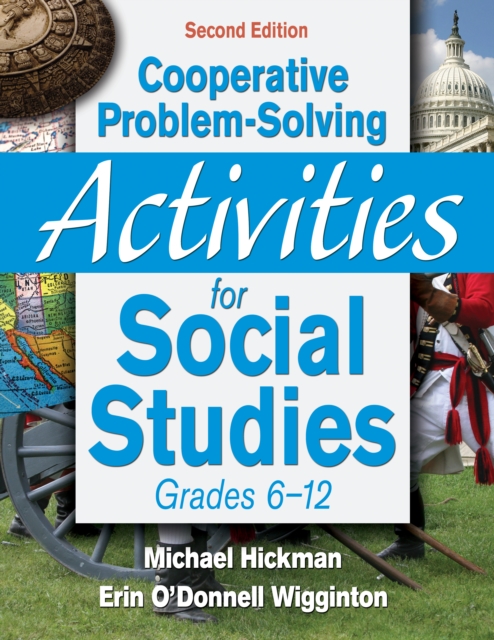
Cooperative problem-solving activities for social studies, grades 6-12
Give your students the opportunity to think, to discover, and to learn together! The second edition of Catch Them Thinking in Social Studies demonstrates how teachers can use cooperative learning strategies to fully engage students in the social studies curriculum. The authors offer engaging activities and a variety of problem-solving lessons in five areas of social studies instruction: geography, politics, economics, culture, and history. This updated edition includes new activities and helps teachers prepare students to: - Rely on themselves and their peers for information - Work closely with others Make suggestions - Use trial-and-error strategies Have fun learning about social studies
eBook

Learners’ Perspectives on ARCH + STEM: Integration of Archaeology and Indigenous Knowledges with Western Knowledges of STEM
It is often the case that the integration of archaeology and Indigenous knowledges with science, technology, engineering, and mathematics (STEM) concepts, practices, and processes is missing in school-based contexts, which limits learners’ perspectives of STEM. This study examined how an afterschool program focused on the intersection of STEM and the field of archaeology and Indigenous knowledges developed and/or enhanced middle school learners’ perspective of (a) Indigenous people; (b) the field of archaeology; and (c) STEM concepts, practices, and processes. Data were collected through 15 focus group interviews held approximately six weeks after the program’s conclusion. The results demonstrated that learners gained a new perspective of STEM, integrating Indigenous and Western perspectives; gained an understanding of archaeology and archaeological concepts; and made connections between STEM concepts embedded in the program and those within and outside of their school experience. Based on the results, we contend that the integration of alternative knowledges and ways of being and seeing the world within nonformal learning environments has the potential to diminish differences and/or tensions between Indigenous and Western knowledges and perspectives of STEM, as well as support archaeology as an approach to facilitating the learning and application of STEM concepts, practices, and processes.
Journal Article


Equitable STEM+CS learning experiences for girls of color: nurturing an independent learning approach via a learning ecosystem
Purpose
There is a critical need to understand how to attract Black girls and other girls of color to the science, technology, engineering, math, and computer science (STEM+CS) field. This study aims to look at the design and implementation of a CS learning ecosystem that supports girls of color in acquiring critical CS skills starting in middle school.
Design/methodology/approach
This mixed-method case study included 53 girls, between the ages of 11 and 13, in four US middle schools. Study methods included the analysis of a pre-program student survey, longitudinal interviews and focus groups, weekly observations and computing artifacts.
Findings
Program participants were interested in CS, were confident in their ability to learn CS, had prior coding and CS experience and had parents and teachers who encouraged them to learn CS. But some students showed dependent learning behaviors while engaging in CS activities. These included relying on instructors and being reticent to make mistakes–behaviors that limit learning. The CS learning ecosystem supported students as they shifted from applying dependent learning approaches to applying independent learning approaches. Instructors sustained a growth mindset and supported productive struggle as students learned CS skills.
Originality/value
A CS learning system supported equitable learning experiences and helped students develop independent learning behaviors that led to deeper engagement in CS.
Journal Article

Efficacy of Peer Support Arrangements to Increase Peer Interaction and AAC Use
Supporting interaction in inclusive settings between students with complex communication needs (CCN) and their peers requires careful planning and support. We used a multiple-probe-across-participants design to investigate the efficacy of collaborative planning and peer support arrangements to increase peer interaction in inclusive classrooms. Participants were four middle school students with CCN who had an intellectual disability and used an iPad with Proloquo2Go as augmentative and alternative communication (AAC). Educational teams comprised of a special educator, general educator, paraprofessional, and speech-language pathologist participated in collaborative planning for the intervention. For all four students, the intervention substantially increased communication to and from their peers. AAC use increased for one student. We offer implications for research and practice on supporting social interaction in general education settings.
Journal Article

Preparing Teachers to Design Instruction for Deep Understanding in Middle School Earth Science
This study compared the efficacy of 3 approaches to professional development in middle school Earth science organized around the principles of Understanding by Design (
Wiggins & McTighe, 1998
) in a sample of 53 teachers from a large urban district. Teachers were randomly assigned to a control group or to 1 of 3 conditions that varied with respect to the conceptions of ideal curriculum use embedded within. Teachers either designed units of instruction, adopted units developed by expert Earth scientists and Earth science educators, or learned principled ways to adapt expert-designed curricula. Relying on data from surveys and independent ratings of naturally occurring teacher assignments, we used hierarchical linear modeling techniques to analyze the impacts of the professional development on how teachers planned and coordinated instruction. Our results suggest that to realize positive effects on both their planning and coordination of instruction, teachers need access to high-quality curriculum materials and professional development that helps them plan for principled adaptation of those materials.
Journal Article