
Catalogue Search | MBRL


Are you sure you want to remove the book from the shelf?

{{itemTitle}}
18,561
result(s) for
"Search engine optimization"
Sort by:

“Outside the industry, nobody knows what we do” SEO as seen by search engine optimizers and content providers
PurposeIn commercial web search engine results rankings, four stakeholder groups are involved: search engine providers, users, content providers and search engine optimizers. Search engine optimization (SEO) is a multi-billion-dollar industry and responsible for making content visible through search engines. Despite this importance, little is known about its role in the interaction of the stakeholder groups.Design/methodology/approachWe conducted expert interviews with 15 German search engine optimizers and content providers, the latter represented by content managers and online journalists. The interviewees were asked about their perspectives on SEO and how they assess the views of users about SEO.FindingsSEO was considered necessary for content providers to ensure visibility, which is why dependencies between both stakeholder groups have evolved. Despite its importance, SEO was seen as largely unknown to users. Therefore, it is assumed that users cannot realistically assess the impact SEO has and that user opinions about SEO depend heavily on their knowledge of the topic.Originality/valueThis study investigated search engine optimization from the perspective of those involved in the optimization business: content providers, online journalists and search engine optimization professionals. The study therefore contributes to a more nuanced view on and a deeper understanding of the SEO domain.
Journal Article

Open access publications drive few visits from Google Search results to institutional repositories
Given the importance of
Google Search
in generating visits to institutional repositories (IR), a lack of visibility in search engine results pages can hinder the possibility of their publications being found, read, downloaded, and, eventually, cited. To address this, institutions need to evaluate the visibility of their repositories to determine what actions might be implemented to enhance them. However, measuring the search engine optimization (SEO) visibility of IRs requires a highly accurate, technically feasible method. This study constitutes the first attempt to design such a method, specifically applied here to measuring the IR visibility of Spain’s national university system in
Google Search
based on a set of SEO-based metrics derived from the
Ubersuggest
SEO tool. A comprehensive dataset spanning three months and comprising 217,589 bibliographic records and 316,899 organic keywords is used as a baseline. Our findings show that many records deposited in these repositories are not ranked among the top positions in
Google Search
results, and that the most visible records are mainly academic works (theses and dissertations) written in Spanish in the Humanities and Social Sciences. However, most visits are generated by a small number of records. All in all, our results call into question the role played by IRs in attracting readers via
Google Search
to the institutions’ scientific heritage and serve to underscore the prevailing emphasis within IRs on preservation as opposed to online dissemination. Potential improvements might be achieved using enhanced metadata schemes and normalized description practices, as well as by adopting other actionable insights that can strengthen the online visibility of IRs. This study increases understanding of the role played by web indicators in assessing the web-based impact of research outputs deposited in IRs, and should be of particular interest for a range of stakeholders, including open access and open science advocates, research agencies, library practitioners, repository developers, and website administrators.
Journal Article

SEO as Audience Analysis: Accounting for Algorithms in Content Strategy
Purpose: This project contributes a rhetorical approach to search engine optimization (SEO) as algorithmic audience analysis. It positions SEO as an activity that requires strategists to compose website content that is optimized to both human search engine users and the algorithmic
audience (Gallagher, 2017) of a search engine???s indexed content. Method: Actor-Network Theory (Latour, 2005), with its focus on the agency of non-human entities combined with human agency in social activity, provides the theoretical framework for this approach. The project combines
usability testing with web development methods to trace rhetorical agency during online search activities (Hocutt, 2019). Doing so demonstrates the role search algorithms play as receptive audiences of SEO strategies. Results: Approaches to teaching SEO within the framework of technical
and professional communication (TPC) rhetorical foundations require understanding the algorithmic audiences of SEO practices. By matching timestamp data from videorecorded usability tests and HTTP archive (HAR) files produced during usability testing sessions, content strategists can overlay
the chronological recordings with their SEO strategies to better understand how successfully SEO met human and algorithmic audience expectations. When SEO practice identifies human audience expectations effectively and develops content signals attractive to its technological audiences, both
audiences succeed in an assembled meaning-making exercise. By applying existing methods of audience analysis to search algorithms, content strategists can improve SEO and help surface relevant content for their human users. Conclusion: The results of this project provide a framework
for practicing SEO as rhetorical activity built upon audience analysis of both human and non-human users.
Journal Article
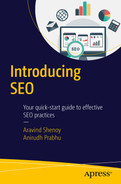
Introducing SEO
Use this easy-to-digest brief introduction to leverage search engine optimization (SEO) - an imperative methodology used to improve the visibility of websites using different strategies and techniques.
eBook

OPPORTUNITIES AND CHALLENGES FOR DESTINATION MARKETING USING SEARCH ENGINE DATA
Destination branding and digital diplomacy, as two driving forces for the tourism industry, can capitalize on branding strategies and marketing instruments from commercial practice. Although existing research has explored ways this should include search engine optimization (SEO) tools and analyses, implementation has been limited so far. Currently, daily queries and results in global search engines have a major impact on international perceptions of countries and the formation of public opinions in the context of the tourism industry and country relations. SEO tools not only create new challenges and possibilities for data analysis for related scientific disciplines, but also offer great benefits for political, cultural, and educational institutions and decision-makers in destination branding and tourism. It is crucial for these entities to carefully evaluate and strategically employ websites and web content to rank better in search engine results. This study closes a gap in applied research by critically examining common approaches to search engine analysis for tourism purposes, especially those based on Google Trends data. This includes introducing previously neglected SEO analysis methods, along with cases regarding their applications. The study concludes by discussing the limitations of search engine resources and their potential for future research and use in destination branding and digital diplomacy in the tourism context.
Journal Article

An Effective SEO Techniques and Technologies Guide-map
The paper analyzes from a technical point of view the search engine optimization (SEO) techniques and technologies, which lead to effective results up to date. More specifically, it examines the potential SEO alternatives, with ultimate target to increase the organic visitors of a website and climb it up on top of the ranking in respective search engine’s queries. The main problem every website’s owner has to solve is which of these SEO techniques have to be implemented in order to increase the organic traffic with the minimum budget. This paper aims to present the dominant SEO techniques and evaluate their effectiveness to organic traffic. This paper aims to present the way well-known websites apply SEO nowadays. Taking advantage of this information, Webmasters will know in advance which exactly SEO techniques should apply to their websites and in which specific order to gain higher search results, resulting to higher traffic.
Journal Article
THE ROLE OF DIGITAL MARKETING STRATEGIES IN ENHANCING PRODUCTIVITY AND FINANCIAL INCLUSION IN EMERGING BANKING SECTORS: EVIDENCE FROM NIGERIA
This study investigates the impact of digital marketing strategies on the productivity of United Bank for Africa (UBA), focusing on social media marketing, content marketing, email marketing, and search engine optimization (SEO). Using a cross-sectional survey design and quantitative analysis, the research explores the correlation between digital marketing variables and organizational productivity. The findings reveal that social media marketing and content marketing have significant positive effects on productivity, while SEO shows a moderate but meaningful contribution. Conversely, email marketing demonstrates no significant effect, reflecting changing consumer preferences toward more interactive platforms. The study reinforces the Resource-Based View (RBV) and Technology-Organization-Environment (TOE) framework, emphasizing digital capabilities as critical drivers of competitive advantage. Policy implications highlight the role of digital marketing in advancing financial inclusion, reducing transaction costs, and enhancing customer engagement in Nigeria’s banking sector. Overall, the study concludes that strategic deployment of digital marketing not only enhances firm performance but also contributes to broader economic growth in emerging economies.
Journal Article

Increasing visibility and discoverability of scholarly publications with academic search engine optimization
With the help of academic search engine optimization (ASEO), publications can more easily be found in academic search engines and databases. Authors can improve the ranking of their publications by adjusting titles, keywords and abstracts. Carefully considered wording makes publications easier to find and, ideally, cited more often. This article is meant to support authors in making their scholarly publications more visible. It provides basic information on ranking mechanisms as well as tips and tricks on how to improve the findability of scholarly publications while also pointing out the limits of optimization. This article, authored by three scholarly communications librarians, draws on their experience of hosting journals, providing workshops for researchers and individual publication support, as well as on their investigations of the ranking algorithms of search engines and databases.
Journal Article

Sustainability for Predicting Customer Lifetime Value: A Mediation–Moderation Effect Across SEO Metrics in Europe
The aim of this study was to analyse the relationship between sustainability and customer lifetime value (CLV) through the mediation–moderation effect of search engine optimization (SEO) metrics of websites. We obtained a data sample of 296 European sustainable firms from both industrial and technological industries. Based on the theory of source credibility, the firm’s official website, where SEO techniques are applied, is more credible regarding its sustainability activities than other sources such as social media, paid advertising, etc. As a result, we show that sustainability is a precursor of financial performance over time in sustainable firms, represented by CLV. Furthermore, we found that the value of the moderating variable, website traffic, alters the indirect effects produced by the mediating variable called website relevance (domain authority), thereby demonstrating a moderated mediation effect. The contribution of this research to the body of literature is twofold. First, it deepens the understanding of how sustainability predicts marketing outcomes based on both digital and customer metrics over time. Second, we rely on recent literature on prediction-oriented modelling (PLS-SEM) to support that it is not suitable for estimation by reflective measurement models due to the woozle effect.
Journal Article

Digital Trends in the Italian Beer Market: A Time-Series and Search Engine Optimisation Analysis of Gluten-Free and Low/No-Alcohol Beers
Beer consumption patterns are evolving, with gluten-free beers (GFBs) and low- and no-alcohol beers (NABLABs) exhibiting continuous growth, underpinned by health-conscious consumers, younger generations’ preference for moderate drinking, and a rising awareness of gluten intolerance. This study investigates whether online search behaviour reflects these market changes and anticipates future consumption trends. A combined methodological framework was applied, integrating time-series analysis of Google Trends data—based on a decomposition model with a five-year forecast—with descriptive and semantic insights from Search Engine Optimisation (SEO) techniques using the specialised SEOZoom platform. The statistical decomposition enabled the identification of long-term trends, cyclical variations, and seasonal patterns in user interest. Italy was selected as a case study, representing a market where these niche segments have grown considerably despite a traditionally limited craft beer culture. The results reveal a steady rise in online interest in both GFB and NABLAB; GFB searches are primarily linked to health and dietary concerns, whilst NABLAB queries encompass a broader set of topics, including physiology, legislation, and consumption contexts. The forecasts confirm the persistence of this positive trend over the next five years. The approach demonstrates the potential of integrating digital and statistical tools to monitor emerging consumption dynamics and guide strategic decisions in the beverage sector.
Journal Article