
Catalogue Search | MBRL


Are you sure you want to remove the book from the shelf?

{{itemTitle}}
101
result(s) for
"Selling High technology"
Sort by:

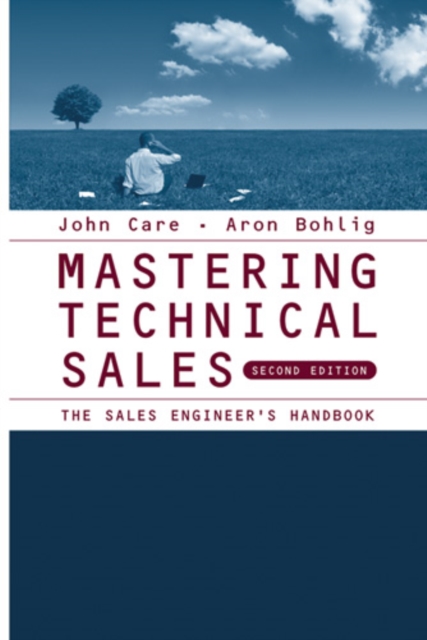
Mastering technical sales: the sales engineer's handbook
Take your career to new heights by adding powerhouse sales and presentation skills to your technical background. This newly revised and expanded edition of Mastering Technical Sales: The Sales Engineer's Handbook offers invaluable insights and tips for every stage of the selling process, explained step-by-step by a pair of technical sales pros with decades of eye-popping, industry-giant success under their belt. The second edition features nearly 40% new material, including how to make the most of Webcasts and remote demonstrations, how to give impressive \"snap\" demonstrations, and how to use CRM/SFA systems effectively.This indispensable sales tool shows you the ropes of lead qualification, the RFP process, and needs analysis and discovery, and explains how your technical know-how can add invaluable leverage to sales efforts at every step. You learn how to plan and present the perfect pitch, demonstrate products effectively, build customer relationship skills, handle objections and competitors, negotiate prices and contracts, close the sale, and so much more - including how to avoid the critical selling mistakes so often made by technical pros who jump to sales. The book also addresses key career management and team-building topics, and includes detailed case studies, concise chapter summaries, and handy checklists of skill-building tips that reinforce all the career-boosting skills and techniques you learn.
eBook

Mastering technical sales : the sales engineer's handbook
Intro -- Contents v -- Acknowledgments xvii -- 1 Introduction: Why Study Sales Consulting? 1 -- 2 An Overview of the Sales Process 7 -- Definition of the Market 8 -- Marketing Campaigns 8 -- Lead Qualification 9 -- Request for Proposal 10 -- Discovery and First Customer Engagement 10 -- Propose and Demo 11 -- Evaluation (Optional) 12 -- Negotiations: Close or LoseŠGetting the Deal 12 -- Ongoing Account Management: Upsell Opportunities and Postsales Support 12 -- Summary 13 -- 3 Lead Qualification 15 -- Lead Quality 17 -- Effective Lead Qualification 20 -- Internal Roles in the Lead Qualification Process 23 -- Lead Qualification in Action: Three Common Scenarios 25 -- Summary 27 -- 4 The RFP Process 29 -- Creation of an RFP 29 -- Basic Rule of RFPs 30 -- The Go/No-Go Decision 31 -- Handling Deadlines 33 -- Strategies for Avoiding an RFP 34 -- Completing the RFP 35 -- Presentation and Follow-Up 36 -- Summary 37 -- 5 Needs Analysis and Discovery 39 -- Overview 39 -- Why Discovery Is Critical 40 -- The Seven-Step Needs Analysis Approach 41 -- Customizing the Discovery Process 53 -- Summary 56 -- 6 Successful Customer Engagement 59 -- First Contact 60 -- Identify the People You Need to Know 63 -- Coaches 65 -- Credibility 69 -- Summary 70 -- 7 The Perfect Pitch 71 -- Nonverbal Delivery Skills 72 -- Verbal Delivery Skills 74 -- Developing a Focused Message 76 -- Special Situations 78 -- Using Nervous Energy to Your Advantage 81 -- Summary 83 -- 8 The Dash to Demo 85 -- Why Does the Dash to Demo Occur? 87 -- What Is The Product ? 87 -- Failing to Plan Is Planning to Fail 88 -- Logistical Implications 90 -- The Agenda 91 -- Preparing the Way 91 -- The Audience 92 -- Checkpoint Charlie 95 -- Summary 96 -- Appendix 8A: Sample Agenda 97 -- 9 Evaluation Strategies 99 -- Developing the Strategy 99 -- How to Win: Determining the Success Criteria 101.
eBook

Mastering Technical Sales
This indispensable sales tool shows you the ropes of lead qualification, the RFP process, and needs analysis and discovery, and explains how your technical know-how can add invaluable leverage to sales efforts at every step. You learn how to plan and present the perfect pitch, demonstrate products effectively, build customer relationship skills, handle objections and competitors, negotiate prices and contracts, close the sale, and so much more.
Book

Improving the predictive accuracy of the cross-selling of consumer loans using deep learning networks
Traditionally most cross-selling models in retail banking use demographics information and interactions with marketing as input to statistical models or machine learning algorithms to predict whether a customer is willing to purchase a given financial product or not. We overcome with such limitation by building several models that also use several years of account transaction data. The objective of this study is to analysis credit card transactions of customers, in order to come up with a good prediction in cross-selling products. We use deep-learning algorithm to analyze almost 800,000 credit cards transactions. The results show that such unique data contains valuable information on the customers’ consumption behavior and it can significantly increase the predictive accuracy of a cross-selling model. In summary, we develop an auto-encoder to extract features from the transaction data and use them as input to a classifier. We demonstrate that such features also have predictive power that enhances the performance of the cross-selling model even further.
Journal Article

CONSIDERATIONS ON HUMAN CAPITAL AS A KEY ELEMENT OF IT PRODUCT SALES MANAGEMENT
Over the last two decades, Romania has developed into a true regional hub for IT services, becoming a point of reference in Central and Eastern Europe. A key factor is the availability of a well-trained workforce. The higher education system has consistently produced graduates with solid skills in areas such as computer science, software engineering, artificial intelligence or cybersecurity. The workforce in the information and communications technology sector represents one of the most valuable resources of the Romanian economy. Therefore, the coordinates of sales management in an IT organization represent the key elements that structure and guide the sales activity, so that it is efficient, customer-oriented and aligned with the strategic objectives of the company. The specifics of the technology market must also be taken into account, as it is dynamic, competitive and innovative. The main elements of interest are: sales strategy, sales team structure, sales processes, performance management, support technology, training and development, customer relationship.
Journal Article

Developing Issue-Selling Effectiveness over Time: Issue Selling as Resourcing
This paper considers how issue sellers advance new issues within an organization over time, and how they gain competence at doing so. Using ethnographic, archival, and interview data spanning a six-year period, it describes the moves made by members of a high-tech manufacturer to introduce environmental considerations into the design of new manufacturing processes. A significant shift occurred in the pattern of moves used over time, and explanations for the shift are found in two accompanying dynamics: The gradual accumulation of assets by the group advancing the issues and their adjustment of moves used based on earlier experiences. The findings are used to develop a model of issue selling as resourcing ; that is, a practical accomplishment through which issue sellers moves enact key schemas held by issue recipients, triggering their attention and action on the issue. Issue selling as resourcing builds on recent work on resources and organizational boundaries to address how organizational contexts shape opportunities for and barriers to issue selling, and to identify how issue sellers learn to operate effectively within them.
Journal Article

Co-patents' commercialization: evidence from China
Co-patents are outcomes of R&D collaboration, which has been proven with higher-quality. Does this mean that high-quality patents should also extend their advantage to the technology market? Based on the transaction cost theory, we use the China National Intellectual Property Administration (CNIPA) database and logit model to explore the effect of co-ownership on firms' patent commercialization and the factors of co-patents that affect their commercialization. Our findings illustrate that co-ownership has a negative impact on patent commercialization. In addition, the co-owner's nature, country, and co-patent's industry influence the commercialization of co-patents. Firstly, a company and a university or research institution's co-owned co-patents are less likely to be commercialization than a company and a company co-owned co-patents. Secondly, multi-countries co-owned co-patents are less likely to be commercialization than a single-country co-owned co-patents. Thirdly, co-patents in high technology (high-tech) industries are less likely to be commercialization than co-patents in non-high-tech industries. This paper supports policymakers in implementing policies to promote the co-patents' commercialization. Meanwhile, our paper suggests that to pursue the economic value of the R&D collaborative intellectual property fruits, R&D collaborative intellectual property fruits are not be encouraged to be applied as the co-patents.
Journal Article

Three-Dimensional MIMO Channel Model with High-Mobility Wireless Communication Systems Using Leaky Coaxial Cable in Rectangular Tunnel
With the rapid development of high-mobility wireless communication systems, e.g., high-speed train (HST) and metro wireless communication systems, more and more attention has been paid to the wireless communication technology in tunnel-like scenarios. In this paper, we propose a three-dimensional (3D) nonstationary multiple-input multiple-output (MIMO) channel model with high-mobility wireless communication systems using leaky coaxial cable (LCX) inside a rectangular tunnel over the 1.8 GHz band. Taking into account single-bounce scattering under line-of-sight (LoS) and non-line-of-sight (NLoS) propagations condition, the analytical expressions of the channel impulse response (CIR) and temporal correlation function (T-CF) are derived. In the proposed channel model, it is assumed that a large number of scatterers are randomly distributed on the sidewall of the tunnel and the roof of the tunnel. We analyze the impact of various model parameters, including LCX spacing, time separation, movement velocity of Rx, and K-factor, on the T-CF of the MIMO channel model. For HST, the results of some further studies on the maximum speed of 360 km/h are given. By comparing the T-CF between the dipole MIMO system and the LCX-MIMO system, we can see that the performance of the LCX-MIMO system is better than that of the dipole MIMO system.
Journal Article