
Catalogue Search | MBRL


Are you sure you want to remove the book from the shelf?

{{itemTitle}}
35
result(s) for
"U-boat"
Sort by:

War and Punishment
What makes wars drag on and why do they end when they do? Here H. E. Goemans brings theoretical rigor and empirical depth to a long-standing question of securities studies. He explores how various government leaders assess the cost of war in terms of domestic politics and their own postwar fates. Goemans first develops the argument that two sides will wage war until both gain sufficient knowledge of the other's strengths and weaknesses so as to agree on the probable outcome of continued war. Yet the incentives that motivate leaders to then terminate war, Goemans maintains, can vary greatly depending on the type of government they represent. The author looks at democracies, dictatorships, and mixed regimes and compares the willingness among leaders to back out of wars or risk the costs of continued warfare.
Democracies, according to Goemans, will prefer to withdraw quickly from a war they are not winning in order to appease the populace. Autocracies will do likewise so as not to be overthrown by their internal enemies. Mixed regimes, which are made up of several competing groups and which exclude a substantial proportion of the people from access to power, will likely see little risk in continuing a losing war in the hope of turning the tide. Goemans explores the conditions and the reasoning behind this \"gamble for resurrection\" as well as other strategies, using rational choice theory, statistical analysis, and detailed case studies of Germany, Britain, France, and Russia during World War I. In so doing, he offers a new perspective of the Great War that integrates domestic politics, international politics, and battlefield developments.
eBook

Albert Ballin
This study of Albert Ballin, a powerful member of the banking and commercial elite in Imperial Germany and manager of the Hamburg-American Line from 1899-1918, illuminates the political and social structure of the aristocracy and the upper middle class in the German Empire.
Originally published in 1967.
The Princeton Legacy Library uses the latest print-on-demand technology to again make available previously out-of-print books from the distinguished backlist of Princeton University Press. These editions preserve the original texts of these important books while presenting them in durable paperback and hardcover editions. The goal of the Princeton Legacy Library is to vastly increase access to the rich scholarly heritage found in the thousands of books published by Princeton University Press since its founding in 1905.
eBook

Out of sight, out of reach: Moral issues in the globalization of the battlefield
The Great War ushered in a new era of long-distance combat. For the first time, weapons with a very long range were massively deployed, in previously unheard-of places: under the sea and in the air. Stealth fighting also included espionage and propaganda, now orchestrated on a global scale. In reaction to the carnage in the trenches, a degree of moral rehabilitation came to be conferred on the weapons initially associated with a “cowards’ war”. This in turn encouraged experimentation with the new, unmanned technology that would lead to the first prototypes of guided munitions and drones.
Journal Article

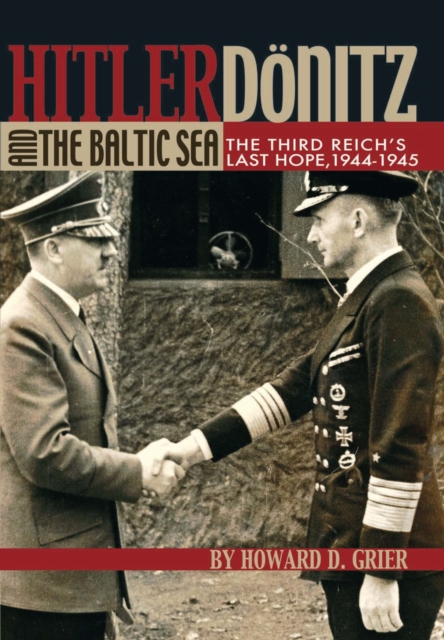
Hitler, Donitz, and the Baltic Sea
The popular conception of Hitler in the final years of World War II is that of a deranged Fuhrer stubbornly demanding the defense of every foot of ground on all fronts and ordering hopeless attacks with nonexistent divisions. To imply that Hitler had a rational plan to win the war flies in the face of widely accepted interpretations, but historian Howard D. Grier persuasively argues here that Hitler did possess a strategy to regain the initiative in 1944-45 and that the Baltic theater played the key role in his plan. In examining that strategy, Grier answers lingering questions about the Third Reich's final months and also provides evidence of its emphasis upon naval affairs and of Admiral Karl Donitz's influence in shaping Hitler's grand strategy. Donitz intended to starve Britain into submission and halt the shipment of American troops and supplies to Europe with a fleet of new Type XXI U-boats. But to test the new submarines and train their crews the Nazis needed control of the Baltic Sea and possession of its ports, and to launch their U-boat offensive they needed Norway, the only suitable location that remained after the loss of France in the summer of 1944. This work analyzes German naval strategy from 1944 to 1945 and its role in shaping the war on land in the Baltic. The first six chapters provide an operational history of warfare on the northern sector of the eastern front and give evidence of the navy s demands that the Baltic coast be protected in order to preserve U-boat training areas. The next three chapters look at possible reasons for Hitler's defense of the Baltic coast, concluding that the most likely reason was Hitler's belief in Donitz's ability to turn the tide of war with his new submarines. A final chapter discusses Donitz's personal and ideological relationship with Hitler, his influence in shaping overall strategy, and
the reason Hitler selected the admiral as his successor rather than a general or Nazi Party official. With Grier's thorough examination of Hitler's strategic motives and the reasons behind his decision to defend coastal sectors in the Baltic late in the war, readers are offered an important new interpretation of events for their consideration.
eBook

Blinders, Blunders, and Wars
The history of wars caused by misjudgments, from Napoleon’s invasion of Russia to America’s invasion of Iraq, reveals that leaders relied on cognitive models that were seriously at odds with objective reality. Blinders, Blunders, and Wars analyzes eight historical examples of strategic blunders regarding war and peace and four examples of decisions that turned out well, and then applies those lessons to the current Sino-American case.
eBook

July 1917
This chapter includes Pershing’s July 1917 correspondence about the American Expeditionary Force’s potential points of debarkation, use of railroad lines, locations of supply depots, the use of hospitals, and zones of operation with the French Mission. Pershing described the American presence as boosting Allied morale in part due to a Fourth of July celebration in Paris. Letters from Allied commanders express concern about Russia’s commitment to the Eastern Front and Pershing assuages their worries with studies evaluating the loss of Russia. The chapter includes extensive supplementary information to provide the reader with background information pertinent to Pershing’s letters.
Book Chapter

Crystal Two: The Origin of Iqaluit
Iqaluit is unique among Canadian Arctic communities in that it originated not from a commercial venture, such as mining or the fur trade, or as a government administrative centre, but as a Second World War military airfield. This airfield, though never fully used for its intended purpose as a refueling base for short-range military aircraft en route from America to Great Britain, is the cornerstone of the city of Iqaluit. It opened the region to development during the postwar years. As a result, Iqaluit became a key transportation and communication hub for the eastern Arctic and, ultimately, the capital city of the new territory of Nunavut. This survey of Iqaluit's wartime origins and subsequent development focuses on four topics. The first is the pre-war and wartime effort to establish an air route from North America to Europe via the Arctic; the second, the world events that precipitated construction of a series of northern airfields, including Crystal Two, that would form the links in the Crimson Air Route. The third is the importance of the Crystal Two airfield for the postwar development of Iqaluit, and the final focus is on the resourceful individuals who pulled it all together, overcoming a myriad of apparently insurmountable obstacles to complete their mission. /// Iqaluit est unique en son genre au Canada en ce qu' elle n' a pas vu le jour à la suite d'une entreprise commerciale, comme l'exploitation minière ou la traite des fourrures, ou encore en tant que centre de l'administration gouvernementale, mais comme terrain d'aviation militaire durant la Deuxième Guerre mondiale. Bien qu'il n'ait jamais servi complètement son but prévu de base de ravitaillement en carburant pour les avions militaires à court rayon d'action volant entre l'Amérique et la Grande-Bretagne, ce terrain d'aviation est la pierre angulaire de la ville d'Iqaluit. Il a ouvert la région au développement durant les années de l'aprèsguerre, faisant ainsi d'Iqaluit une plaque tournante majeure du transport et des communications dans l'Arctique oriental et, en fin de compte, la capitale du nouveau territoire du Nunavut. Cette étude sur les origines d'Iqaluit durant la guerre et son évolution subséquente se concentre sur quatre grands éléments. Le premier est l'effort avant et durant la guerre visant à établir une route aérienne entre l'Amérique du Nord et l'Europe via l'Arctique; le second, les événements mondiaux qui précipitèrent la construction d'une série de terrains d'aviation dans le Nord -y compris Crystal Two -qui allaient créer les relais de la route aérienne Crimson. Le troisième est l'importance du terrain d'aviation Crystal Two pour le développement d' Iqaluit après la guerre, et le dernier concerne les individus ingénieux qui ont mené à bien le projet, tout en étant confrontés à une myriade d'obstacles apparemment insurmontables pour accomplir leur mission.
Journal Article

THE ENIGMAS - AND OTHER RECOVERED ARTEFACTS - OF U-85
Whereas the German army (Heer) and air force (Luftwaffe) had a total of five wired wheels from which to select the three moveable wheels for daily use in their Enigmas, the navy (Kriegsmarine) had a total of eight wheels from which to make this selection8.
Journal Article