
Catalogue Search | MBRL


Are you sure you want to remove the book from the shelf?

{{itemTitle}}
2,310
result(s) for
"Vegan"
Sort by:


Vegan Nutrition for Mothers and Children: Practical Tools for Healthcare Providers
As the number of subjects choosing vegan diets increases, healthcare providers must be prepared to give the best advice to vegan patients during all stages of life. A completely plant-based diet is suitable during pregnancy, lactation, infancy, and childhood, provided that it is well-planned. Balanced vegan diets meet energy requirements on a wide variety of plant foods and pay attention to some nutrients that may be critical, such as protein, fiber, omega-3 fatty acids, iron, zinc, iodine, calcium, vitamin D, and vitamin B12. This paper contains recommendations made by a panel of experts from the Scientific Society for Vegetarian Nutrition (SSNV) after examining the available literature concerning vegan diets during pregnancy, breastfeeding, infancy, and childhood. All healthcare professionals should follow an approach based on the available evidence in regard to the issue of vegan diets, as failing to do so may compromise the nutritional status of vegan patients in these delicate periods of life.
Journal Article

The Healthspan solution : how and what to eat to add life to your years : 100 easy, whole-food recipes
\"Want to increase your healthspan? Learn how a single lifestyle modification -- changing what you eat -- can dramatically improve your quality of life and result in sustainable, lasting health benefits with a plant-based diet designed to help you lose weight, reverse disease, and achieve optimal health.\" --from back cover.
Book

Nutritional Status and the Influence of the Vegan Diet on the Gut Microbiota and Human Health
The human gut microbiota is considered a well-known complex ecosystem composed of distinct microbial populations, playing a significant role in most aspects of human health and wellness. Several factors such as infant transitions, dietary habits, age, consumption of probiotics and prebiotics, use of antibiotics, intestinal comorbidities, and even metabolic diseases may continously alter microbiota diversity and function. The study of vegan diet–microbiota interactions is a rapidly evolving field, since plenty of research has been focused on the potential effects of plant-based dietary patterns on the human gut microbiota. It has been reported that well-planned vegan diets and their associated components affect both the bacterial composition and metabolic pathways of gut microbiota. Certain benefits associated with medical disorders but also limitations (including nutritional deficiencies) have been documented. Although the vegan diet may be inadequate in calorific value, it is rich in dietary fiber, polyphenols, and antioxidant vitamins. The aim of the present study was to provide an update of the existing knowledge on nutritional status of vegan diets and the influence of their food components on the human gut microbiota and health.
Journal Article


Status symbolism in vegan fashion: an experimental study on the role of vegan material authenticity
This study examines how the status symbolism associated with vegan fashion materials (vegan leather vs. vegan fur) influences consumer responses and how vegan material authenticity moderates these effects in women’s handbag advertising. Drawing on the Value–Attitude–Behavior framework, schematic processing theory, and cognitive dissonance theory, we conducted a 2 × 2 between-subjects experiment using fictitious handbag advertisements featuring vegan leather and vegan fur. Data were collected from 487 U.S. women and analyzed using ANCOVA and SPSS Process Macro model 4 and 8, with fashion involvement included as a covariate. The results reveal three key findings. First, vegan leather handbags elicited a more favorable advertising attitude and higher purchase intention than vegan fur handbags. Second, perceived vegan material authenticity moderated these responses: higher authenticity amplified favorable responses to vegan leather but attenuated favorable responses to vegan fur. This interaction was most pronounced for advertising attitude, whereas the effect on purchase intention was only marginally significant. Third, advertising attitude mediated the effect of status symbolism on purchase intention, with this indirect effect emerging only under high vegan material authenticity but not under low authenticity. Taken together, vegan material authenticity does not uniformly enhance consumer responses in vegan fashion contexts; rather, its effects depend on the symbolic congruence between a vegan material and its product category. The study extends prior research on vegan fashion by demonstrating that material symbolism and authenticity shape consumer responses alongside the ethical and functional considerations emphasized in earlier work, offering context-specific implications for vegan handbag advertising.
Journal Article

Nutrient Intake and Status in Adults Consuming Plant-Based Diets Compared to Meat-Eaters: A Systematic Review
Health authorities increasingly recommend a more plant-based diet, rich in fruits, vegetables, pulses, whole grains and nuts, low in red meat and moderate in dairy, eggs, poultry and fish which will be beneficial for both health and the environment. A systematic review of observational and intervention studies published between 2000 and January 2020 was conducted to assess nutrient intake and status in adult populations consuming plant-based diets (mainly vegetarian and vegan) with that of meat-eaters. Mean intake of nutrients were calculated and benchmarked to dietary reference values. For micronutrient status, mean concentrations of biomarkers were calculated and compared across diet groups. A total of 141 studies were included, mostly from Europe, South/East Asia, and North America. Protein intake was lower in people following plant-based diets compared to meat-eaters, but well within recommended intake levels. While fiber, polyunsaturated fatty acids (PUFA), folate, vitamin C, E and magnesium intake was higher, eicosapentaenoic acid (EPA) and docosahexaenoic acid (DHA) intake was lower in vegetarians and vegans as compared to meat-eaters. Intake and status of vitamin B12, vitamin D, iron, zinc, iodine, calcium and bone turnover markers were generally lower in plant-based dietary patterns compared to meat-eaters. Vegans had the lowest vitamin B12, calcium and iodine intake, and also lower iodine status and lower bone mineral density. Meat-eaters were at risk of inadequate intakes of fiber, PUFA, α-linolenic acid (ALA), folate, vitamin D, E, calcium and magnesium. There were nutrient inadequacies across all dietary patterns, including vegan, vegetarian and meat-based diets. As plant-based diets are generally better for health and the environment, public health strategies should facilitate the transition to a balanced diet with more diverse nutrient-dense plant foods through consumer education, food fortification and possibly supplementation.
Journal Article
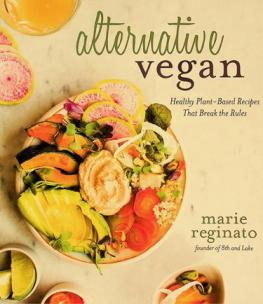
Alternative vegan : healthy plant-based recipes that break the rules
Vibrant and Veggie-Rich Recipes for All Kinds of Vegans Flexible vegans, look no further. Marie Reginato makes plant-based cooking more exciting with over 75 healthy recipes with the option of adding in seafood or eggs. Marie's recipes are inspired by her healthy-cooking journey and allow for experimentation so you can make each dish your own. Recipes include Cupboard Curry, Minty-Pistachio Falafels, Veggie Filled Miso To-Go, Basil-Stuffed Zucchini Rolls, and Caramelized Fennel and Dill Cakes. With delicious recipes-a majority of which are dairy, egg and gluten free- and the wiggle room to stick to a healthy lifestyle long term, Alternative Vegan is the carefully-crafted, modern approach to ditching the \"one size fits all\" mentality
Book

Micronutrient status and intake in omnivores, vegetarians and vegans in Switzerland
Purpose
Vegetarian and vegan diets have gained popularity in Switzerland. The nutritional status of individuals who have adopted such diets, however, has not been investigated. The aim of this study was to assess the intake and status of selected vitamins and minerals among vegetarian and vegan adults living in Switzerland.
Methods
Healthy adults [omnivores (OVs),
n
OV
= 100; vegetarians (VGs),
n
VG
= 53; vegans (VNs),
n
VN
= 53] aged 18–50 years were recruited, and their weight and height were measured. Plasma concentrations of the vitamins A, C, E, B1, B2, B6, B12, folic acid, pantothenic acid, niacin, biotin and β-carotene and of the minerals Fe, Mg and Zn and urinary iodine concentration were determined. Dietary intake was assessed using a three-day weighed food record, and questionnaires were issued in order to assess the physical activity and lifestyle of the subjects.
Results
Omnivores had the lowest intake of Mg, vitamin C, vitamin E, niacin and folic acid. Vegans reported low intakes of Ca and a marginal consumption of the vitamins D and B12. The highest prevalence for vitamin and mineral deficiencies in each group was as follows: in the omnivorous group, for folic acid (58 %); in the vegetarian group, for vitamin B6 and niacin (58 and 34 %, respectively); and in the vegan group, for Zn (47 %). Despite negligible dietary vitamin B12 intake in the vegan group, deficiency of this particular vitamin was low in all groups thanks to widespread use of supplements. Prevalence of Fe deficiency was comparable across all diet groups.
Conclusions
Despite substantial differences in intake and deficiency between groups, our results indicate that by consuming a well-balanced diet including supplements or fortified products, all three types of diet can potentially fulfill requirements for vitamin and mineral consumption.
Journal Article