
Catalogue Search | MBRL


Are you sure you want to remove the book from the shelf?

{{itemTitle}}
345
result(s) for
"Vernacular theology"
Sort by:

The politics of Middle English parables
The politics of Middle English parables examines the dynamic intersection of fiction, theology, and social practice in translated Gospel stories. Parables occupy a prominent place in Middle English literature, appearing in dream visions and story collections as well as in lives of Christ and devotional treatises. While most scholarship approaches these scriptural stories as stable vehicles of Christian teachings, this book characterises Gospel parables as ambiguous, riddling stories that invited audience interpretation and inspired the construction of new, culturally inflected narratives. In parables related to labour, social inequality, charity, and penance, the book locates a creative theological discourse through which writers reconstructed scriptural stories and, in doing so, attempted to shape Christian belief and practice. Analysis of these diverse retellings reveals not what a given parable meant in a definitive sense but rather how Middle English parables inscribe the ideologies, power structures, and cultural debates of late medieval Christianity.
eBook

Juliana van Norwich (1342–ca.1416) as post-skolastiese teoloog
Julian of Norwich (1342-ca.1416) as a post-scholastic theologian. This article positions the 'first female English writer from the Middle Ages', Julian of Norwich (1342-ca.1416), within the context of 'post-scholasticism', the very last period in late Medieval Philosophy, of which one feature was the final separation of theology and philosophy in the late Medieval index. Julian should in terms of this placing be engaged as a theologian proper, distinguished from the six other prominent female thinkers from the Medieval Latin West (Héloïse, Hildegard, Mechtild, Hadewijch, Marguerite and Catherine), who were all philosopher-theologians. However, Julian's epistemology and metaphysics were intertwined with her theology, as presented in her Book of Showings, to such an extent that it is impossible to isolate it from her theological output. She is within the socio-historical context of the third wave of the Black Plague in Norwich in 1369 henceforth profiled as a 'post-scholastic theologian' and presented on the basis of prominent theological features in Showings, including its immanent-mystical character (being a presentation of convent theology rather than scholastic theology), its vernacular (Middle English) originality and profound pastoral appeal, its maternal-Christological imagery (Moder Jhesu), its Trinitarian orientation (for the trinitie is god, god is the trinitie) and its deeply eschatological, open-ended engagement with a world devastated by the Plague (alle shalle be wele).
Journal Article

The Inevitable Eckhart: The Critical Reception of Eckhartian Motives in the Work of Jan van Leeuwen
The influence of Meister Eckhart on European mystical culture is heavily debated. In recent scholarship there seems to be a growing resistance to recognize too easily Eckhart's mark on medieval mystical traditions outside Germany. This article will show how language and motives commonly associated with the work of Eckhart and his followers did leave its traces in Brabant mysticism, and especially in the work of the Groenendaal author Jan van Leeuwen, pupil of the famous Jan van Ruusbroec. Its findings suggest that controversial topics, e.g., the relation between the created and uncreated parts of the soul, the necessity of grace for salvation and the value of good works, were also for Brabant mysticism pivotal conundrums.
Journal Article

When the Goddess Speaks Her Mind: Possession, Presence, and Narrative Theology in the Gaṅgamma Tradition of Tirupati, South India
In the context of the South Indian Gangamma grāmadevata (village goddess) tradition, this article asks: what can ethnographers learn by thinking theologically, an orientation that is identified as theological ethnography. Within this analytic perspective, the ethnographer looks and listens for ways in which worshipers ritually perform and narrate their own theologies about the goddess, but does not create theological analyses for that community. The article further asks what we can learn about the goddess—her agency and its limits, the ways in which she acts and moves in the human world, her desires, and her motivations to possess devotees—by listening to personal narratives of women so possessed. These narratives are forms of vernacular theology and imply a dialogic agency between humans and goddess. They help us to answer what both the goddess and humans gain (and may lose) when Gangamma enters the human world through possession in/of and in the presence of human bodies. To imagine, describe, and analyze a world in which gods/goddesses are active agents is a theological move, and also one mode of good ethnography.
Journal Article

Speech and Translation in Patience
Although most scholars characterize the anonymous Middle English Patience as sustained biblical translation or paraphrase, few have examined the work in relation to ongoing concerns about the nature and status of vernacular religious writing in later medieval England. This essay argues that the poem evidences and responds to such concerns through its complex treatment of the commonplace association of vernacular writing with speech. Like a number of other, more explicit vernacular prologues, the opening of Patience uses references to speech to position vernacular writing between the authority of scriptural texts and the immediacy and broad reach of the liturgy and storytelling. The poet further explores the relation between authority and immediacy in his subsequent retelling of the story of Jonah, the disobedient but ultimately effective prophet to the Gentiles. By underscoring qualitative differences between divine and human speech, and between Jonah as penitential witness and inspired prophet, the poet presents vernacular religious writing as foremost hortatory and affective–a means of moving–rather than a medium for theological speculation. Jonah's varied roles as speaker, and his juxtaposition with the prophet Daniel in Cleanness, reveal a poet exploring, rather than narrowly defining, the work and nature of vernacular religious writing.
Journal Article
Juliana van Norwich (1342–ca.1416) as post-skolastiese teoloog
Julian of Norwich (1342–ca.1416) as a post-scholastic theologian. This article positions the ‘first female English writer from the Middle Ages’, Julian of Norwich (1342–ca.1416), within the context of ‘post-scholasticism’, the very last period in late Medieval Philosophy, of which one feature was the final separation of theology and philosophy in the late Medieval index. Julian should in terms of this placing be engaged as a theologian proper, distinguished from the six other prominent female thinkers from the Medieval Latin West (Héloïse, Hildegard, Mechtild, Hadewijch, Marguerite and Catherine), who were all philosopher-theologians. However, Julian’s epistemology and metaphysics were intertwined with her theology, as presented in her Book of Showings, to such an extent that it is impossible to isolate it from her theological output. She is within the socio-historical context of the third wave of the Black Plague in Norwich in 1369 henceforth profiled as a ‘post-scholastic theologian’ and presented on the basis of prominent theological features in Showings , including its immanent-mystical character (being a presentation of convent theology rather than scholastic theology), its vernacular (Middle English) originality and profound pastoral appeal, its maternal-Christological imagery (Moder Jhesu), its Trinitarian orientation (for the trinitie is god, god is the trinitie) and its deeply eschatological, open-ended engagement with a world devastated by the Plague (alle shalle be wele). Contribution: As a millennium-long discourse, Medieval philosophy functions in a Venn diagrammatical relationship with Medieval history, Church history, patristics and philosophy of religion. Whenever ‘mainstream’ or ‘canonised’ Medieval philosophy is impacted from specialist research, it may well have implications that these closely related disciplines could take note of. Such is the case in this reappraisal of Julian of Norwich’ theological and pastoral legacy from its original context of the Black Plague in the 14th century – and indeed within the context of the Covid-19 pandemic in 2020.
Journal Article

Mysticism and the Vernacular
This chapter contains sections titled:
Contemplative Feeling
Vernacular Mysticism and Experiential Knowledge
Women and Textual Culture
Vernacular Mystical Theology Does Politics
Conclusion
References
Bibliography
Book Chapter
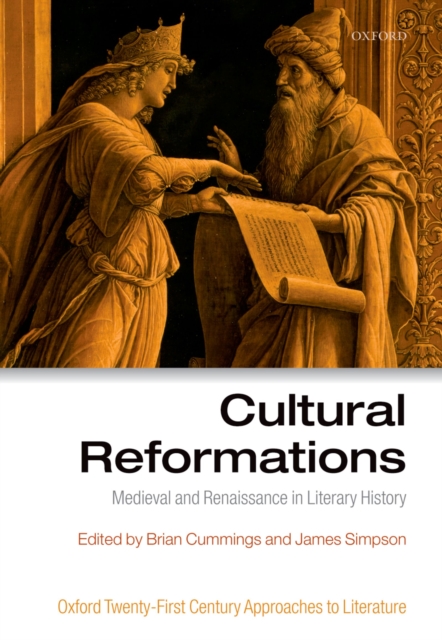
Cultural Reformations
This title is part of the the Oxford Twenty-First Century Approaches to Literature series, edited by Paul Strohm. This book examines cultural history and cultural change in the period between the fourteenth and the seventeenth centuries, a period spanning the medieval and Renaissance. It takes a dynamically diachronic approach to cultural history and brings the perspective of a longue durée to literary history. It redraws historical categories and offers a fresh perspective on historical temporality by challenging the stereotypes that might encourage any iconographic division between medieval and Renaissance modes of thinking. It also discusses the concept of nation in relation to three issues that have particular relevance to cross-period “cultural reformations”: modernity, language, and England and Englishness. The book is organized into nine sections: Histories, Spatialities, Doctrines, Legalities, Outside the Law, Literature, Communities, Labor, and Selfhood. Each contributor focuses on a theme that links pre- and post-Reformation cultures, from anachronism and place to travel, vernacular theology, conscience, theater, monasticism, childbirth, passion, style, despair, autobiography, and reading. The essays highlight the creative and destructive anxieties as well as the legacy of the Reformation.
eBook

Aberystwyth, National Library of Wales, MS Peniarth 12
Aberystwyth, National Library of Wales, MS Peniarth 12 is a predominantly Welsh-language miscellany that also contains texts in Middle English and Latin. On folio 79v is the inscription ‘Llyfr Hugh Evans yw hwn Anno 1583’, that is ‘This is Hugh Evans’s book, in the year 1583’. As a miscellany the manuscript is of interest as much for what it suggests about the process of compilation as for its contents, for while it is in one sense of the late 16th century, a number of significant parts are gatherings from medieval manuscripts, both Welsh and English. The evidence of the process of compilation that the manuscript yields has much to suggest about the interplay between Welsh-language and English-language culture over a broad historical perspective, and this raises questions about the linguistic and cultural history of medieval and early modern Wales.
Book Chapter

Vernacular Theology
This article explores the problems arising from the asymmetrical status of mysticism across the period between medieval and Renaissance. It begins with James Nayler’s mysticism before proceeding with a discussion of vernacular theology in relation to social and cultural change during the period between Lollardy and the English Civil War. It then considers the failure of mysticism in the context of historiography, the connections between religious literature produced across the period between Lollardy and the English Civil War, and how confessionalization gave rise to Protestantism and Roman Catholicism. It also examines the religious writings of Julian of Norwich and George Herbert before concluding with an assessment of religious reform in Western Europe during the period.
Book Chapter