
Catalogue Search | MBRL


Are you sure you want to remove the book from the shelf?

{{itemTitle}}
331
result(s) for
"Violoncellists"
Sort by:


At Auschwitz, Cello in Hand: Anita Lasker-Wallfisch/A Auschwitz, un violoncelle a la main: Anita Lasker-Wallfisch
The breadth of experience that Anita Lasker-Wallfisch can attest to is almost unbelievable, yet one knows when hearing her talk that it is fact. I interviewed her in London, UK in January 2016 and in several subsequent meetings in some of the most surprising conversations I have ever had. Lasker-Wallfisch is an Auschwitz and Bergen-Belsen survivor who became a founding member of the English Chamber Orchestra and has since toured the world performing. It was not without trepidation that I asked her about some of the traumatic times she faced: being imprisoned in Germany as a young girl, deportation to the worst killing centre of the Holocaust, and rebuilding her life after liberation. The reasoning behind her insistence of the importance of music comes not from the fact that her cello-playing saved her life, but the conclusions she drew from it that apply to anyone fortunate enough to learn music.
Journal Article
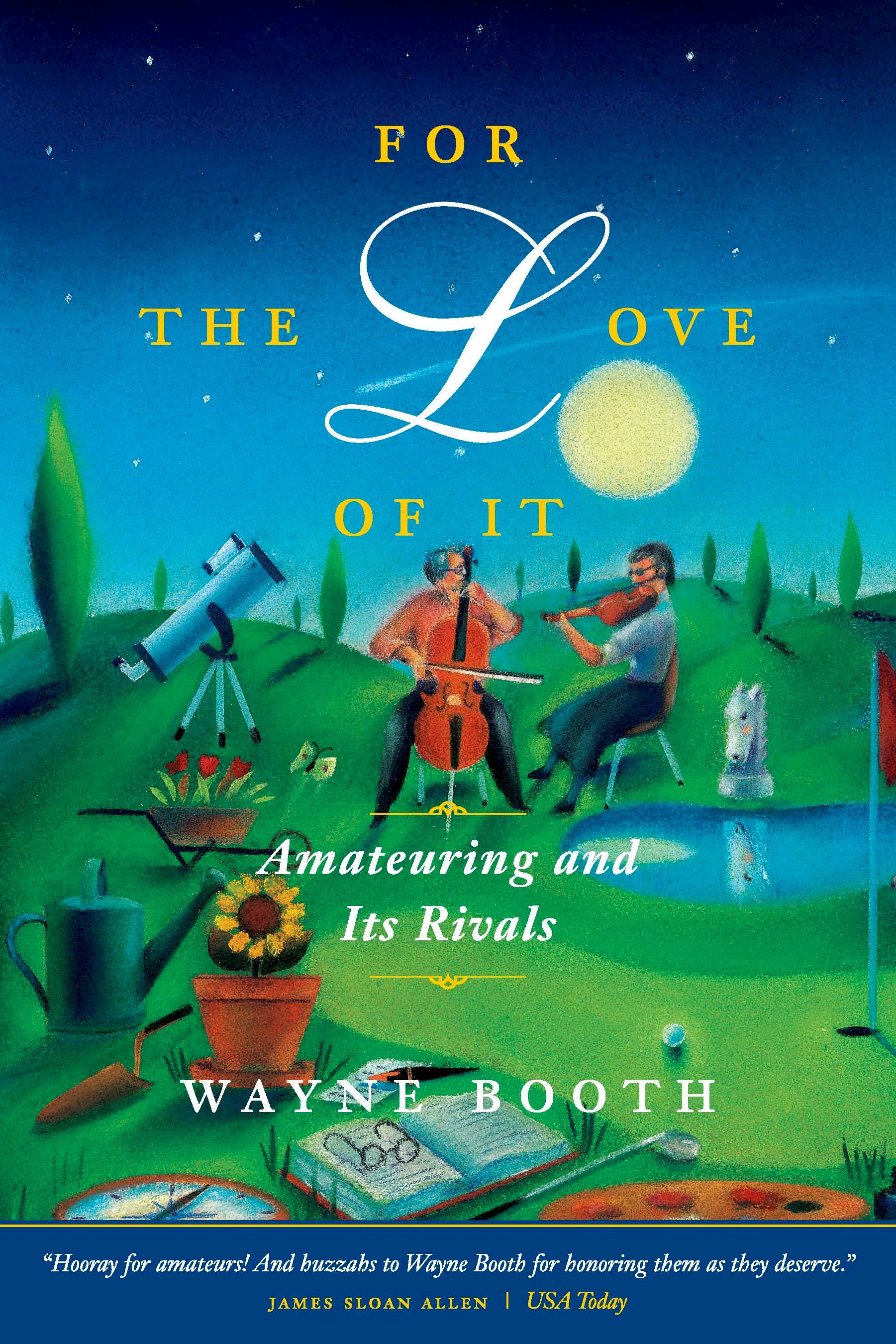
For the Love of It
For the Love of It is a story not only of one intimate struggle between a man and his cello, but also of the larger struggle between a society obsessed with success and individuals who choose challenging hobbies that yield no payoff except the love of it.
\"If, in truth, Booth is an amateur player now in his fifth decade of amateuring, he is certainly not an amateur thinker about music and culture. . . . Would that all of us who think and teach and care about music could be so practical and profound at the same time.\"—Peter Kountz, New York Times Book Review
\"[T]his book serves as a running commentary on the nature and depth of this love, and all the connections it has formed in his life. . . . The music, he concludes, has become part of him, and that is worth the price.\"—Clea Simon, Boston Globe
\"The book will be read with delight by every well-meaning amateur who has ever struggled. . . . Even general readers will come away with a valuable lesson for living: Never mind the outcome of a possibly vain pursuit; in the passion that is expended lies the glory.\"—John von Rhein, Chicago Tribune
\"Hooray for amateurs! And huzzahs to Wayne Booth for honoring them as they deserve. For the Love of It celebrates amateurism with genial philosophizing and pointed cultural criticism, as well as with personal reminiscences and self-effacing wit.\"—James Sloan Allen, USA Today
\"Wayne Booth, the prominent American literary critic, has written the only sustained study of the interior experience of musical amateurism in recent years, For the Love of It. [It] succeeds as a meditation on the tension between the centrality of music in Booth's life, both inner and social, and its marginality. . . . It causes the reader to acknowledge the heterogeneity of the pleasures involved in making music; the satisfaction in playing well, the pride one takes in learning a difficult piece or passage or technique, the buzz in one's fingertips and the sense of completeness with the bow when the turn is done just right, the pleasure of playing with others, the comfort of a shared society, the joy of not just hearing, but making, the music, the wonder at the notes lingering in the air.\"—Times Literary Supplement
eBook


Exploring Relational Ethics and Care: A Longitudinal Study of a Hong Kong Cellist's Marriage Disintegration and Identity Change
I am a survivor of divorce. When I visited Hong Kong, a mutual friend introduced me to a cellist going through a divorce as a participant for my research which investigates music learning and identity of Chinese musicians. My research took a different path because I decided to explore how she constructed meaning through divorce, leading to her identity change. I referred her to counselling and supported her through regular messaging. Research is more than just data collection; the wounded-healer standing by the wounded is therapeutic for both of us. Using Interpretative Phenomenological Analysis (IPA), this study reports our conversations, including two face-to-face semi-structured interviews and messaging over eighteen months. Four themes emerged about the cellist’s understanding of her marital conflict: an urge for financial security and materialistic pursuit; faith abandonment; prioritizing children’s education and parenthood; and diverging lives. This longitudinal study explored relational ethics, researcher care and research as emancipation. It acknowledged the freedom and choice-making responsibility of the researcher who extended the project boundary to improve the wellbeing of the participant. This is the essence of qualitative research, with unanticipated life-changing consequences that transform the researcher, the participant, and global readers who share a similar experience.
Journal Article

Las trayectorias de Pablo Casals en Puerto Rico
Emilio F. Ruiz, historiador, marinero, arqueólogo y experto en el pensamiento español del siglo XX, soriano, cumple una vez más con la línea de investigación que le sugirió su maestro y amigo Julián Marías a principios de los años 90: organizar y dar coherencia a las excepcionales fuentes documentales del archivo de Jaime Benítez en la institución universitaria puertorriqueña. De esos tesoros vemos el nacimiento de esta obra, que en buena medida es hermana de La continuidad creadora (2017), editada por el Archivo Histórico del BBVA. Una de las máximas de Marías, para entender a la persona, era ser capaz de vislumbrar la coherencia entre sus trayectorias biográficas. En este libro apreciamos esa cualidad tanto en su autor como en Casals, su esposa, Marta Montañez, Jaime Benítez e Inés Mendoza.
Otro de los aciertos del escritor es presentarnos los papeles relevantes que las mujeres han tenido y siguen teniendo en la historia, frente a las campañas propagandistas que ciertos grupos de interés llevan lanzando en los últimos años ofreciendo una imagen sesgada. Aquí vemos a Marta Montañez y a Inés Mendoza como ejecutivas clave del Festival de Prades, del Festival de Puerto Rico, de las giras de Casals y de las orquestas y músicos a los que aquél impulsó por América, Europa y Asia. Ellas fueron decisivas en la creación de una fecunda institución como es el Conservatorio de Música de Puerto Rico para que los niños y niñas de la isla y de otras latitudes desde los años cincuenta hasta hoy amen este noble arte, lo practiquen y los más competentes y trabajadores se ganen la vida con esa vocación. Esas dos insignes damas bajo el paraguas de la figura comprometida de Casals lucharon porque trabajadores puertorriqueños con problemas laborales pudieran salir adelante. [Texto de la editorial]
eBook
For the love of it
For the Love of It is a story not only of one intimate struggle between a man and his cello, but also of the larger struggle between a society obsessed with success and individuals who choose challenging hobbies that yield no payoff except the love of it.
eBook