
Catalogue Search | MBRL


Are you sure you want to remove the book from the shelf?

{{itemTitle}}
864
result(s) for
"World Council of Churches."
Sort by:

Trajectories of religion in Africa : essays in honour of John S. Pobee
The book, in the main, discusses issues relating to mission, ecumenism, and theological education and is presented in four sections. The first segment discusses works on ecumenical and theological education and assesses the relevance of the World Council of Churches. Other issues discussed in this segment relate to the interrelationships that exist between academic theology, ecumenism, and Christianity. The World Missionary Conference held in Edinburgh in 1910, which set the agenda for world-wide mission in a promising manner in the 1920s, is also assessed in this section of the work. 0The second segment, which covers Religion and Public Space, discusses works that examine the relationships between religion and power, religion and development, religion and traditional religious beliefs, and religion and practices in Africa. The third segment of the book treats Religion and Cultural Practices in African and how all these work out in couching out an African theology and African Christianity. Some of the issues discussed in this section related to African traditional philosophy, spiritism, and the interrelationships that exist between African Christianity and African Traditional Religion.0The last segment of the book discusses the issue of African biblical hermeneutics and specifically looks at contemporary hermeneutical approaches to biblical interpretations in Africa.
Book
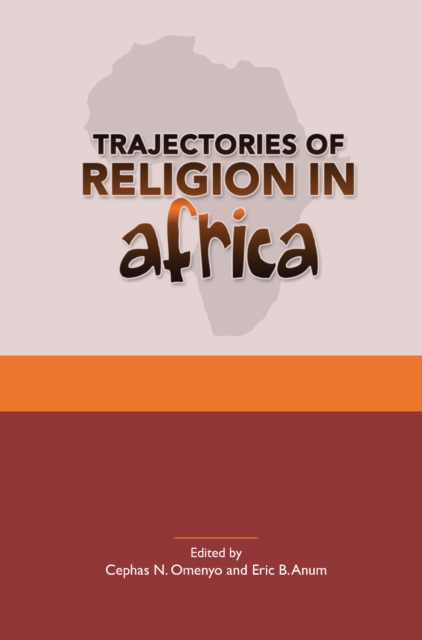
Trajectories of Religion in Africa
The book, in the main, discusses issues relating to mission, ecumenism, and theological education and is presented in four sections. The first segment discusses works on ecumenical and theological education and assesses the relevance of the World Council of Churches. Other issues discussed in this segment relate to the interrelationships that exist between academic theology, ecumenism, and Christianity. The World Missionary Conference held in Edinburgh in 1910, which set the agenda for world-wide mission in a promising manner in the 1920s, is also assessed in this section of the work. The second segment, which covers Religion and Public Space, discusses works that examine the relationships between religion and power, religion and development, religion and traditional religious beliefs, and religion and practices in Africa. The third segment of the book treats Religion and Cultural Practices in African and how all these work out in couching out an African theology and African Christianity. Some of the issues discussed in this section related to African traditional philosophy, spiritism, and the interrelationships that exist between African Christianity and African Traditional Religion. The last segment of the book discusses the issue of African biblical hermeneutics and specifically looks at contemporary hermeneutical approaches to biblical interpretations in Africa.
eBook

A critical review of World Council of Churches' responses to the global challenges of migration
This article views migration as a topical issue that poses challenges, especially in recent times, for migrant sending and hosting nations and the migrants themselves. In response, the church has recommended various ways of addressing the prevailing migration situation. In acknowledging these proposed intervention measures, this article aims to establish if the churches' approaches to the migration situation are harmonised and integrated. To accomplish this, the article reviews the World Council of Churches' (WCC) responses to migration challenges as a window and insight into the broader approaches employed by the churches. The WCC mirrors the churches' efforts, strategies and positions on migration issues. However, some churches do not adequately execute some of the interventions because of lack of finances to meet the material needs of the migrants, whilst others break the laws of the land as they respond to migration challenges. The article concludes by making recommendations on how the WCC can improve some of its intervention strategies in order to effectively respond to migration challenges. Intradisciplinary and/or interdisciplinary implications: This article views migration as a topical issue that poses challenges to migrant sending and hosting nations and the migrants themselves. It acknowledges that the Church has recommended various ways of addressing the prevailing situation of migration. After acknowledging the aforesaid, it then proceeds to determine if the Churches' approaches and interventions to the migration situation are harmonised and integrated. As such, the article is interdisciplinary as it seeks to understand the integration and harmonisation of the churches' approaches and interventions to the topical issue of migration.
Journal Article


Tacit dewesternisation in the ecumenical movement: The example of the World Council of Churches
Dewesternisation is a concept still undergoing conceptual clarification and refinement. It is used in different theoretical approaches, often differently meant and assessed. Irrespective of its still uncertain theoretical scope, it appears to be a valuable tool for denoting the phenomena and processes taking place in global Christianity, especially in the ecumenical movement, including the World Council of Churches (WCC). The article aims to identify the crucial field of the WCC’ teaching that demonstrates and highlights dewesternisation processes within the ecumenical movement. Before tackling the main problem of this study, it discusses the issues ‘internal’ for dewesternisation and ecumenism, such as evolutionism, postcolonial theory and postcolonial theology. They all set a historical deduction that helps better comprehend dewesternisation within the ecumenical movement, as exemplified by the WCC. Literary analysis is the primary method employed in this study.ContributionBy identifying and exemplifying the term of dewesternisation within the WCC, the article contributes to its better comprehension, particularly in the Northern Hemisphere.
Journal Article
‘Please Mister President, have mercy…’: The Church’s calling to reach out to refugees and migrants
President Donald Trump’s executive order to deport illegal migrants and refugees in the United States of America once again brought the plight of millions of migrants and asylum seekers worldwide to the attention of church leaders locally as well as within the ecumenical community. Revisiting the Old and New Testaments’ message on the calling of God’s people to reach out to the ‘other’ in the community, the article points to six perspectives on the church’s calling to minister the migrants and refugees. The perspectives are: (1) all Christians are foreigners and sojourners in the world; (2) following in the footsteps of Jesus; (3) standing with the Lord against injustice; (4) welcoming migrants and refugees into the church; (5) praying for the harassed and helpless; (6) joining in journeys of hope. The circumstances of refugees and migrants, as well as the churches’ calling to minister to them, are high on the agenda. In local churches, in the ecumenical community as well as institutions of theological training, much attention is given to the subject.Intradisciplinary and/or interdisciplinary implicationsThis article offers a number of perspectives to reach out to the marginalised that may serve as guidelines in the fields of missiology, practical theology, ethics, church history and ecumenical studies to focus on the calling of the Church internationally as well as in South Africa. The article also offers a literature study of older and more recent publications on the subject, presenting several relevant perspectives.
Journal Article

The Church’s Visible Unity as an Ecumenical Goal
The ecumenical movement’s basic purpose is to seek Christian unity. In facing the challenge of mission and ecumenism today, it is important to explicate how the ecumenical movement understands unity currently, and how the concept may have changed. This article’s hypothesis is that the goal of the church’s visible unity has changed less than appearances might suggest. The concept is now generally understood more holistically in ecumenical theology. In this article, a historical-systematic analysis focuses on the concept of visible unity, especially in the unity statements of the Assemblies of the World Council of Churches. An analysis of ecumenical models of unity and ways of realising churches’ unity in practice follows, as well as a reflection on the turns created by the latest ecumenical debate. The analysis confirms that the visible unity remains a central ecumenical goal in the quest for Christian unity. The turn towards holistic ecumenism seems to help address those who shun institutional ecumenism, without forgetting the Trinitarian and Christological theological basis and the institutional dimension. Diversity is not arbitrary: at its best it supports creativity and trust, freeing individuals for common witness and service.
Journal Article

Declaring the Global Economy a Status Confessionis?
This article revisits theologian Ulrich Duchrow's three-decade-old use of the Protestant notion of status confessionis to denounce the capitalist global economy. Scholars quickly dismissed Duchrow's argument; however, philosopher Thomas Pogge has developed a remarkable \"negative duty\"-based critique of the current global economic order that might help revitalize Duchrow's position. The article argues that sound reasons exist for the churches to declare the contemporary world economy a-provisionally termed-status confessionis minor. After explaining the inadequacy of Duchrow's original position and summarizing Pogge's account, the article develops a twofold argument. First, Pogge's in-depth inquiry into the world economy gives Duchrow's call for a status confessionis a strong yet narrowing economic foundation. Second, to declare the world economy a status confessionis minor is theological-ethically justifiable if the limited though indispensable \"prophetic\" significance of doing so is acknowledged. Thus, Duchrow's approach is justified, but only partially.
Journal Article
Contemporary Critical Reflections on Ion Bria’s Vision for Ecumenical Dialogue
In this study, I will expose the perspective of the ecumenical dialogue in the theology of Fr. Ion Bria, one of the well-known Romanians involved in the ecumenical movement. In the first part, after a short introduction, I will present the most important biographical milestones of the Romanian theologian, as well as some details about his activity in the World Council of Churches. Then, in the second part, I will critically present the most important aspects of Bria’s ecumenical theology, as well as the reception of these ideas in contemporary Orthodox theology, in discussion with common witness and eucharistic communion within ecumenical dialogue. In the last part, I will present the critical remarks on ecumenism in Bria’s theology. Through this analysis, I will emphasize important directions that the ecumenical dialogue can exploit today to overcome some historical, cultural or theological preconceptions and misunderstandings.
Journal Article
The International Discourse on Ecumenical Diaconia as a Chance to Strengthen the Specific Profile and Potential of Churches as Actors of Eco-Social Transformation—A German Perspective
There has always been a conviction in the ecumenical movement that social service is part of the essence of what it means to be the church. The strengthening of social and political witness of churches through church-related agencies and networks in the context of the beginning development discourse from the 1960s until the 1990s, however, led to a scenario in which the secular language of development and political action received much attention. In 2014 at the Malawi consultation, the World Council of Churches (WCC) and Action of Churches Together (ACT Alliance) reviewed their working relationships and explored better collaboration between agencies and churches, stating that the specific nature of churches as entities with an added value and particular profile in the area of social and political service would be strengthened. From this consultation, a mandate was given by the WCC Central Committee to develop a study document on the understanding and core components of the concept of “ecumenical diaconia”, which then was made available to the 11th Assembly of the WCC in Karlsruhe, 2022. This article introduces the context, major content, and key convictions of this study document and related discussions in Karlsruhe. It answers the question: what is the significance of the global ecumenical fellowship of churches in focusing on a common language of diaconia and a more explicit church-related terminology to describe and strengthen the social services of churches and their engagement in diaconia and social witness? It is recognized that this article is predominantly written from a German context and perspective in its construction of the international discourse on ecumenical diaconia.
Journal Article