
Catalogue Search | MBRL


Are you sure you want to remove the book from the shelf?

{{itemTitle}}
4,521
result(s) for
"bilingual policy"
Sort by:

Language power and hierarchy : multilingual education in China
\"Shunning polemicism and fashioning a new agenda for a critically informed yet practically orientated approach, this book explores aspects of multilingual education in the People's Republic of China (PRC). Amongst other issues, it also looks at the challenges associated with bilingual and trilingual education in Xinjiang and Tibet as well as the mediation between religion and culture in multi-ethnic schools, covering these issues from a range of perspectives - Korean, Uyghur, Tibetan, Mongolian and Yi. The PRC promotes itself as a harmonious, stable multicultural mosaic, with over 50 distinct ethnic groups striving for common prosperity. Beneath this rhetoric, there is also inter-ethnic discord, with scenes of ethnic violence in Lhasa and Urumqi over the last few years. China has a complex system of multilingual education - with dual-pathway curricula, bilingual and trilingual instruction, specialised ethnic schools. This education system is a lynchpin in the Communist party state's efforts to keep a lid on simmering tensions and transform a rhetoric of harmony into a critical pluralistic harmonious multiculturalism. This book examines this supposed lynchpin\"-- Provided by publisher.
Book

Bilingual education
Questions regarding whether a first or a second/foreign language should be used as a medium of instruction (MOI) in schools, and if yes, for whom, and when, have been enthusiastically debated in recent years in Hong Kong and many Southeast Asian societies
eBook


Exploring Taiwanese Students’ Stances on the Bilingual 2030 policy: Multiple Perspectives, Positionings, and Discourses
This paper explores how Taiwan’s recent Bilingual 2030 policy—an initiative that endeavors to boost Taiwanese citizens’ global competitiveness by strengthening their English proficiency—has been perceived and received by its intended subjects. Through the lens of
Stance Theory (
Du Bois,
2007
), the paper analyzes position papers written by a group of Taiwanese university students on the bilingual policy to understand their evaluations of the policy, their self-positioning vis-à-vis their evaluations, and the possible language and social discourses shaping their (dis) alignment with the policy. This survey of students’ evaluations unveils the multiple positionings that the student-authors took when evaluating the policy, the diverse social and language discourses shaping their evaluations, and the dialogic nature of their stancetaking acts. Meanwhile, this opportunity to understand and evaluate the bilingual policy has allowed the students to critically reflect on the nuts and bolts of it and assess their stakes beyond the popular “English opens doors” refrain. Compared to the policymakers’ top-down imagination of the nation and its people, their responses to the policy articulate the multiplicity embodied in Taiwanese people’s linguistic and social realities and showcase a more complicated outlook for the nation in the globalizing world.
Journal Article


Immigrant children and the politics of English-only
Examines restrictions on bilingual education in California, demonstrating relationships between educational practice and political and pedagogical ideologies; some focus on the effect of California's anti-bilingual initiative, Proposition 227, on the education of Latinos, and on the teachers' role in enacting the policy, studying two schools which developed their own Proposition 227. Partial contents: Teachers' place in the local enactment of language policy; Research methods, research site, and participants; Proposition 227 policy context; Proposition 227 and teachers' work: English-only and open court; Literacy practice at Open Valley.
eBook

臺灣2030背景下的家庭語言政策: 兩位母親的家庭語言策略比較研究 Family Language Policy in the Context of Taiwan’s Bilingual 2030 Policy: A Comparative Analysis of Two Mothers’ Approaches at Home
鑑於家庭語言政策雖屬個人作為,卻深具社會影響力(Spolsky, 2012),本研究深度訪談臺灣兩位對於 2030 雙語政策之語言選擇和家庭語言規劃策略持對立態度的母親,並記錄其二人的日常對話和共讀會話錄音以供分析。這兩位母親各育有年齡 5-8 歲的子女,一位選擇臺灣方言(閩南語)作為家庭的主要語言,另一位則選擇華語。選擇臺灣方言的母親認為,華語是一種霸權語言,對臺灣母語之存續構成威脅,而另一位母親則認為長期以來華語被視為臺灣的國語,她的孩子應該具備華語能力,研究發現,這兩位母親的家庭背景與人生經歷使其對 2030 雙語政策有不同看法,一位遵循政策,另一位則認為將對保存臺灣遺產形成威脅,但面對臺灣家庭普遍存在的單一語言使用環境,兩位母親皆對 2030 雙語政策在實際操作中的有效性感到懷疑,甚至擔心它可能產生不良的語言發展效果。本研究細膩描述在臺灣 2030 雙語政策背景下的家庭語言規劃動態,期透過理解個人信念、社會規範和語言實踐間的相互作用,提供在多語言環境中有助於孩子語言發展的家庭語言政策建議。 Family Language Policy (FLP) is a private practice with public ramifications (Spolsky, 2012). This study employs Spolsky’s framework to explore the language choices and home language planning strategies of two Taiwanese mothers holding contrasting attitudes toward Taiwan’s Bilingual 2030 Policy. Both mothers, whose children were between 5-8 years old at the time of the study, participated in in-depth interviews. Furthermore, the study documented their daily conversations and shared reading session recordings for analysis. Although both mothers were from Taiwanese families, one mother chose the Taiwanese dialect and another chose Mandarin Chinese as the main language of the family. These choices illuminate contrasting perceptions of the social language context in Taiwan. Specifically, the mother who opted for Taiwanese perceived Mandarin Chinese as a hegemonic language that posed a threat to their Taiwanese mother tongue, whereas the other mother felt that her child should be raised to speak Mandarin Chinese, long entrenched as Taiwan’s national language. The results reveal contrasting beliefs toward the Taiwanese government’s policy of bilingualism between Mandarin Chinese and English: One followed the policy, whereas the other perceived it as a threat to preserving her Taiwanese heritage. The two mothers’ ideologies, deeply rooted in their personal histories and experiences, were significantly influences on the FLP that they set. Because Taiwanese dialect–only and English language–only environments do not exist in Taiwan, both mothers sought external support to bolster their children’s language proficiency. However, both mothers shared a common concern regarding the effectiveness of a bilingual policy in a country where families exist in a monolingual home environment. This study traces the nuanced dynamics of family language planning in the context of Taiwan’s Bilingual 2030 Policy. Illuminating the complex interplay between individual beliefs, broader societal norms, and language practices enables a deeper understanding of how family-level decisions shape a child’s linguistic development in a multilingual context
Journal Article

Internationalization of higher education and language policy
Universities worldwide, in placing a greater emphasis on global mobility, have recently seen a growing number of in- and outbound students. Parallel to this development has been the need to internationalize individual campuses, an important aspect of which is to have a common language (or languages) used for communication. The language policies in Asian universities have been complicated by the growing presence of international students who may only understand one of the languages used as the medium of instruction, typically English. Drawing on Tinto's integration (Leaving college: Rethinking the causes and cures of student attrition, The University of Chicago Press, Chicago, 1987) and Spolsky's language policy (Language management, Cambridge University Press, Cambridge, 2009) frameworks, this exploratory, perceptual study solicits the views from 38 international students on the implementation of a bilingual education policy, especially with respect to whether the policy facilitated these sojourners' academic and social integration at a Taiwanese university that is actively advocating internationalization. The findings suggest that Mandarin Chinese continues to be the mainstream medium of instruction and social activities, while English is used rather sparingly and on an as-needed basis. The recognition of the growing economic power of China and importance of Chinese as well as the scholarships provided may have overridden these sojourners' integration concerns and challenges arising from the underuse of English as a lingua franca. (HRK / Abstract übernommen).
Journal Article

Family Language Policy in the Context of Taiwan's Bilingual 2030 Policy: A Comparative Analysis of Two Mothers' Approaches at Home
Family Language Policy (FLP) is a private practice with public ramifications (Spolsky, 2012). This study employs Spolsky's framework to explore the language choices and home language planning strategies of two Taiwanese mothers holding contrasting attitudes toward Taiwan's Bilingual 2030 Policy. Both mothers, whose children were between 5-8 years old at the time of the study, participated in in-depth interviews. Furthermore, the study documented their daily conversations and shared reading session recordings for analysis. Although both mothers were from Taiwanese families, one mother chose the Taiwanese dialect and another chose Mandarin Chinese as the main language of the family. These choices illuminate contrasting perceptions of the social language context in Taiwan. Specifically, the mother who opted for Taiwanese perceived Mandarin Chinese as a hegemonic language that posed a threat to their Taiwanese mother tongue, whereas the other mother felt that her child should be raised to speak Mandarin Chinese, long entrenched as Taiwan's national language. The results reveal contrasting beliefs toward the Taiwanese government's policy of bilingualism between Mandarin Chinese and English: One followed the policy, whereas the other perceived it as a threat to preserving her Taiwanese heritage. The two mothers' ideologies, deeply rooted in their personal histories and experiences, were significantly influences on the FLP that they set. Because Taiwanese dialect-only and English language-only environments do not exist in Taiwan, both mothers sought external support to bolster their children's language proficiency. However, both mothers shared a common concern regarding the effectiveness of a bilingual policy in a country where families exist in a monolingual home environment. This study traces the nuanced dynamics of family language planning in the context of Taiwan's Bilingual 2030 Policy. Illuminating the complex interplay between individual beliefs, broader societal norms, and language practices enables a deeper understanding of how family-level decisions shape a child's linguistic development in a multilingual context.
Journal Article
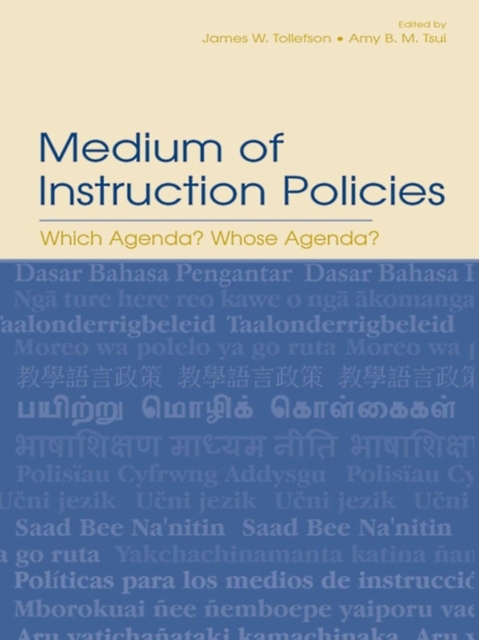
Medium of Instruction Policies
Medium of instruction policies in education have considerable impact not only on the school performance of students and the daily work of teachers, but also on various forms of social and economic (in)equality.
In many multiethnic and multilingual countries, the choice of a language for the medium of instruction in state educational systems raises a fundamental and complex educational question: what combination of instruction in students' native language(s) and in a second language of wider communication will ensure that students gain both effective subject-content education, as well as the second-language skills necessary for higher education and employment? Beyond this educational issue of choice of language(s) of instruction, medium of instruction policies are also linked to a range of important sociopolitical issues, including globalization, migration, labor policy, elite competition, and the distribution of economic resources and political power. The contributors to this volume examine the tension between the educational agendas and other social and political agendas underlying medium of instruction policies in different countries around the world, and unravel the connections between these policies and the related, critically important educational, social, political, and economic issues.
Medium of Instruction Policies: Which Agenda? Whose Agenda? is intended for scholars and specialists in education, language policy, sociolinguistics, applied linguistics, and language teaching, and is intended for use in graduate and advanced undergraduate courses on language education and language policy.
Contents: Preface. A.B.M. Tsui, J.W. Tollefson, The Centrality of Medium-of-Instruction Policy in Sociopolitical Processes. Part I: Minority Languages in English-Dominant States. S. May, Maori-Medium Education in Aotearoa/New Zealand. D.V. Jones, M. Martin-Jones, Bilingual Education and Language Revitalization in Wales: Past Achievements and Current Issues. T.L. McCarty, Dangerous Difference: A Critical-Historical Analysis of Language Education Policies in the United States. Part II: Language in Post-Colonial States. A.B.M. Tsui, Medium of Instruction in Hong Kong: One Country, Two Systems, Whose Language? A. Pakir, Medium-of-Instruction Policy in Singapore. S.K. Gill, Medium-of-Instruction Policy in Higher Education in Malaysia: Nationalism Versus Internationalization. I. Nical, J.J. Smolicz, M.J. Secombe, Rural Students and the Philippine Bilingual Education Program on the Island of Leyte. E. Annamalai, Medium of Power: The Question of English in Education in India. H. Alidou, Medium of Instruction in Post-Colonial Africa. Part III: Managing and Exploiting Language Conflict. V. Webb, Language Policy in Post-Apartheid South Africa. K.A. King, C. Benson, Indigenous Language Education in Bolivia and Ecuador: Contexts, Changes, and Challenges. J.W. Tollefson, Medium of Instruction in Slovenia: European Integration and Ethnolinguistic Nationalism. J.W. Tollefson, A.B.M. Tsui, Contexts of Medium-of-Instruction Policy.
eBook