
Catalogue Search | MBRL


Are you sure you want to remove the book from the shelf?

{{itemTitle}}
218,409
result(s) for
"court elections"
Sort by:

Have State Supreme Court Elections Nationalized?
Over the past several years, scholars of political behavior have become increasingly interested in the nationalization of U.S. elections. Research has shown that there is now a strong connection between presidential vote patterns and voting in House, Senate, gubernatorial, and state legislative elections. In this article, we extend previous research by examining the role of the presidential vote in state supreme court elections. Using an original dataset containing county-level election results (N = 15,237) from 2000-2018 for all states that hold partisan or nonpartisan state supreme court elections, we examine the influence of presidential vote share in state supreme court elections. A number of important findings emerge. First, we find that presidential vote share influences voting in state supreme court contests. There is a statistically significant relationship in both partisan and nonpartisan elections even after controlling for incumbency, though the relationship is much stronger in states with partisan elections. Second, the relationship between presidential vote share and the state supreme court vote has been quite stable over time in states with partisan elections. Third, in states with states with nonpartisan elections, there has been some variability in the relationship between presidential and state supreme court voting patterns, although the data reveal an uptick in the strength of the relationship over time. Future research should continue to track the role of national political forces in state supreme court elections.
Journal Article

Free to judge : the power of campaign money in judicial elections
The idea that wealthy people use their money to influence things, including politics, law, and media will surprise very few people. However, as Michael S. Kang and Joanna Shepherd argue in this readable and rich study of the state judiciary, the effect of money on judicial outcomes should disturb and anger everyone. In the current system that elects state judges, the rich and powerful can spend money to elect and re-elect judges who decide cases the way they want. Free to Judge is about how and why money increasingly affects the dispensation of justice in our legal system, and what can be done to stop it.
One of the barriers to action in the past has been an inability to prove that campaign donations influence state judicial decision-making. In this book, Kang and Shepherd answer that challenge for the first time, with a rigorous empirical study of campaign finance and judicial decision-making data. Pairing this with interviews of past and present judges, they create a compelling and persuasive account of people like Marsha Ternus, the first Iowa state supreme court justice to be voted out of office after her decision in a same-sex marriage case. The threat of such an outcome, and the desire to win reelection, results in judges demonstrably leaning towards the interests and preferences of their campaign donors across all cases.
Free to Judge is thus able to identify the pieces of our current system that invite bias, such as judicial reelection, and what reforms should focus on. This thoughtful and compellingly written book will be required reading for anybody who cares about creating a more just legal system.
eBook
Elections and Decision Making on State High Courts: Examining Legitimacy and Judicial Review
There has long been a debate over how we should select and retain justices on state supreme courts. Many argue that electing the members of these courts challenges the impartiality of the judicial branch. Others highlight that these elected institutions are to be accountable to the public, a condition that is being met. To inform this debate, scholars have long sought to determine if there are significant differences in the composition of, or decision making on these courts. This article continues in that tradition, examining the use of the courts' most important power, judicial review, on elected and appointed courts. I find very few differences in the use of judicial review among courts with different methods of selection and retention.
Journal Article
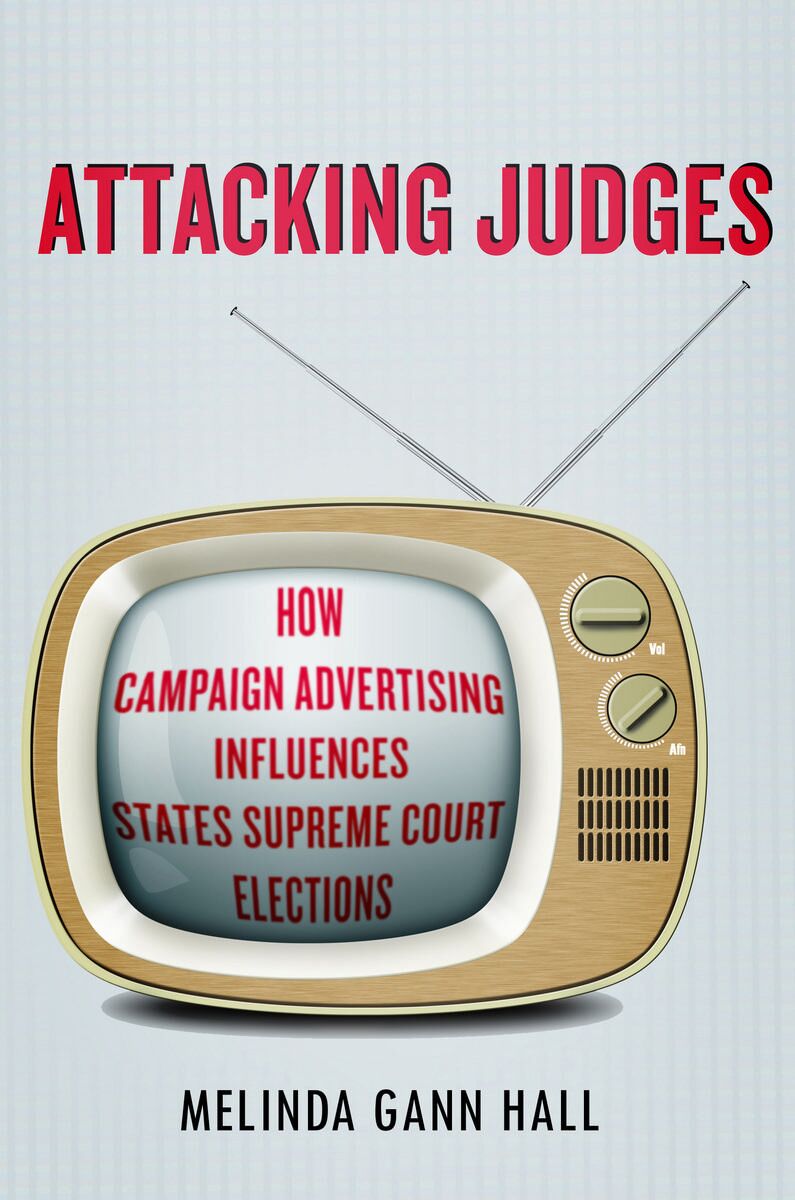
Attacking judges : how campaign advertising influences state supreme court elections
Nasty, below-the-belt campaigns, mudslinging, and character attacks. These tactics have become part and parcel of today's election politics in America, and judicial elections are no exception. Attacking Judges takes a close look at the effects of televised advertising, including harsh attacks, on state supreme court elections. Author Melinda Gann Hall investigates whether these divisive elections have damaging consequences for representative democracy. To do this, Hall focuses on two key aspects of those elections: the vote shares of justices seeking reelection and the propensity of state electorates to vote. In doing so, Attacking Judges explores vital dimensions of the conventional wisdom that campaign politics has deleterious consequences for judges, voters, and state judiciaries.
Countering the prevailing wisdom with empirically based conclusions, Hall uncovers surprising and important insights, including new revelations on how attack ads influence public engagement with judicial elections and their relative effectiveness in various types of state elections. Attacking Judges is a testament to the power of institutions in American politics and the value of empirical political science research in helping to inform some of the most significant debates on the public agenda. This book's results smartly contest and eradicate many of the fears judicial reformers have about the damaging effects of campaign negativity in modern state supreme court elections.
eBook

Form over Substance: Possibilities to Prove Electoral Irregularities under Serbian Law
The article analyses Serbian legislation and case law applicable to electoral disputes, in particular those relevant to the determination of facts in these disputes, and the potential influence of procedural rules on the efficiency of protection of constitutionally guaranteed electoral rights. Besides Serbian legislation and case law, the analysis leans on the relevant European standards, including the case law of the European Court of Human Rights. The results show that in practice, electoral commissions and courts use a limited circle of means of evidence and that the evidence submitted by complainants is not evaluated in the same way as the one coming from electoral boards. Although the application of general rules on administrative disputes is explicitly envisaged in electoral laws, the Administrative Court usually defers to the decisions and reasoning of electoral commissions, without supplementing the facts within court procedure, and relatively rarely or selectively decides in full jurisdiction. The author suggests amendments to the relevant legislation, aiming at a more explicit inclination towards the relevant procedural norms or, possibly, special regulation of evidencing in electoral legislation. In her view, a more explicit direction towards the application of the rules of general administrative procedure, in particular rules on evidencing, would lead to their more consistent application in practice.
Journal Article
In Chinese lore, this is the year of the Tiger
War is Not Healthy for Children and Other Living Things
eBook
Voters' Verdicts
InVoters' Verdicts,Chris Bonneau and Damon Cann address contemporary concerns with judicial elections by investigating factors that influence voters' decisions in the election of state supreme court judges. Bonneau and Cann demonstrate that the move to nonpartisan elections, while it depresses political participation, does little to mute the effects of partisanship and ideology. The authors note the irony that judicial elections, often faulted for politicizing the legal process, historically represented an attempt to correct the lack of accountability in the selection of judges by appointment, since unlike appointive systems, judicial elections are at least transparent.
This comprehensive study rests on a broad evidentiary base that spans numerous states and a variety of electoral systems. Bonneau and Cann use the first national survey of voters in state supreme court elections paired with novel laboratory experiments to evaluate the influence of incumbency and other ballot cues on voters' decisions. Data-rich and analytically rigorous, this provocative volume shows why voters decide to participate in judicial elections and what factors they consider in casting their votes.
A volume in the series Constitutionalism and Democracy
eBook

Judicial Selection and Death Penalty Decisions
Most U.S. state supreme court justices face elections or reappointment by elected officials, and research suggests that judicial campaigns have come to resemble those for other offices. We develop predictions on how selection systems should affect judicial decisions and test these predictions on an extensive dataset of death penalty decisions by state courts of last resort. Specifically, the data include over 12,000 decisions on over 2000 capital punishment cases decided between 1980 and 2006 in systems with partisan, nonpartisan, or retention elections or with reappointment. As predicted, the findings suggest that judges face the greatest pressure to uphold capital sentences in systems with nonpartisan ballots. Also as predicted, judges respond similarly to public opinion in systems with partisan elections or reappointment. Finally, the results indicate that the plebiscitary influences on judicial behavior emerge only after interest groups began achieving success at targeting justices for their decisions.
Journal Article
Campaign Finance Regulations and Public Policy
Despite a century of efforts to constrain money in American elections, there is little consensus on whether campaign finance regulations make any appreciable difference. Here we take advantage of a change in the campaign finance regulations of half of the U.S. states mandated by the Supreme Court’s Citizens United decision. This exogenously imposed change in the regulation of independent expenditures provides an advance over the identification strategies used in most previous studies. Using a generalized synthetic control method, we find that after Citizens United, states that had previously banned independent corporate expenditures (and thus were “treated” by the decision) adopted more “corporate-friendly” policies on issues with broad effects on corporations’ welfare; we find no evidence of shifts on policies with little or no effect on corporate welfare. We conclude that even relatively narrow changes in campaign finance regulations can have a substantively meaningful influence on government policy making.
Journal Article
Misdemeanor Disenfranchisement? The Demobilizing Effects of Brief Jail Spells on Potential Voters
This paper presents new causal estimates of incarceration’s effect on voting, using administrative data on criminal sentencing and voter turnout. I use the random case assignment process of a major county court system as a source of exogenous variation in the sentencing of misdemeanor cases. Focusing on misdemeanor defendants allows for generalization to a large population, as such cases are very common. Among first-time misdemeanor defendants, I find evidence that receiving a short jail sentence decreases voting in the next election by several percentage points. Results differ starkly by race. White defendants show no demobilization, while Black defendants show substantial turnout decreases due to jail time. Evidence from pre-arrest voter histories suggest that this difference could be due to racial differences in exposure to arrest. These results paint a picture of large-scale, racially-disparate voter demobilization in the wake of incarceration.
Journal Article