
Catalogue Search | MBRL


Are you sure you want to remove the book from the shelf?

{{itemTitle}}
135,661
result(s) for
"electronic circuits"
Sort by:

All-Optical Switch and Transistor Gated by One Stored Photon
The realization of an all-optical transistor, in which one \"gate\" photon controls a \"source\" light beam, is a long-standing goal in optics. By stopping a light pulse in an atomic ensemble contained inside an optical resonator, we realized a device in which one stored gate photon controls the resonator transmission of subsequently applied source photons. A weak gate pulse induces bimodal transmission distribution, corresponding to zero and one gate photons. One stored gate photon produces fivefold source attenuation and can be retrieved from the atomic ensemble after switching more than one source photon. Without retrieval, one stored gate photon can switch several hundred source photons. With improved storage and retrieval efficiency, our work may enable various new applications, including photonic quantum gates and deterministic multiphoton entanglement.
Journal Article

Electric and Electronic Circuit Simulation using TINA-TI
A circuit simulator is a computer program that permits us to see circuit behavior, i.e. circuit voltages and currents, without making the circuit. Use of a circuit simulator is a cheap, efficient, and safe way to study the behavior of circuits. The Toolkit for Interactive Network Analysis (TINA®) is a powerful yet affordable SPICE based circuit simulation and PCB design software package for analyzing, designing, and real time testing of analog, digital, VHDL, MCU, and mixed electronic circuits and their PCB layouts. This software was created by DesignSoft. TINA-TI is a spinoff software program that was designed by Texas Instruments (TI®) in cooperation with DesignSoft which incorporates a library of pre-made TI components to for the user to utilize in their designs. This book shows how a circuit can be analyzed in the TINA-TI® environment. Students of engineering (for instance, electrical, biomedical, mechatronics and robotics to name a few), engineers who work in industry and anyone who want to learn the art of circuit simulation with TINA-TI can benefit from this book.
eBook

Programmable nanowire circuits for nanoprocessors
Programmable nanowire nanoprocessor
In a significant step forward in complexity and capability for bottom-up assembly of nanoelectronic circuits, Yan
et al
. demonstrate scalable and programmable logic tiles based on semiconductor nanowire transistor arrays. The same logic tile, consisting of 496 configurable transistor nodes in an area of about 960 square micrometres, can be programmed and operated as a full-adder or full-subtractor circuit, and used for various other functions including multiplexers. It should be possible in future to cascade these logic tiles to realize fully integrated nanoprocessors with computing, memory and addressing capabilities.
In a significant step forward in complexity and capability for bottom-up assembly of nanoelectronic circuits, this study demonstrates scalable and programmable logic tiles based on semiconductor nanowire transistor arrays. The same logic tile, consisting 496 configurable transistor nodes in an area of about 960 μm
2
, could be programmed and operated as, among other functions, a full-adder, full-subtractor and multiplexer. The promise is that these logic tiles can be cascaded to realize fully integrated nanoprocessors with computing, memory and addressing capabilities.
A nanoprocessor constructed from intrinsically nanometre-scale building blocks is an essential component for controlling memory, nanosensors and other functions proposed for nanosystems assembled from the bottom up
1
,
2
,
3
. Important steps towards this goal over the past fifteen years include the realization of simple logic gates with individually assembled semiconductor nanowires and carbon nanotubes
1
,
4
,
5
,
6
,
7
,
8
, but with only 16 devices or fewer and a single function for each circuit. Recently, logic circuits also have been demonstrated that use two or three elements of a one-dimensional memristor array
9
, although such passive devices without gain are difficult to cascade. These circuits fall short of the requirements for a scalable, multifunctional nanoprocessor
10
,
11
owing to challenges in materials, assembly and architecture on the nanoscale. Here we describe the design, fabrication and use of programmable and scalable logic tiles for nanoprocessors that surmount these hurdles. The tiles were built from programmable, non-volatile nanowire transistor arrays. Ge/Si core/shell nanowires
12
coupled to designed dielectric shells yielded single-nanowire, non-volatile field-effect transistors (FETs) with uniform, programmable threshold voltages and the capability to drive cascaded elements. We developed an architecture to integrate the programmable nanowire FETs and define a logic tile consisting of two interconnected arrays with 496 functional configurable FET nodes in an area of ∼960 μm
2
. The logic tile was programmed and operated first as a full adder with a maximal voltage gain of ten and input–output voltage matching. Then we showed that the same logic tile can be reprogrammed and used to demonstrate full-subtractor, multiplexer, demultiplexer and clocked D-latch functions. These results represent a significant advance in the complexity and functionality of nanoelectronic circuits built from the bottom up with a tiled architecture that could be cascaded to realize fully integrated nanoprocessors with computing, memory and addressing capabilities.
Journal Article
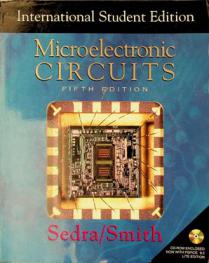
Microelectronic circuits
CD-ROM contains: free student version of PSpice 9.2 Lite Edition (SPICE simulator) and new industry-based design examples.
Book
Wafer-Scale Graphene Integrated Circuit
A wafer-scale graphene circuit was demonstrated in which all circuit components, including graphene field-effect transistor and inductors, were monolithically integrated on a single silicon carbide wafer. The integrated circuit operates as a broadband radio-frequency mixer at frequencies up to 10 gigahertz. These graphene circuits exhibit outstanding thermal stability with little reduction in performance (less than 1 decibel) between 300 and 400 kelvin. These results open up possibilities of achieving practical graphene technology with more complex functionality and performance.
Journal Article
Generation of Fock states in a superconducting quantum circuit
Cavity quantum electrodynamics: Fock states represent quantum purity
In cavity quantum electrodynamics (QED), light–matter interactions between a single emitter (an atom or an atom-like system with discrete energy levels) and a resonant optical cavity are investigated at a fundamental level. Recent advances in solid-state implementations, which offer great design flexibility, have given this field considerable momentum. An outstanding important question has been which features in such a system show true quantum behaviour and cannot be explained with classical models. Hofheinz
et al
. study a 'circuit' QED system where a superconducting qubit acts as an atom-like two-energy level system and is embedded in a microwave transmission circuit, acting as the optical cavity. They demonstrate in this system the creation of pure quantum states, known as Fock states, which give specific numbers of energy quanta, in this case photons. Fock states with up to six photons are prepared and analysed. The results are important because cavity QED is expected to play a crucial role in the development of quantum information processing and communication applications.
A 'circuit' quantum electrodynamics system where a superconducting qubit acts as an atom-like two-energy level system and is embedded in a microwave transmission circuit (acting as the optical cavity) is studied. In this system, it is demonstrated that the creation of pure quantum states, known as Fock states, which give specific numbers of energy quanta, in this case photons. Fock states with up to six photons are prepared and analysed.
Spin systems and harmonic oscillators comprise two archetypes in quantum mechanics
1
. The spin-1/2 system, with two quantum energy levels, is essentially the most nonlinear system found in nature, whereas the harmonic oscillator represents the most linear, with an infinite number of evenly spaced quantum levels. A significant difference between these systems is that a two-level spin can be prepared in an arbitrary quantum state using classical excitations, whereas classical excitations applied to an oscillator generate a coherent state, nearly indistinguishable from a classical state
2
. Quantum behaviour in an oscillator is most obvious in Fock states, which are states with specific numbers of energy quanta, but such states are hard to create
3
,
4
,
5
,
6
,
7
. Here we demonstrate the controlled generation of multi-photon Fock states in a solid-state system. We use a superconducting phase qubit
8
, which is a close approximation to a two-level spin system, coupled to a microwave resonator, which acts as a harmonic oscillator, to prepare and analyse pure Fock states with up to six photons. We contrast the Fock states with coherent states generated using classical pulses applied directly to the resonator.
Journal Article