
Catalogue Search | MBRL


Are you sure you want to remove the book from the shelf?

{{itemTitle}}
23,012
result(s) for
"endemic"
Sort by:

Using plants for stormwater management : a green infrastructure guide for the Gulf South
The subtropical climate of the Gulf South supports a varied abundance of flora, and this diversity is sustained by the ample amount of rainwater that characterizes the region. Managing rainwater in a planned environment and mitigating its effect on human habitation can test the skills of even the most seasoned landscape architect or designer. That challenge has never been more acute as increased human demand for natural resources compels professionals and home gardeners alike to seek out sustainable ecological solutions. In this guidebook, Dana Nunez Brown details ways to manage each drop of rainwater where it falls, using a cost-effective and environmentally sensitive approach. Under natural conditions, rainfall primarily percolates into the ground and flows as groundwater until it is absorbed by trees and other vegetation, after which it is evaporated into the atmosphere and the cycle starts anew. Brown identifies plants and techniques that leverage this natural process in order to filter, clean, and slow runoff, a practice known as Low Impact Development. Using Plants for Stormwater Management presents the native ecological communities and plant species of the Gulf South in easy-to-follow sections and diagrams. Information ranging from the productiveness of root structures and the compatibility of plants with local soils to the optimal elevation of specific vegetation and the average dimensions of foliage is represented by graphic icons for quick and easy identification. An accessible and essential resource, this book gives both novices and experts the know-how to harness rainfall and create beautiful, ecologically functioning landscapes. -- Provided by publisher.
Book
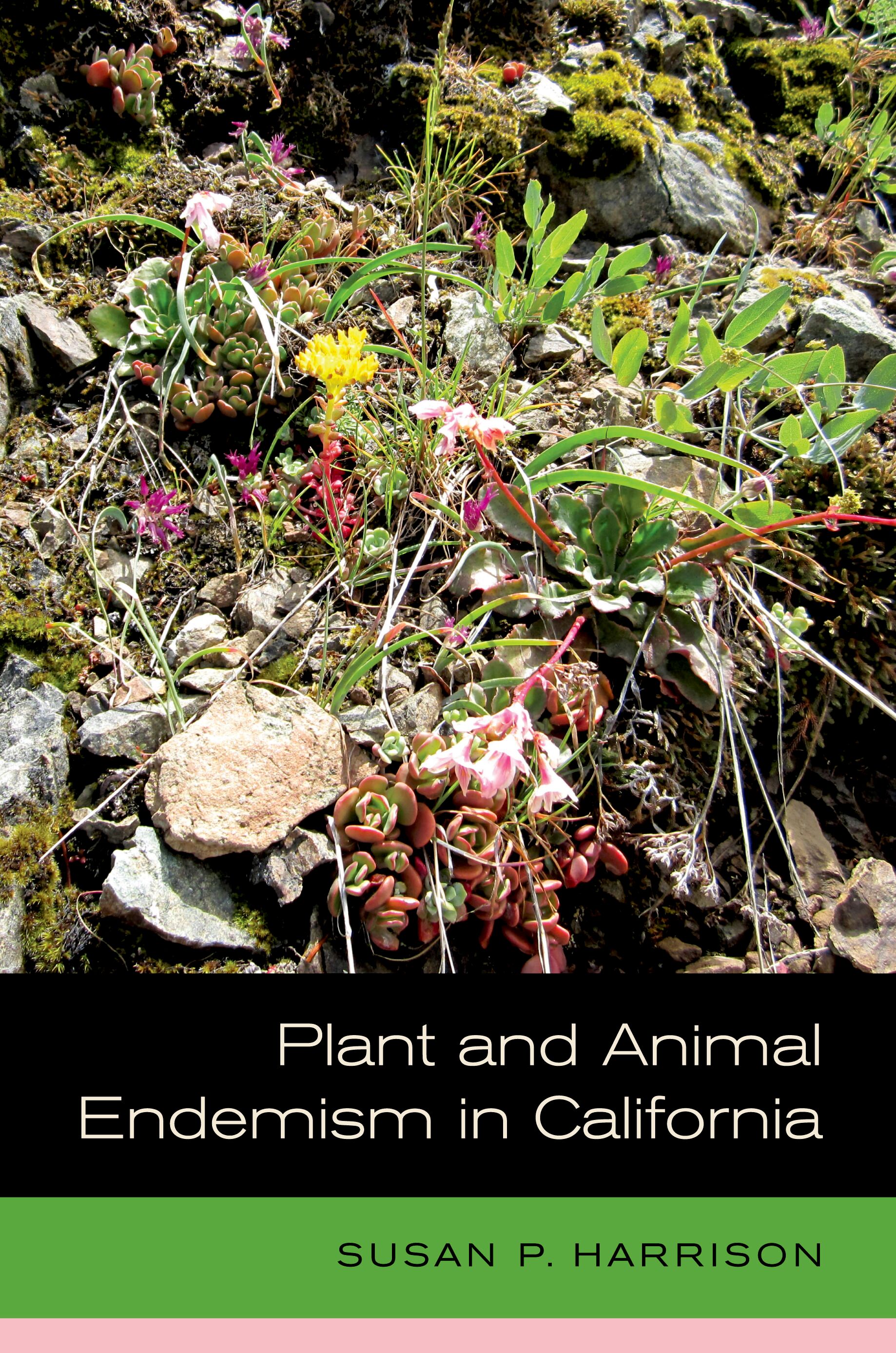
Plant and animal endemism in California
California is globally renowned for its biological diversity, including its wealth of unique, or endemic, species. Many reasons have been cited to explain this abundance: the complex geology and topography of its landscape, the special powers of its Mediterranean-type climate, and the historic and modern barriers to the wider dispersal of its flora and fauna. Plant and Animal Endemism in California compiles and synthesizes a wealth of data on this singular subject, providing new and updated lists of native species, comparing patterns and causes of both plant and animal endemism, and interrogating the classic explanations proposed for the state's special significance in light of new molecular evidence. Susan Harrison also offers a summary of the innovative tools that have been developed and used in California to conserve and protect this stunning and imperiled diversity.
eBook


A Prospective, Open-label, Randomized Trial of Doxycycline Versus Azithromycin for the Treatment of Uncomplicated Murine Typhus
Abstract
Background
Murine typhus, or infection with Rickettsia typhi, is a global but neglected disease without randomized clinical trials to guide antibiotic therapy.
Methods
A prospective, open, randomized trial was conducted in nonpregnant, consenting inpatient adults with rapid diagnostic test evidence of uncomplicated murine typhus at 2 hospitals in Vientiane, Laos. Patients were randomized to 7 days (D7) or 3 days (D3) of oral doxycycline or 3 days of oral azithromycin (A3). Primary outcome measures were fever clearance time and frequencies of treatment failure and relapse.
Results
Between 2004 and 2009, the study enrolled 216 patients (72 per arm); 158 (73.2%) had serology/polymerase chain reaction (PCR)–confirmed murine typhus, and 52 (24.1%) were R. typhi PCR positive. The risk of treatment failure was greater for regimen A3 (22.5%; 16 of 71 patients) than for D3 (4.2%; 3 of 71) or D7 (1.4%; 1 of 71) (P < .001). Among R. typhi PCR–positive patients, the area under the time-temperature curve and the fever clearance time were significantly higher for A3 than for D3 (1.8- and 1.9-fold higher, respectively; P = .005) and D7 (1.5- and 1.6-fold higher; P = .02). No patients returned with PCR-confirmed R. typhi relapse.
Conclusion
In Lao adults, azithromycin is inferior to doxycycline as oral therapy for uncomplicated murine typhus. For doxycycline, 3- and 7-day regimens have similar efficacy. Azithromycin use in murine typhus should be reconsidered. Investigation of genomic and phenotypic markers of R. typhi azithromycin resistance is needed.
Clinical Trial Registration
ISRCTN47812566.
A clinical trial of murine typhus, or infection with Rickettsia typhi, in Lao adults suggests that azithromycin is inferior to doxycycline for the oral therapy of uncomplicated murine typhus. Three and 7 days of doxycycline have similar efficacy.
Journal Article


Efficacy of a Tetravalent Dengue Vaccine in Healthy Children and Adolescents
It is estimated that there are 390 million cases of dengue virus infection each year. In this double-blind, placebo-controlled trial, a tetravalent dengue vaccine was evaluated in 20,071 children. The vaccine was found to be 80% effective in preventing dengue infection.
Journal Article

The quiet extinction : stories of North America's rare and threatened plants
\"The Quiet Extinction explores the reasons many of our native plants are disappearing, noting their significance to the continent's natural heritage. Kara Rogers captures the excitement of their discovery, the tragedy that has come to define their existence, and the remarkable efforts underway to save them\"-- Provided by publisher.
Book
Community-wide Screening for Tuberculosis in a High-Prevalence Setting
Tuberculosis transmission continues to be a major public health challenge. In this cluster-randomized, controlled trial conducted in Vietnam, active community-wide screening for tuberculosis over 4 years is shown to decrease the prevalence of tuberculosis.
Journal Article

Efficacy of a Tetravalent Dengue Vaccine in Children in Latin America
Dengue is a mosquito-borne viral illness that causes hundreds of millions of infections each year. No specific therapy exists. In this randomized, controlled trial involving Latin American children, a tetravalent dengue vaccine showed significant protective efficacy.
Dengue is a mosquito-borne disease that is present in many parts of the world. From 2003 through 2013, the number of dengue cases that were reported to the Pan American Health Organization (PAHO) increased by a factor of five.
1
–
3
The disease is caused by one of four closely related virus serotypes from the genus flavivirus. Mosquitoes that transmit the virus are present in tropical and subtropical regions worldwide and in some temperate areas of the United States, Europe, Africa, and the Middle East.
4
Dengue is an increasing public health problem despite efforts to manage epidemics through vector control.
5
Several . . .
Journal Article