
Catalogue Search | MBRL


Are you sure you want to remove the book from the shelf?

{{itemTitle}}
427,440
result(s) for
"human population"
Sort by:

Population and settlement geo facts
Learn about population in countries around the world, and how changes in the number, age, and gender of people living in a place affect life there. Explore different settlements, from ancient towns to sprawling, modern cities. Find out why and where people migrate, and discover how we can protect our planet from the risks of overpopulation.
Book

Large carnivore expansion in Europe is associated with human population density and land cover changes
Cimatti, M., Ranc, N., Benítez-López, A., Maiorano, L., Boitani, L., Cagnacci, F., Čengić, M., Ciucci, P., Huijbregts, M.A.J., Krofel, M., López-Bao, J.V., Selva, N., Andren, H., Bautista, C., Ćirović, D., Hemmingmoore, H., Reinhardt, I., Marenče, M., Mertzanis, Y., Pedrotti, L., Trbojević, I., Zetterberg, A., Zwijacz-Kozica, T., Santini, L.
Journal Article

How evolution shapes our lives : essays on biology and society
\" It is easy to think of evolution as something that happened long ago, or that occurs only in \"nature,\" or that is so slow that its ongoing impact is virtually nonexistent when viewed from the perspective of a single human lifetime. But we now know that when natural selection is strong, evolutionary change can be very rapid. In this book, some of the world's leading scientists explore the implications of this reality for human life and society. With some twenty-five essays, this volume provides authoritative yet accessible explorations of why understanding evolution is crucial to human life--from dealing with climate change and ensuring our food supply, health, and economic survival to developing a richer and more accurate comprehension of society, culture, and even what it means to be human itself. Combining new essays with ones revised and updated from the acclaimed Princeton Guide to Evolution, this collection addresses the role of evolution in aging, cognition, cooperation, religion, the media, engineering, computer science, and many other areas. The result is a compelling and important book about how evolution matters to humans today. The contributors include Francisco J. Ayala, Dieter Ebert, Elizabeth Hannon, Richard E. Lenski, Tim Lewens, Jonathan B. Losos, Jacob A. Moorad, Mark Pagel, Robert T. Pennock, Daniel E. L. Promislow, Robert C. Richardson, Alan R. Templeton, and Carl Zimmer.\"-- Provided by publisher.
Book

Dynamic population mapping using mobile phone data
During the past few decades, technologies such as remote sensing, geographical information systems, and global positioning systems have transformed the way the distribution of human population is studied and modeled in space and time. However, the mapping of populations remains constrained by the logistics of censuses and surveys. Consequently, spatially detailed changes across scales of days, weeks, or months, or even year to year, are difficult to assess and limit the application of human population maps in situations in which timely information is required, such as disasters, conflicts, or epidemics. Mobile phones (MPs) now have an extremely high penetration rate across the globe, and analyzing the spatiotemporal distribution of MP calls geolocated to the tower level may overcome many limitations of census-based approaches, provided that the use of MP data is properly assessed and calibrated. Using datasets of more than 1 billion MP call records from Portugal and France, we show how spatially and temporarily explicit estimations of population densities can be produced at national scales, and how these estimates compare with outputs produced using alternative human population mapping methods. We also demonstrate how maps of human population changes can be produced over multiple timescales while preserving the anonymity of MP users. With similar data being collected every day by MP network providers across the world, the prospect of being able to map contemporary and changing human population distributions over relatively short intervals exists, paving the way for new applications and a near real-time understanding of patterns and processes in human geography.
Journal Article


great human expansion
Genetic and paleoanthropological evidence is in accord that today’s human population is the result of a great demic (demographic and geographic) expansion that began approximately 45,000 to 60,000 y ago in Africa and rapidly resulted in human occupation of almost all of the Earth’s habitable regions. Genomic data from contemporary humans suggest that this expansion was accompanied by a continuous loss of genetic diversity, a result of what is called the “serial founder effect.” In addition to genomic data, the serial founder effect model is now supported by the genetics of human parasites, morphology, and linguistics. This particular population history gave rise to the two defining features of genetic variation in humans: genomes from the substructured populations of Africa retain an exceptional number of unique variants, and there is a dramatic reduction in genetic diversity within populations living outside of Africa. These two patterns are relevant for medical genetic studies mapping genotypes to phenotypes and for inferring the power of natural selection in human history. It should be appreciated that the initial expansion and subsequent serial founder effect were determined by demographic and sociocultural factors associated with hunter-gatherer populations. How do we reconcile this major demic expansion with the population stability that followed for thousands years until the inventions of agriculture? We review advances in understanding the genetic diversity within Africa and the great human expansion out of Africa and offer hypotheses that can help to establish a more synthetic view of modern human evolution.
Journal Article
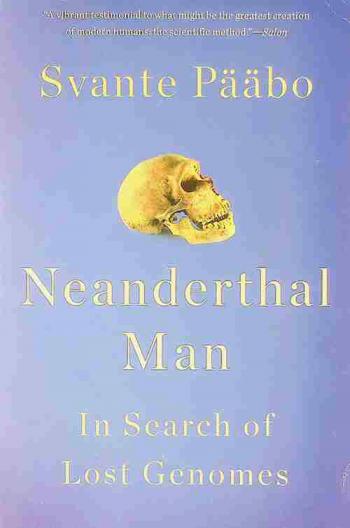
Neanderthal man : in search of lost genomes
\"What can we learn from the genes of our closest evolutionary relatives? Neanderthal Man tells the story of geneticist Svante P�a�abo's mission to answer that question, beginning with the study of DNA in Egyptian mummies in the early 1980s and culminating in his sequencing of the Neanderthal genome in 2009. From P�a�abo, we learn how Neanderthal genes offer a unique window into the lives of our hominin relatives and may hold the key to unlocking the mystery of why humans survived while Neanderthals went extinct. Drawing on genetic and fossil clues, P�a�abo explores what is known about the origin of modern humans and their relationship to the Neanderthals and describes the fierce debate surrounding the nature of the two species' interactions. A riveting story about a visionary researcher and the nature of scientific inquiry, Neanderthal Man offers rich insight into the fundamental question of who we are\"-- Provided by publisher.
Book
Target-group backgrounds prove effective at correcting sampling bias in Maxent models
Aim Accounting for sampling bias is the greatest challenge facing presence‐only and presence‐background species distribution models; no matter what type of model is chosen, using biased data will mask the true relationship between occurrences and environmental predictors. To address this issue, we review four established bias correction techniques, using empirical occurrences with known sampling effort, and virtual species with known distributions. Innovation Occurrence data come from a national recording scheme of hoverflies (Syrphidae) in Great Britain, spanning 1983–2002. Target‐group backgrounds, distance‐restricted backgrounds, travel time to cities and human population density were used to account for sampling bias in 58 species of hoverfly. Distributions generated by bias correction techniques were compared in geographical space to the distribution produced accounting for known sampling effort, using Schoener's distance, centroid shifts and range size changes. To validate our results, we performed the same comparisons using 50 randomly generated virtual species. We used sampling effort from the hoverfly recording scheme to structure our biased sampling regime, emulating complex real‐life sampling bias. Main conclusions Models made without any correction typically produced distributions that mapped sampling effort rather than the underlying habitat suitability. Target‐group backgrounds performed the best at emulating sampling effort and unbiased virtual occurrences, but also showed signs of overcompensation in places. Other methods performed better than no‐correction, but often differences were difficult to visually detect. In line with previous studies, when sampling effort is unknown, target‐group backgrounds provide a useful tool for reducing the effect of sampling bias. Models should be visually inspected for biological realism to identify any areas of potential overcompensation. Given the disparity between corrected and un‐corrected models, sampling bias constitutes a major source of error in species distribution modelling, and more research is needed to confidently address the issue.
Journal Article

The social atlas of Europe
This social atlas highlights the notion of Europe as a single entity by looking at its physical and population geography simultaneously in new ways, using state-of-the-art Geographical Information Systems (GIS) and new human cartography techniques, building on recent developments and innovative Worldmapper applications. In this atlas, we present nearly two hundred maps and illustrations, painting a picture of Europe, its people and its environment in relation to a wide range of themes and using data from a variety of sources such as the European Values Survey, Eurostat, the International Labour Organisation, the World Bank and the World Health Organization.
Book

Genomic Variation in Seven Khoe-San Groups Reveals Adaptation and Complex African History
The history of click-speaking Khoe-San, and African populations in general, remains poorly understood. We genotyped ~2.3 million single-nucleotide polymorphisms in 220 southern Africans and found that the Khoe-San diverged from other populations ≥100,000 years ago, but population structure within the Khoe-San dated back to about 35,000 years ago. Genetic variation in various sub-Saharan populations did not localize the origin of modern humans to a single geographic region within Africa; instead, it indicated a history of admixture and stratification. We found evidence of adaptation targeting muscle function and immune response; potential adaptive introgression of protection from ultraviolet light; and selection predating modern human diversification, involving skeletal and neurological development. These new findings illustrate the importance of African genomic diversity in understanding human evolutionary history.
Journal Article