
Catalogue Search | MBRL


Are you sure you want to remove the book from the shelf?

{{itemTitle}}
9,358
result(s) for
"katharine hepburn"
Sort by:

‘What Am I Going to Do with My Philodendron?’ Looking at a Plant in Desk Set
Desk Set, a 1957 20th Century Fox studio comedy, made with the sponsorship of IBM, charts the relationship between a reference librarian, Bunny Watson, and Richard Sumner, the inventor of a computer which appears to threaten her job. The film displays a thriving philodendron within Bunny’s skyscraper office, illustrating her organic style of thinking, and implicitly inviting us to see the plant in opposition to the computer. The suggestion that the plant is in some sense excessive, claiming attention beyond the norms of the ornamental background houseplant, opens questions about how we look at plants on film. We find here a reframing of figure and ground, which relates the philodendron to moments where plants become conspicuous in early film and in horror. Desk Set reflects a vegetal landscape characterised by all the commonplace instrumentalising of plants in modernity, amongst which the philodendron emerges as an exception. The plant does not point outwards to a putative wilderness. Instead, our looking at it allows us to contemplate it as an individuated specimen, and to move from that act of looking to recognise its deep entanglement with the urban environment, and with human care.
Journal Article

Quick-Witted Eccentrics: The Genre and Genders of Screwball Comedy
Focusing on the type of funny woman that came to life in the Hollywood screwball comedy genre of the 1930s and 1940s, this article explores the intersections of genre and gender. The particular type of female comedic performance associated with the screwball comedy is characterized by an accelerated speed of dialogue, in which the woman demonstrates rhetorical skill, wit, and quick intelligence, as well as eccentric behavior that leads to comical situations. By taking a closer look at specific scenes from canonical screwball comedies, such as Bringing Up Baby, The Lady Eve, and His Girl Friday, as well as less widely known films, such as Four’s a Crowd and Take a Letter, Darling, the article demonstrates how the comic effect stems from the incongruity between the woman’s gender performance and conventional scripts of femininity, without however making the woman the object of the joke. Instead, the woman’s actions serve as the motor of the comic by radically disrupting the man’s sense of authority and the patriarchal order, by extension. The article argues that by featuring women as agents who disrupt the established or conventional order of things, the screwball comedy genre makes possible the emergence of a new way (or ways) of inhabiting femininity.
Journal Article


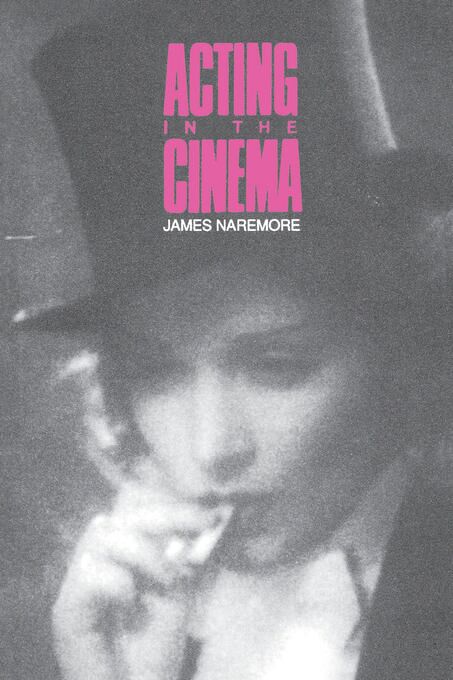
Acting in the Cinema
In this richly detailed study, James Naremore focuses on the work of film acting, showing what players contribute to movies. Ranging from the earliest short subjects of Charles Chaplin to the contemporary features of Robert DeNiro, he develops a useful means of analyzing performance in the age of mechanical reproduction; at the same time, he reveals the ideological implications behind various approaches to acting, and suggests ways that behavior on the screen can be linked to the presentation of self in society. Naremore's discussion of such figures as Lillian Gish, Marlene Dietrich, James Cagney, and Cary Grant will interest the specialist and the general reader alike, helping to establish standards and methods for future writing about performers and their craft.
eBook

A Legend in Her Own Time
In 1970, more than twenty-five years after her film debut, Lauren Bacall made a dramatic comeback as Margo Channing in Applause (1970–73), the Broadway musical remake of All About Eve (1950). Defying critical skepticism and popular ageism and confronting the public’s enduring memory of her screen image, she achieved new heights in her lucrative and award-winning turn onstage. This essay examines the show’s production history from the vantage point of Bacall’s own archives, placing personal writing in conversation with press coverage to trace how the star leveraged theatrical success to reinvent herself as a “living legend” of Old Hollywood.
Journal Article

To Have and to Hold: The Possessive Spectator, the Spinster Narrative, and Katharine Hepburn in David Lean’s Summertime (1955)
Since the cinematic experience is so ephemeral, it has always been difficult to hold on to its precious moments, images and, most particularly, its idols . . . . the desire to possess and hold the elusive image led to repeated viewing, a return to the cinema to watch the same film over and over again . . [...]Starring Katharine Hepburn\" examines Katharine Hepburn's star persona in the mid-1950s, which complicates what at first seems to be a clichéd portrayal of an American spinster finding love abroad in the mid-1950s. On other fronts, the postwar market for American film exports was, in theory, high in some European countries now that wartime embargoes had been lifted, but those countries' currencies were often either nonexistent or so unstable that they had no real method to pay Hollywood film companies in ways that would show as profit in accounting ledgers, as Shandley points out (8). [...]because the United States controlled such a large percentage of the world's economy immediately after the war, some countries wanted to hang on to the few dollars they possessed in order to pay for essential commodities-hence \"the freezing of earnings generated by American companies so that such earnings had to be reinvested in the national economies rather than removed in the form of dollars\" (Shandley 8-9). [...]Shandley's title Runaway Romances has a double meaning, in the sense that it refers both to those Hollywood productions that migrated to Europe and to the runaway romance's narrative convention, which usually involves an American (male or female) traveler away from home becoming romantically involved with a European, almost always on a temporary basis.
Journal Article

My Wife's Not My Wife, She's My Daughter\: Relocating A Bill of Divorcement from Stage to Screen
Clemence Dane's hit West End play A Bill of Divorcement (1921) was adapted into a successful Hollywood film from RKO Studios, a 1932 David O. Selznick production directed by George Cukor and starring John Barrymore and Katharine Hepburn in her screen debut. This essay argues that the combination of the text's formal, geographic, and temporal relocation from one medium to another shifts the message of the text, emphasizing different aspects of its content and thereby reconfiguring its meaning for a new audience. An analysis of the social norms, notions of inheritance, sickness and health, marriage and family and, in particular, the treatment of eugenics in the two versions of the texts, elucidate the shifts in their historical contexts and imagined audiences.
Journal Article

I met May Swenson just once
The salon was held in the main house, Mrs. Dorland's, in a room heavy with timeworn, out-of-place objects: dark antique furniture, framed photographs, silver candlesticks, ornate jug-shaped vases, bookcases with grilled doors, brown-and-red rug on the floor. (Knudsen, I'd been told, was heir to the dairy fortune; I don't know how many times I'd bought their pink container of low-fat cottage cheese.) The colony's first director, Elisabeth Des Marais, a lovely woman with blonde hair and milky skin, an aspiring playwright, read from a piece in progress.
Journal Article