
Catalogue Search | MBRL


Are you sure you want to remove the book from the shelf?

{{itemTitle}}
1,080
result(s) for
"mule deer"
Sort by:

Experimental SARS-CoV-2 Infection of Elk and Mule Deer
To assess the susceptibility of elk (Cervus canadensis) and mule deer (Odocoileus hemionus) to SARS-CoV-2, we performed experimental infections in both species. Elk did not shed infectious virus but mounted low-level serologic responses. Mule deer shed and transmitted virus and mounted pronounced serologic responses and thus could play a role in SARS-CoV-2 epidemiology.
Journal Article
Lesions of Mycobacterium avium spp. hominissuis Infection Resembling M. bovis Lesions in a Wild Mule Deer, Canada
We used molecular analyses to confirm Mycobacterium avium spp. hominissuis infection in lung granulomas and pyogranulomas in the tracheobronchial lymph node in a wild mule deer in Banff, Canada. These lesions are similar to those found in M. bovis–infected animals, emphasizing the critical need for disease surveillance in wildlife populations.
Journal Article

Mule deer fawn recruitment dynamics in an energy disturbed landscape
Wildlife population dynamics are modulated by abiotic and biotic factors, typically climate, resource availability, density‐dependent effects, and predator–prey interactions. Understanding whether and how human‐caused disturbances shape these ecological processes is helpful for the conservation and management of wildlife and their habitats within increasingly human‐dominated landscapes. However, many jurisdictions lack either long‐term longitudinal data on wildlife populations or measures of the interplay between human‐mediated disturbance, climate, and predator density. Here, we use a 50‐year time series (1962–2012) on mule deer (Odocoileus hemionus) demographics, seasonal weather, predator density, and oil and gas development patterns from the North Dakota Badlands, USA, to investigate long‐term effects of landscape‐level disturbance on mule deer fawn fall recruitment, which has declined precipitously over the last number of decades. Mule deer fawn fall recruitment in this study represents the number of fawns per female (fawn:female ratio) that survive through the summer to October. We used this fawn recruitment index to evaluate the composite effects of interannual extreme weather conditions, energy development, and predator density. We found that density‐dependent effects and harsh seasonal weather were the main drivers of fawn fall recruitment in the North Dakota Badlands. These effects were further shaped by the interaction between harsh seasonal weather and predator density (i.e., lower fawn fall recruitment when harsh weather was combined with higher predator density). Additionally, we found that fawn fall recruitment was modulated by interactions between seasonal weather and energy development (i.e., lower fawn fall recruitment when harsh weather was combined with higher density of active oil and gas wells). Interestingly, we found that the combined effect of predator density and energy development was not interactive but rather additive. Our analysis demonstrates how energy development may modulate fluctuations in mule deer fawn fall recruitment concurrent with biotic (density‐dependency, habitat, predation, woody vegetation encroachment) and abiotic (harsh seasonal weather) drivers. Density‐dependent patterns emerge, presumably due to limited quality habitat, being the primary factor influencing fall fawn recruitment in mule deer. Secondarily, stochastic weather events periodically cause dramatic declines in recruitment. And finally, the additive effects of human disturbance and predation can induce fluctuations in fawn fall recruitment. Here we make the case for using long‐term datasets for setting long‐term wildlife management goals that decision makers and the public can understand and support. We use a 50 years time series to investigate the relative roles of population ecology, landscape change, climate, predation, and human disturbance on mule deer population recruitment in a changing landscape. We found that density‐dependent effects and quality habitat availability were the main drivers of mule deer recruitment but interactions with severe seasonal weather, predation, and oil and gas development modulated recruitment in a more subtle way. Approximately, we demonstrate the value of long‐term data collection and formal data analysis to disentangle the drivers of wildlife communities in a changing world for evidence‐based policy and management of landscapes and wildlife.
Journal Article

Overcoming cohort effects in a Mediterranean ecosystem: The role of density and precipitation on southern mule deer body mass
Cohort effects on body mass of deer species are caused by both density-dependent and -independent factors. Cohort effects occur in the year of birth and affect body size throughout life. We hypothesized that deer in low latitudes should be able to overcome cohort effects through compensatory or catch-up growth because mild and wet winter conditions are more amenable for animal growth. We analyzed 27 years of mule deer harvest data from Camp Pendleton, California. Using generalized least-squares regression with restricted maximum likelihood estimation to estimate parameters, we determined that eviscerated body mass of southern mule deer (Odocoileus hemionus fuliginatus) was affected by precipitation and relative abundance. We also found that deer were able to recover from periods of poor nutrition and overcome cohort effects by 2.5 years of age, which has not been demonstrated in other ungulate populations. This study demonstrates that body mass can be used as a tool to assess the nutritional state of a population in an environment with high inter-annual variation in biotic and abiotic factors. Further, managers in environments where mild and wet winters extend growing seasons should consider the possibility that deer may be able to recover from periods of missed growth when making harvest recommendations.
Journal Article
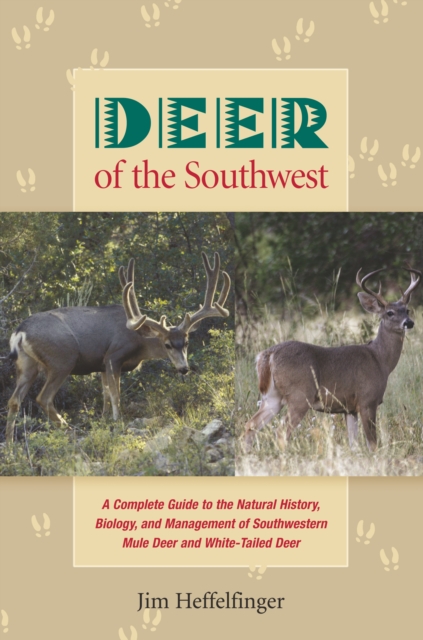
Deer of the Southwest
Wildlife biologist Jim Heffelfinger has combed scientific literature, researched historical archives, rousted researchers out of retirement, badgered other deer biologists for information to create this comprehensive reference on mule deer white-tailed deer in the North American Southwest.
eBook

Differential effects of environmental predictability on ungulate movement behavior in disparate ecosystems
Increasing ecological perturbations resulting from global change processes are altering the environmental predictability (EP) of critical forage and water resources for wildlife. While research has furthered our understanding of how EP both underlies and directs animal movement, studies have mainly focused on relationships between EP and large-scale movement behaviors (e.g. migration) at the species level, neglecting the mediating influence that environmental context has on the behavior of wide-ranging species. We address these knowledge gaps by examining how EP of forage in mule deer Odocoileus hemionus–a cosmopolitan species of the American southwest–seasonal home ranges relates to average daily movement distance, focusing on two female populations inhabiting disparate ecoregions in Utah, USA (n = 225, 2015-2022). We employed two separate metrics of EP, representing spatial and temporal constancy of vegetation productivity, and explored how home range (HR) area, forage availability, and season modulate the relationships between EP and daily movement distance. We found spatial constancy of an individual's HR significantly impacted movement during the summer and had significant interactions with HR area and forage availability. Interestingly, individuals inhabiting spatially constant HRs moved more in resource-limited seasonal environments, and less in non-limiting environments. Temporal constancy was a significant predictor of movement in non-limiting seasonal environments, resulting in shorter daily movements of deer with temporally constant HR areas. Finally, we found a significant interaction between spatial and temporal constancy, resulting in shorter daily movements of individuals inhabiting resource-limited HRs that were spatially and temporally constant. Interactions between HR area, forage availability, and constancy metrics demonstrate how the EP may become a larger driver of movement decisions as habitat quality is reduced. Understanding how EP drives movement of mule deer aids our ability to predict how global change will impact individual fitness, space use requirements and population demographics of ungulates.
Journal Article

Migratory plasticity is not ubiquitous among large herbivores
The migratory movements of wild animals can promote abundance and support ecosystem functioning. For large herbivores, mounting evidence suggests that migratory behaviour is an individually variable trait, where individuals can easily switch between migrant and resident tactics. The degree of migratory plasticity, including whether and where to migrate, has important implications for the ecology and conservation of large herbivores in a changing world. Mule deer (Odocoileus hemionus) are an iconic species of western North America, but are notably absent from the body of literature that suggests large herbivore migrations are highly plastic. We evaluated plasticity of migration in female mule deer using longitudinal GPS data collected from 312 individuals across nine populations in the western United States, including 882 animal‐years (801 migrants and 81 residents). We followed both resident and migratory mule deer through time to determine whether individual animals switched migratory behaviours (i.e., whether to migrate) from migratory to residency or vice versa. Additionally, we examined the fidelity of individuals to their migration routes (i.e., where to migrate) to determine whether they used the same routes year after year. We also evaluated whether age and reproductive status affected propensity to migrate or fidelity to migratory routes. Our results indicate that mule deer, unlike other large herbivores, have little or no plasticity in terms of whether or where they migrate. Resident deer remained residents, and migrant deer remained migrants, regardless of age, reproductive status or number of years monitored. Further, migratory individuals showed strong fidelity (>80%) to their migration routes year after year. Our study clearly shows that migration plasticity is not ubiquitous among large herbivores. Because of their rigid migratory behaviour, mule deer may not adapt to changing environmental conditions as readily as large herbivores with more plastic migratory behaviour (e.g., elk). The fixed migratory behaviours of mule deer make clear that conservation efforts aimed at traditional seasonal ranges and migration routes are warranted for sustaining this iconic species that continues to decline across its range. This study reveals that mule deer, unlike many other large herbivores, have little or no plasticity in terms of whether or where they migrate. The authors found resident deer remained residents, and migrant deer remained migrants, regardless of age, reproductive status or number of years monitored.
Journal Article

Where to forage when afraid
The availability and quality of forage on the landscape constitute the foodscape within which animals make behavioral decisions to acquire food. Novel changes to the foodscape, such as human disturbance, can alter behavioral decisions that favor avoidance of perceived risk over food acquisition. Although behavioral changes and population declines often coincide with the introduction of human disturbance, the link(s) between behavior and population trajectory are difficult to elucidate. To identify a pathway by which human disturbance may affect ungulate populations, we tested the Behaviorally Mediated Forage-Loss Hypothesis, wherein behavioral avoidance is predicted to reduce use of available forage adjacent to disturbance. We used GPS collar data collected from migratory mule deer (Odocoileus hemionus) to evaluate habitat selection, movement patterns, and time-budgeting behavior in response to varying levels of forage availability and human disturbance in three different populations exposed to a gradient of energy development. Subsequently, we linked animal behavior with measured use of forage relative to human disturbance, forage availability, and quality. Mule deer avoided human disturbance at both home range and winter range scales, but showed negligible differences in vigilance rates at the site level. Use of the primary winter forage, sagebrush (Artemisia tridentata), increased as production of new annual growth increased but use decreased with proximity to disturbance. Consequently, avoidance of human disturbance prompted loss of otherwise available forage, resulting in indirect habitat loss that was 4.6-times greater than direct habitat loss from roads, well pads, and other infrastructure. The multiplicative effects of indirect habitat loss, as mediated by behavior, impaired use of the foodscape by reducing the amount of available forage for mule deer, a consequence of which may be winter ranges that support fewer animals than they did before development.
Journal Article


Estimating age of mule deer in the field: Can we move beyond broad age categories?
Age of individuals is an intrinsic demographic parameter used in the modeling and management of wildlife. Although analysis of cementum annuli from teeth is currently the most accurate method used to age ungulates, the age of live ungulates in the field can be estimated by examining tooth wear and tooth replacement patterns. However, there may be limitations to aging based on tooth wear as the rate of tooth wear likely varies among individuals due to factors such as age, diet, environment, and sex. Our objective was to determine the reliability of estimating age for mule deer based on tooth wear and tooth replacement patterns. We compared ages estimated by tooth wear (collected at time of capture for a statewide monitoring effort) to ages determined from cementum analysis (from teeth collected after mortalities of radio-tracked animals from the monitoring effort). Accuracy was high; ages estimated from tooth wear were within one year of cementum ages >75% of the time when aged by experienced observers. Bias in accuracy for estimates of age was low but slightly biased toward underestimation (i.e., 0.6 years on average)—especially as cementum age increased. Our results indicate that aging mule deer using patterns in tooth wear can be reliable if observers estimating age have experience using this method.
Journal Article