
Catalogue Search | MBRL


Are you sure you want to remove the book from the shelf?

{{itemTitle}}
1,339
result(s) for
"Baker, David P."
Sort by:
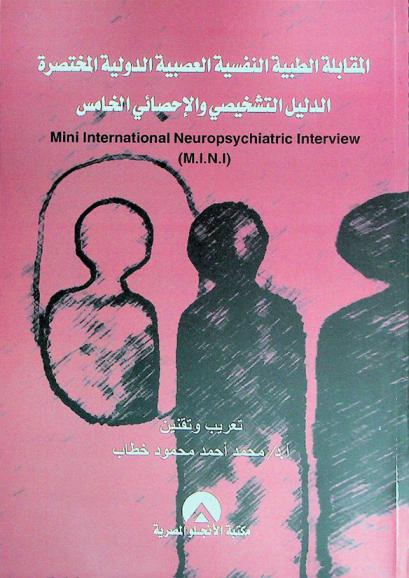
المقابلة الطبية النفسية العصبية الدولية المختصرة : الدليل التشخيصي والإحصائي الخامس
يقدم هذا الدليل أداة تقييم سريرية موجزة تعرف ب المقابلة الطبية النفسية العصبية الدولية المختصرة (MINI)، والمعدة لتشخيص الاضطرابات النفسية وفقا لمعايير الدليل التشخيصي والإحصائي الخامس (DSM-5). يستخدم هذا النموذج في المقابلات السريرية لتحديد التشخيص بدقة وكفاءة خلال وقت قصير نسبيا، ويغطي طيفا واسعا من الاضطرابات مثل الاكتئاب، الفصام، اضطراب القلق، الإدمان، واضطرابات الشخصية. يهدف الدليل إلى توحيد أسلوب التقييم السريري، وتحسين الدقة التشخيصية، وتسهيل اتخاذ القرار العلاجي خاصة في البيئات العلاجية أو البحثية.
BOOK

An evolving international research collaboration network: spatial and thematic developments in co-authored higher education research, 1998–2018
Co-authored research articles in the disciplinarily heterogeneous field of higher education have dramatically increased in this century. As in other fields, rising international co-authorships reflect evolving international collaboration networks. We examine higher education research over two decades, applying automated bibliometric topic identification and social network analysis of 9067 papers in 13 core higher education journals (1998–2018). Remarkable expansion in the volume of papers and co-authorships has, surprisingly, not resulted in a more diverse network. Rather, existing co-authorship patterns are strengthened, with the dominance of scholars from a few Anglophone countries largely maintained. Researchers globally seek to co-author with leading scholars in these countries, especially the US, UK, and Australia—at least when publishing in the leading general higher education journals based there. Further, the two-mode social network analysis of countries and topics suggests that while Anglophone countries have led the development of higher education research, China and Germany, as leading research-producing countries, are increasingly influential within this world-spanning network. Topically, the vast majority of co-authored papers in higher education research focuses on individual-level phenomena, with organizational and system or country-level analysis constituting (much) smaller proportions, despite policymakers’ emphasis on cross-national comparisons and the growing importance of university actorhood. We discuss implications thereof for the future of the multidisciplinary field of higher education.
Journal Article

The Education Effect on Population Health: A Reassessment
Demographic research frequently reports consistent and significant associations between formal educational attainment and a range of health risks such as smoking, drug abuse, and accidents, as well as the contraction of many diseases, and health outcomes such as mortality—almost all indicating the same conclusion: better-educated individuals are healthier and live longer. Despite the substantial reporting of a robust education effect, there is inadequate appreciation of its independent influence and role as a causal agent. To address the effect of education on health in general, three contributions are provided: 1) a macro-level summary of the dimensions of the worldwide educational revolution and a reassessment of its causal role in the health of individuals and in the demographic health transition are carried out; 2) a meta-analysis of methodologically sophisticated studies of the effect of educational attainment on all-cause mortality is conducted to establish the independence and robustness of the education effect on health; and 3) a schoolingcognition hypothesis about the influence of education as a powerful determinant of health is developed in light of new multidisciplinary cognitive research.
Journal Article

UNDERSTANDING THE ASSOCIATION BETWEEN MATERNAL EDUCATION AND USE OF HEALTH SERVICES IN GHANA: EXPLORING THE ROLE OF HEALTH KNOWLEDGE
This paper examines the role of health knowledge in the association between mothers' education and use of maternal and child health services in Ghana. The study uses data from a nationally representative sample of female respondents to the 2008 Ghana Demographic and Health Survey. Ordered probit regression models evaluate whether women's health knowledge helps to explain use of three specific maternal and child health services: antenatal care, giving birth with the supervision of a trained professional and complete child vaccination. The analyses reveal that mothers' years of formal education are strongly associated with health knowledge; health knowledge helps explain the association between maternal education and use of health services; and, net of a set of stringent demographic and socioeconomic controls, mothers' health knowledge is a key factor associated with use of health services.
Journal Article

Gender, equality and education from international and comparative perspectives
Investigates the often controversial relationship between gender, equality and education from international and comparative perspectives. This volume also investigates whether gender equality in education is really being achieved in schools around the world or not.
eBook

University vs. Research Institute? The Dual Pillars of German Science Production, 1950–2010
The world’s third largest producer of scientific research, Germany, is the origin of the research university and the independent, extra-university research institute. Its dual-pillar research policy differentiates these organizational forms functionally: universities specialize in advanced research-based teaching; institutes specialize intensely on research. Over the past decades this policy affected each sector differently: while universities suffered a lingering “legitimation crisis,” institutes enjoyed deepening “favored sponsorship”—financial and reputational advantages. Universities led the nation’s reestablishment of scientific prominence among the highly competitive European and global science systems after WWII. But sectoral analysis of contributions to science, technology, engineering, mathematics, and medical and health journal publications (1950–2010) finds that Germany’s small to medium-sized independent research institutes have made significant, growing contributions, particularly in publishing in higher impact journals proportionally more than their size. Simultaneously—despite dual-pillar policy implications—the university sector continues to be absolutely and relatively successful; not eclipsed by the institutes. Universities have consistently produced two-thirds of the nation’s publications in the highest quality journals since at least 1980 and have increased publications at a logarithmic rate; higher than the international mean. Indeed, they led Germany into the global mega-science style of production. Contrary to assumed benefits of functional differentiation, our results indicate that relative to their size, each sector has produced approximately similar publication records. While institutes have succeeded, the larger university sector, despite much less funding growth, has remained fundamental to German science production. Considering these findings, we discuss the future utility of the dual-pillar policy.
Journal Article

Deepening and broadening knowledge after the PISA scientific event: bibliometric, semantic network, and expert analyses of scientization in education research
The intensification of science as a social institution—known as scientization—is a hallmark of post-industrial society, characterized by deepening research within primary fields and expanding into new ones. While computational analyses of large bibliometric datasets reveal historical trends in the growth of science, their scale misses underlying dynamics. Conversely, qualitative accounts of specific discoveries provide context but fail to capture broader processes driving scientization. This paper introduces a middle-range approach to studying the expansion of science, focusing on scientific responses to significant scientific events (“S-events”) within specific fields over fixed periods. By combining bibliometric data with natural language processing analyses of semantic networks and expert assessments, this approach sheds light on the development of epistemic communities and their role in deepening, broadening, and interacting to foster scientific progress. The Programme for International Student Assessment (PISA) event generated discovery by facilitating a fluid epistemic community of interconnected scientific papers, journals, and scientists. The accumulation of PISA papers appeared not only in directly relevant journals, but also in those at cognitive distance from educational learning science. A dynamic of new ideas broadened the main conceptual core network, while other ideas formed short-lived distal conceptual cores. This case study highlights the strengths and limitations of this middle-range approach for investigating scientization processes.
Journal Article

Socioeconomic Status, School Quality, and National Economic Development: A Cross‐National Analysis of the “Heyneman‐Loxley Effect” on Mathematics and Science Achievement
Based on 1970s data, the \"Heyneman-Loxley (HL) effect\" proposed that in developing nations, school variables were more important than family socioeconomic status in determining academic achievement. A reassessment of the HL effect using 1990s TIMSS data found the relationship between family background and student achievement to be similar across nations regardless of national income, suggesting that the spread of mass schooling has reduced the HL effect. (SV)
Journal Article

The great antagonism that never was: unexpected affinities between religion and education in post-secular society
A persistent sociological thesis posits that the spread of formal education causes an inevitable decline in religion as a social institution and diminishes adherence to religious beliefs in postindustrial society. Now that worldwide advanced education is a central agent in developing and disseminating Western rationality emphasizing science as the ultimate truth claim about a humanly constructed society and the natural world this seems an ever more relevant thesis. Yet in the face of a robust \"education revolution,\" religion and spirituality endure, and in certain respects thrive, thus creating a sociological paradox: How can both expanding education and mass religion coexist? The solution proposed here is that instead of educational development setting the conditions for the decline and eventual death of religion, the two institutions have been, and continue to be, more compatible and even surprisingly symbiotic than is often assumed. This contributes to a culture of mass education and mass religion that is unique in the history of human society, exemplified by the heavily educated and churched United States. After a brief review of the empirical trends behind the paradox, a new confluence of streams of research on compatible worldviews, overlapping ideologies, and their enactments in educational and religious social movements illustrates the plausibility of an affinity argument and its impact on theory about post-secular society.
Journal Article

Engineering a World Class University? The Impact of Taiwan’s World Class University Project on Scientific Productivity
High profile, university excellence initiatives are becoming increasingly popular national R&D policies globally, with 23 nations implementing some form of an excellence initiative from 1995 to 2013. While differing in tactics, their common strategy is to fund accumulated advantage in science productivity, intentionally stimulating a world-class university among selected best universities to lift their capacity to compete internationally with the world’s most research-intensive universities. Here a ten-year difference-in-differences statistical evaluation of rates of scientific publications of Taiwan’s much-publicized, university excellence initiative “World Class University Project” yields findings unanticipated by the policy design. Significant financial resources provided to the selected and designated “World Class Universities” (WCUs, treatment group) did increase their volume and rate of publication of scientific papers overall and in more prestigious journals, but not at the policy’s anticipated accelerated rate. Also, interestingly the non-selected, less research-intensive universities (control group) also increased their publication rate in parallel and sometimes more than the WCUs over the same period. A possible diffusion effect of institutional norms, greater inter-institutional competition, and isomorphism around science productivity generated by the implementation of the policy is examined and discussed in light of the global spread of university excellence initiatives.
Journal Article