
Catalogue Search | MBRL


Are you sure you want to remove the book from the shelf?

{{itemTitle}}
11
result(s) for
"Yamazaki, Shunpei"
Sort by:
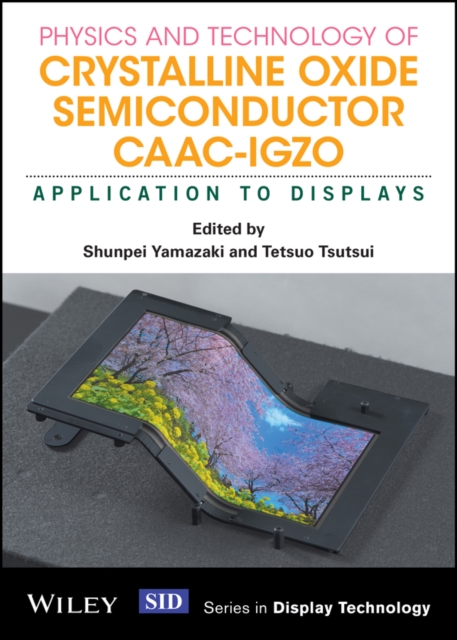
Physics and technology of crystalline oxide semiconductor CAAC-IGZO : application to displays
Physics and Technology of Crystalline Oxide Semiconductor CAAC-IGZO: Application to Displays This book highlights the display applications of c-axis aligned crystalline indium-gallium-zinc oxide (CAAC-IGZO), a new class of oxide material that challenges the dominance of silicon in the field of thin film semiconductor devices.
eBook
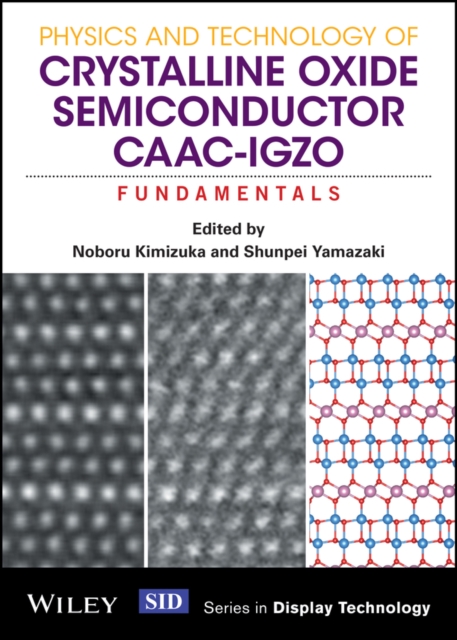
Physics and technology of crystalline oxide semiconductor CAAC-IGZO : fundamentals
Physics and Technology of Crystalline Oxide Semiconductor CAAC-IGZO: Fundamentals
Electronic devices based on oxide semiconductors are the focus of much attention, with crystalline materials generating huge commercial success. Indium–gallium–zinc oxide (IGZO) transistors have a higher mobility than amorphous silicon transistors, and an extremely low off-state current. C-axis aligned crystalline (CAAC) IGZO enables aggressive down-scaling, high reliability, and process simplification of transistors in displays and LSI devices. This original book introduces the CAAC-IGZO structure, and describes the physics and technology of this new class of oxide materials. It explains the crystallographic classification and characteristics of crystalline oxide
semiconductors, their crystallographic characteristics and physical properties, and how this unique material has made a major contribution to the field of oxide semiconductor thin films. Two further books in this series describe applications of CAAC-IGZO in flat-panel displays and LSI devices.
Key features:
* Introduces the unique and revolutionary, yet relatively unknown crystalline oxide semiconductor CAAC-IGZO
* Presents crystallographic overviews of IGZO and related compounds.
* Offers an in-depth understanding of CAAC-IGZO.
* Explains the fabrication method of CAAC-IGZO thin films.
* Presents the physical properties and latest data to support high-reliability crystalline IGZO based on hands-on experience.
* Describes the manufacturing process the CAAC-IGZO transistors and introduces
the device application using CAAC-IGZO.
eBook
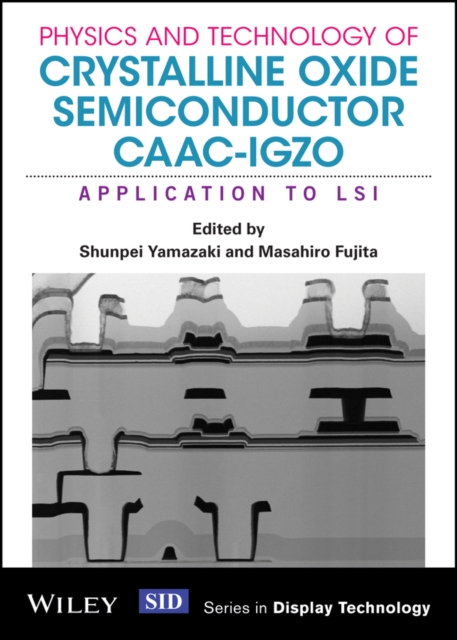
Physics and technology of crystalline oxide semiconductor CAAC-IGZO : application to LSI
Physics and Technology of Crystalline Oxide Semiconductor CAAC-IGZO: Application to LSI This book describes the application of c-axis aligned crystalline In-Ga-Zn oxide (CAAC-IGZO) technology in large-scale integration (LSI) circuits.
eBook
High-performance single-crystalline In2O3 field effect transistor toward three-dimensional large-scale integration circuits
Formation of a single crystalline oxide semiconductor on an insulating film as a channel material capable of three-dimensional (3D) stacking would enable 3D very-large-scale integration circuits. This study presents a technique for forming single-crystalline In2O3 having no grain boundaries in a channel formation region on an insulating film using the (001) plane of c-axis-aligned crystalline indium gallium zinc oxide as a seed. Vertical field-effect transistors using the single-crystalline In2O3 had an off-state current of 10−21 A μm−1 and electrical characteristics were improved compared with those using non-single-crystalline In2O3: the subthreshold slope was improved from 95.7 to 86.7 mV dec.−1, the threshold voltage showing normally-off characteristics (0.10 V) was obtained, the threshold voltage standard deviation was improved from 0.11 to 0.05 V, the on-state current was improved from 22.5 to 28.8 μA, and a 17-digit on/off ratio was obtained at 27 °C.Three-dimensional stacking of single-crystalline oxide semiconductors on insulating films is key to large-scale integration of electronic circuits. Here, a technique is reported for single-crystalline In2O3 formation over an insulting film with no grain boundaries, achieving high processing speed and low power consumption.
Journal Article
Controlling lithium cobalt oxide phase transition using molten fluoride salt for improved lithium-ion batteries
LiCoO2 is a historic lithium-ion battery cathode that continues to be used today because of its high energy density. However, the practical capacity of LiCoO2 is limited owing to the harmful phase transition at high voltages, which prevents the realization of its theoretical capacity. Here, we treat LiCoO2 particles with a molten salt of MgF2–LiF as a reaction accelerator to facilitate the diffusion and doping of magnesium into bulk LiCoO2 and to form a stable coating layer on the particle surface. Ex situ X-ray diffraction analysis confirms the inhibition of the harmful phase transition and the emergence of a different phase as the modified LiCoO2 was charged up to 4.7 V. The modified LiCoO2 shows high electrochemical performance during high-voltage operation. This technology provides a guideline for the suppressing fundamental degradation associated with phase transition and achieving ultra-high energy density LiCoO2 cathodes.The practical capacity of lithium cobalt oxide is limited owing to the harmful phase transition at high voltages. Here, lithium cobalt oxide is treated with a molten salt of magnesium fluoride-lithium fluoride to inhibit of the harmful phase transition at high voltages, suppressing fundamental degradation.
Journal Article

Oxide Ceramic Large‐scale Integration Device for Putting the Brakes on Global Boiling Accelerated by Artificial Intelligence Age Computers
One factor that is considered to be a cause of global boiling, which is becoming a serious social problem, is the rapid progress and widespread use of artificial intelligence (AI). We focus on an oxide ceramic with an extremely low off‐state current (Ioff) of 1 zA/µm to 1 yA/µm and a very large on/off ratio of 17 digits, and we aim to achieve AI with an ultra‐low power consumption using the large‐scale integration of oxide semiconductors (OSs). Field effect transistors (FETs) that include crystal indium oxide (IO) as a channel material exhibit an off‐state current (Ioff) equivalent to that of the FETs that contain indium gallium zinc oxide (IGZO) and an on‐state current (Ion) that is higher than that of the FETs that contain IGZO. Single crystal IO is shown to be a promising material for improving performance and reducing the variation in the characteristics of OS devices. This report introduces the latest trends in the use of oxide ceramics. We expect that the development of these technologies will achieve AI with ultra‐low power consumption in the future, which will be an important remediation against global boiling. The use of oxide ceramic can provide FETs with an extremely low off‐state current of 1 zA/µm to 1 yA/µm and a very large on/off ratio of 17 digits. This report introduces the latest trends in FETs, LSI, and displays using oxide ceramic.
Journal Article
Crystalline IGZO ceramics (crystalline oxide semiconductor)–based devices for artificial intelligence
In 2009, a crystalline oxide semiconductor with a layered structure, which we refer to as c‐axis–aligned crystalline indium‐gallium‐zinc oxide (CAAC‐IGZO), was first discovered. CAAC‐IGZO has a peculiar crystal structure in which clear grain boundaries are not observed despite high c‐axis alignment and absence of a‐b plane alignment. When compared to a Si field‐effect transistor (FET), a metal‐oxide‐semiconductor (MOS) FET, utilizing CAAC‐IGZO, presents lower off‐state current (on the order of yA [10−24 A]). These unique characteristics allow CAAC‐IGZO to realize devices with low power consumption. With the emerging era of artificial intelligence, wherein power saving becomes more significant, CAAC‐IGZO has attracted attention as a potential replacement for Si. This paper describes the characteristics and potentials of CAAC‐IGZO for the development of memory devices with unprecedented functions. In 2009, we discovered a crystalline oxide semiconductor with a layered structure, which we refer to as c‐axis–aligned crystalline indium‐gallium‐zinc oxide (CAAC‐IGZO). A CAAC‐IGZO FET has an extremely low off‐state current and thus realizes devices with low power consumption. With the emerging era of artificial intelligence, wherein power saving becomes more significant, CAAC‐IGZO has attracted attention as a potential replacement for Si.
Journal Article

Establishing the 40Ca(p,pα) Reaction at 392 MeV under Quasi-Free Scattering Conditions
Abstract
The $(p,p\\alpha )$ reaction offers a direct means to probe preformed $\\alpha$-cluster structures in nuclei under quasi-free scattering conditions. Previous studies around 100 MeV provided valuable insights into $\\alpha$ clustering, but quantitative comparison with microscopic cluster wave functions remained limited due to strong distortion effects. At higher energies, the reaction mechanism becomes simpler and the distorted-wave impulse approximation (DWIA) provides a more reliable framework for quantitative analysis. In the present work, the ^{40}$Ca$(p,p\\alpha )$ reaction was measured at an incident energy of 392 MeV using the high-resolution Grand Raiden and Large Acceptance Spectrometer at RCNP. Despite the small cross section in this energy region, the achieved resolution allowed clear separation of the ground and excited states of the residual ^{36}$Ar nucleus, and corresponding momentum distributions were extracted. DWIA calculations using a Woods–Saxon $\\alpha + {}^{36}$Ar bound-state wave function yielded an experimental spectroscopic factor of $S_{\\mathrm{FAC}}^{\\mathrm{WS}} = 0.51 \\pm 0.05$, consistent with the previous result at 101.5 MeV ($0.52 \\pm 0.11$). This agreement demonstrates that the reaction mechanism is well described across a wide energy range. The present study establishes the feasibility of high-precision $(p,p\\alpha )$ measurements at several hundred MeV and highlights their potential as a quantitative probe of $\\alpha$ clustering in medium-mass nuclei, forming the basis for systematic studies in both stable and unstable systems.
Journal Article
Proton-induced deuteron knockout ( p,pd ) on 12C and 16O at 226 MeV
The proton-induced deuteron knockout reaction (p, pd) provides a unique opportunity to exploit proton-neutron correlations and the deuteron cluster structure of nuclei. Direct deuteron knockout experiments on 12C and 16O under quasi-free scattering conditions have been carried out under the ONOKORO project using a 226 MeV proton beam at RCNP, Osaka, Japan. Deuterons from the knockout reaction, acting as clusters, were unambiguously detected at the focal plane of the Large Acceptance Spectrometer. Outgoing protons, following the knockout of clusters, were detected at the focal plane of the Grand Raiden spectrometer to correctly reconstruct the expected events. (p, pd) reactions are established successfully, and excitation energy spectra for the residual nuclei 10B and 14N are obtained. Results showed that a large difference in transition strength toward the low-lying energy level of residual nuclei, including the ground state, was found in comparison to other studies. Theoretical calculations using the PIKOE package based on the distorted-wave impulse approximation are conducted to deduce the triple differential cross section of (p, pd) reaction, and experimental spectroscopic factors of the deuteron cluster are obtained by normalizing the experimental cross section to the theoretical computation. Consistent spectroscopic factors in comparison to shell-model expectations are obtained for transitions involving the orbital angular momentum L = 0 of the cluster. The present work demonstrates that the (p, pd) reactions at 226 MeV as a spectroscopic tool have an advantage in examining spectroscopic aspects of deuteron clustering and the mechanism to form a proton-neutron pair in the spin triplet state with a negligible interference of final state interactions and refraction effects.
Journal Article
Establishing the \\(^{40}\\)Ca\\((p,p \\alpha)\\) reaction at 392 MeV under quasi-free scattering conditions
The \\((p,p \\alpha)\\) reaction offers a direct means to probe preformed \\(\\alpha\\)-cluster structures in nuclei under quasi-free scattering conditions. Previous studies around 100 MeV provided valuable insights into \\(\\alpha\\) clustering, but quantitative comparison with microscopic cluster wave functions remained limited due to strong distortion effects. At higher energies, the reaction mechanism becomes simpler and the distorted-wave impulse approximation (DWIA) provides a more reliable framework for quantitative analysis. In the present work, the \\(^{40}\\)Ca\\((p,p\\alpha)\\) reaction was measured at an incident energy of 392 MeV using the high-resolution Grand Raiden and LAS spectrometers at RCNP. Despite the small cross section in this energy region, the achieved resolution allowed clear separation of the ground and excited states of the residual \\(^{36}\\)Ar nucleus, and corresponding momentum distributions were extracted. DWIA calculations using a Woods-Saxon \\(\\alpha + ^{36}\\)Ar bound-state wave function yielded an experimental spectroscopic factor of \\( S_{\\mathrm{FAC}}^{\\mathrm{WS}} = 0.51 \\pm 0.05 \\), consistent with the previous result at 101.5 MeV \\((0.52 \\pm 0.23 )\\). This agreement demonstrates that the reaction mechanism is well described across a wide energy range. The present study establishes the feasibility of high-precision \\((p,p\\alpha)\\) measurements at several hundred MeV and highlights their potential as a quantitative probe of \\(\\alpha\\) clustering in medium-mass nuclei, forming the basis for systematic studies in both stable and unstable systems.
Paper