
Catalogue Search | MBRL


Are you sure you want to remove the book from the shelf?

{{itemTitle}}
114
result(s) for
"القرآن ترجمة الإنجليزية"
Sort by:

Lexical Shifts in the English Translation of Surat An-Nisaa
This study investigates lexical shifts in the translation of the fourth chapter of the Holy Quran; Surat 'An-Nisaa' (The Women). The term 'shift' means the changes which the text undergoes during the translation process. These changes are mainly attributed to differences in lexical patterning between Arabic and English as well as the stylistic preferences of cohesive devices of each language. The researcher aims at identifying the lexical differences between Arabic and English, with regard to lexical cohesion, which give rise to shifts in the translation of this chapter. The lexical phenomenon under focus in this research is what Halliday & Hasan (1976) call 'reiteration' since it is considered the major type of lexical cohesion. The discussion is supported by a lexical analysis of the shifts in three English translations of the Quran by Ali (2004), Abdel Haleem (2005), and Ghali (2008). The findings of this research are intended to help translators observe sensitive problems that occur in Arabic-English translation and develop appropriate strategies to deal with them.
Journal Article

Al-Bahr in the Holy Quran and Translation Variations
Recent translation studies principally concentrate on the quality of translation. They also focus on terms and their significance in drawing the scope of meaning. From this point, the present study is launched to explore the translation of the term \"bahr\" (= sea) in the Holy Quran through three spaced translations; a term that has a special image in Arabic literature and is used in many different situations to address an audience closely connected with desert. Have these translations succeeded in conveying a term that has signified \"something\" more or less than sea? Through a survey of thirty-nine verses, the study has found out that the broad meaning of the term \"bahr\" has narrowed down by time which reflects the fact that maintaining term meaning has the main concern even in dealing with authoritative texts. In addition, definiteness is brought to light through this paper as a translation norm mistreated in many cases.
Journal Article
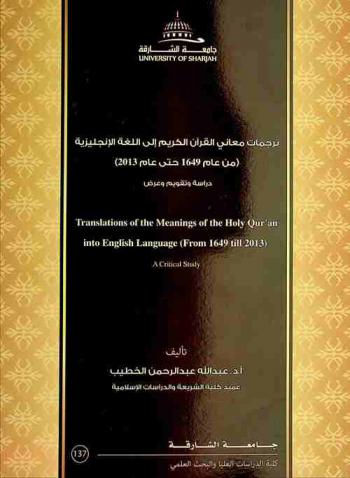
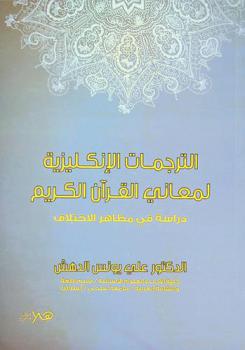
ترجمات معاني القرآن الكريم إلى اللغة الإنجليزية (من عام 1649 حتى عام 2013) : دراسة وتقويم وعرض = Translations of the meanings of the holy qur'an into English language (from 1649 till 2013) : a critical study
يتناول كتاب (ترجمات معاني القرآن الكريم إلى اللغة الإنجليزية (من عام 1649 حتى عام 2013) : دراسة وتقويم وعرض = Translations of the meanings of the holy Qur'an into English language (from 1649 till 2013) : Acritical study) والذي قام بتأليفه (عبد الله عبد الرحمن الخطيب) في حوالي (425) صفحة من القطع المتوسط موضوع (ترجمة القرآن) مستعرضا المحتويات التالية : القسم الأول بعنوان التعريف بترجمة القرآن وحكمها وأهميتها وتاريخ الترجمات الأوروبية والإنجليزية ومعالم مراحل الترجمات، القسم الثاني بعنوان الترجمات التي قام بها غير المسلمين والمسلمون دراسة وتقويم وعرض.
Book

Translation of Dead Metaphors in the Quran
Metaphor is a major problem in translation theory in general. Metaphor translation constitutes a great challenge for translators due to its unique creativity. The problem becomes more apparent when it comes to sensitive religious texts like the Holy Qur'an. Dead metaphors in the Qur'anic text pose a greater difficulty for Qur'an translators due to the fact that they tend to escape translators' attention despite their essential contribution to meaning and effect of the Qur'anic message. This study seeks to shed light on this problem by evaluating the translation strategies and procedures employed in rendering instances of dead metaphors in three translations of the Holy Qur'an using an eclectic approach. The adequacy of the translation strategies and procedures used by the translators are evaluated in light of Skopos theory, the concept of equivalence, Newmark's model for metaphor translation, and Venuti's foreignization and domestication strategies.
Journal Article
Challenges of Rendering Qur'anic Total Paronomasia
The current study attempts to investigate the problematic rendering of paronomasia (agnominatio or punning) in the Qur'an from a semantic pragmatic perspective. M. H. Abrams (1999) defines paronomasia as \"A play on words that are either identical in sound (homonyms) or very similar in sound, but are sharply diverse in meaning\" (253). Thus, paronomasia is a rhetorical device that is like a word play intentionally used to exploit the confusion between words having similar sounds but different meanings. Use of paronomasia in the Qur'an is intentionally employed in order to address the early Arabs who were fluent in their use of language and literature especially in their poetry which was considered part of their daily life. In Arabic rhetoric, paronomasia has two main types: total and partial under which there are 82 types. However, this paper focuses on discussing the use, effect and meaning, and how to translate total paronomasia in the Qur'an. The problem lies in the fact that the translator may not have the linguistic competency, or the cultural background needed for such a mission in order to transfer the implied meaning of Qur'anic paronomasia with the same level of rhetoric into English. The samples of the study are (5) paronomasia verses drawn from the Qur'an. Five sample verses are the samples of the study with their rendering in eight translations of the Qur'ân. The study findings and conclusion found out that in order to overcome the challenges of translating paronomasia in the Qur'an, the translator has to stick to the original Qur'anic text by mentioning their equivalent terms to preserve the faithfulness to the source text of the Qur'an taking into consideration the readership principle. Achieving this complex equation can be through three strategies; adding within-the-text-notes, or footnotes, or endnotes.
Journal Article
Collocational Markedness in the Glorious Qur'an
The present study examines collocation AL nakedness in four translations. The four Translations chosen for the purpose of the study are as follows; The Meaning of the Glorious Coran (1970) by Marmaduke Pick hall, The meaning of the Glorious Qur'an (1934) by Abdullah Yusuf Ali, The Koran (1947) by N.J. Dawood and The Qur'an: A New Translation (1999) by M.A.S. Abdel-Haleem. The main aim of the study is to find out the problems that face the translators when they translate marked collocation in the Qur'an and how they have tried to overcome these problems. Examining the main features of nakedness helps the translators to identify marked collocations in the Source Text, trying to find a marked collocation AL equivalent in the Target Text. The Study adopts Hasan Gazala's model of collocation because it focuses on Arabic collocations. As the ST is the Nobel Qur'an, this model can be regarded as the right choice. The study proves the importance of being familiar of nakedness characteristics. It also shows how the functional approach is the best approach in many cases.
Journal Article