
Catalogue Search | MBRL


Are you sure you want to remove the book from the shelf?

{{itemTitle}}
29,803
result(s) for
"1946"
Sort by:


America Unbound: The Bush Revolution in Foreign Policy
George W. Bush has launched a revolution in American foreign policy. He has redefined how America engages the world, shedding the constraints that friends, allies, and international institutions impose on its freedom of action. He has insisted that an America unbound is a more secure America. How did a man once mocked for knowing little about the world come to be a foreign policy revolutionary? In America Unbound, Ivo H. Daalder and James M. Lindsay dismiss claims that neoconservatives have captured the heart and mind of the president. They show that George W. Bush has been no one's puppet. He has been a strong and decisive leader with a coherent worldview that was evident even during the 2000 presidential campaign. Daalder and Lindsay caution that the Bush revolution comes with significant risks. Raw power alone is not enough to preserve and extend America's security and prosperity in the modern world. The United States often needs the help of others to meet the challenges it faces overseas. But Bush's revolutionary impulse has stirred great resentment abroad. At some point, Daalder and Lindsay warn, Bush could find that America's friends and allies refuse to follow his lead. America will then stand alone-a great power unable to achieve its most important goals.
eBook

Networked David Lynch : critical perspectives on cinematic transmediality
The first multi-disciplinary reconsideration of Lynch's œuvreOffers multi-disciplinary approaches to transmedialityProvides new readings of David Lynch's open œuvreExplores new methods and approaches in film studies, e.g. videographic criticismNetworked David Lynch is a multi-disciplinary reconsideration of Lynch's œuvre in the context of the challenges and opportunities offered by transmedia environments and networks of the 21st century. This collection builds on state-of-the-art-research concepts like video-graphic criticism and video essays to provide a fresh and important approach to any study of David Lynch's œuvre. As such, Networked David Lynch is an attractive entry point to current media theory and recent film history, appealing to cinephiles, academics, researchers, and students.This multi-disciplinary reader provides immediate relevance to university courses focusing on modern film history and on current theory in film, television, and media studies. The scope of approaches featured in the book provides an informative basis for courses on transmedia and media convergence, sound studies, musicology, cultural studies, and American studies.
Book
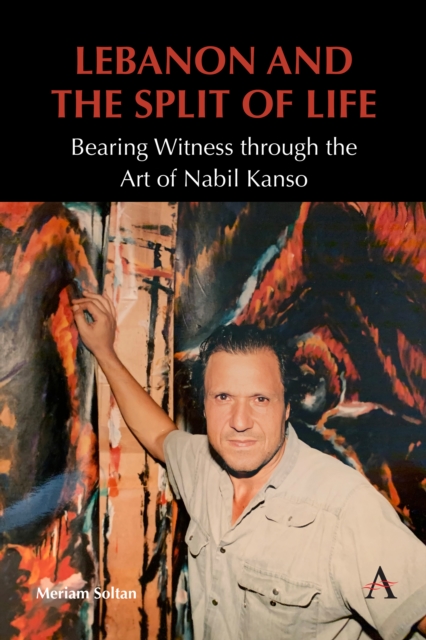
Lebanon and the Split of Life
This scholarly biography traces the life and art of Lebanese-American neo-expressionist, Nabil Kanso (1940-2019). It explores key moments across the artist's transnational career by foregrounding his longest-running, internationally toured exhibition, the Journey of Art for Peace (1985-1993). More specifically, it traces the historical trajectory of his 10 × 28 mural-scale painting, Lebanon, from the circumstances of its production at the height of the Lebanese Civil War in 1983, through its short-lived exhibition history with the Split of Life series in the few years that followed. The book scaffolds an understanding of the artist as an activist and works toward offering distinctly spatial readings of his painterly practice, of which the act of bearing witness is highlighted as permeating the entirety of his oeuvre. It concludes with a contemporary recontextualization of Lebanon in the country's current social, political, and cultural climate, and emphasizes the artist's work as essential to the theorization of larger traditions of political and protest art.The first of its kind and the result of a research fellowship wherein the author was invited to be the first to work through the artist's unpublished archive, this book lays the groundwork for scholarship on the art of Nabil Kanso-an essential yet hitherto unstudied pioneer of the neo-expressionist art movement of the 1960s. It draws extensively on primary source material, including personal notes, diaries, sketchbooks, correspondences, paintings, watercolors, photographs, recorded interviews, and the like. To best animate that source material within the context of this publication, each chapter is prefaced with short narrative anecdotes inspired by the artist's personal notes to better ground the subsequent research and scholarship in the artist's own terms and experiences.Born in Beirut, Kanso, like many of his generation, would seek sought refuge abroad from political instability in his home country. It is through this intrinsic proximity to, yet physical distance from, the cycles of violence and corruption in Lebanon that Kanso would go on to create his grandest greatest mural-scale series. This book, more than anything, explores the artist's oeuvre as an attempt to bear witness and offer testimony to those moments, an inclination that would see the artist grapple with some of the most ferocious crimes against humanity committed throughout his lifetime. As such, this book pairs close readings of Kanso's art and personal practice with both historical and contemporary context meant to animate the relevance of his vast yet never-before-seen artistic archive.
eBook

Stan Smith : some people think I'm a shoe!
\"The first definitive volume that celebrates the best-selling Adidas sneaker with a cultlike global following. Featuring original imagery, historical photos, an exclusive portrait series by artist Juergen Teller, and contributions from style arbiters such as Raf Simons and Pharrell, plus aninterview and anecdotes from the man behind the sneaker, Stan Smith.\" -- Amazon.com
Book

The film paintings of David Lynch : challenging film theory
This book addresses director David Lynch's films from the perspective of the relationship between commercial film, avant-garde art and cultural theory. It offers a unique perspective on the director, weaving together a range of theoretical approaches to Lynch's films to make new connections among film theory, art history, psychoanalysis and cinema.
eBook


Alternative splicing as a regulator of development and tissue identity
Key Points
Alternative splicing explains how a single gene can generate more than one mRNA transcript, thus expanding the complexity of the proteome.
During normal development, a large number of alternative splicing changes occur, and it is now apparent that these transitions between alternatively spliced isoforms contribute to the acquisition of adult tissue functions and identity.
Individual splicing changes are coordinated during development, establishing splicing networks.
As a result of recent progress, we now better understand the mechanisms that coordinate alternative splicing networks and the roles of these networks in cell differentiation, organ development and tissue homeostasis.
Alternative splicing expands the complexity of the proteome by generating multiple transcript isoforms from a single gene. Numerous alternative splicing events occur during cell differentiation and tissue maturation, suggesting that alternative splicing supports proper development. Recent studies shed light on how alternative splicing and its coordination contribute to organ development and tissue homeostasis.
Alternative splicing of eukaryotic transcripts is a mechanism that enables cells to generate vast protein diversity from a limited number of genes. The mechanisms and outcomes of alternative splicing of individual transcripts are relatively well understood, and recent efforts have been directed towards studying splicing networks. It has become apparent that coordinated splicing networks regulate tissue and organ development, and that alternative splicing has important physiological functions in different developmental processes in humans.
Journal Article

The biogenesis and emerging roles of circular RNAs
Circular RNAs (circRNAs) are produced from precursor RNA back-splicing. Recent findings reveal the complexity of the biogenesis of circRNAs and their cell type-specific expression. They also show that circRNAs can shape eukaryotic transcriptomes by sequestering microRNAs and by regulating transcription and interfering with splicing.
Circular RNAs (circRNAs) are produced from precursor mRNA (pre-mRNA) back-splicing of thousands of genes in eukaryotes. Although circRNAs are generally expressed at low levels, recent findings have shed new light on their cell type-specific and tissue-specific expression and on the regulation of their biogenesis. Furthermore, the data indicate that circRNAs shape gene expression by titrating microRNAs, regulating transcription and interfering with splicing, thus effectively expanding the diversity and complexity of eukaryotic transcriptomes.
Journal Article