
Catalogue Search | MBRL


Are you sure you want to remove the book from the shelf?

{{itemTitle}}
378
result(s) for
"Chinese language Psychological aspects."
Sort by:

Reading development and difficulties in monolingual and bilingual Chinese children
This volume explores Chinese reading development, focusing on children in Chinese societies and bilingual Chinese-speaking children in Western societies. The book is structured around four themes: psycholinguistic study of reading, reading disability, bilingual and biliteracy development, and Chinese children's literature. It discusses issues that are pertinent to improving language and literacy development, and complex cognitive, linguistic, and socio-cultural factors that underlie language and literacy development. In addition, the book identifies instructional practices that can enhance literacy development and academic achievement. This volume offers an integrative framework of Chinese reading, and deepens our understanding of the intricate processes that underlie Chinese children's literacy development. It promotes research in reading Chinese and celebrates the distinguished and longstanding career of Richard C. Anderson.
Book

Fictive questions in the Zhuangzi : a cognitive rhetorical study
Rhetoric is intimately related to interaction and cognition. This book explores the cognitive underpinnings of rhetoric by presenting a case study of the rhetorical use of interactional structures, namely expository questions and rhetorical questions, in the classical Chinese tradition.
eBook

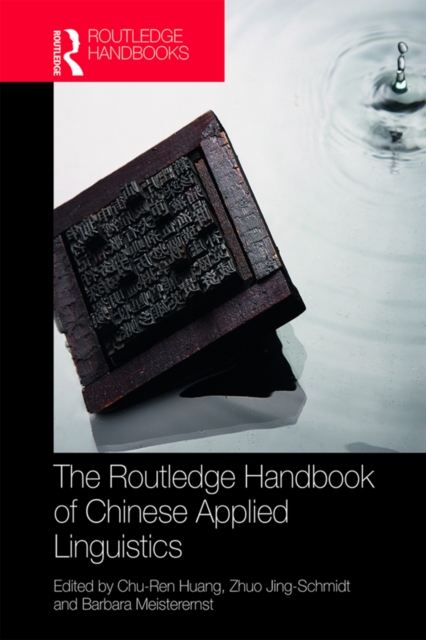
The Routledge Handbook of Chinese Applied Linguistics
The Routledge Handbook of Chinese Applied Linguistics is written for those wanting to acquire comprehensive knowledge of China, the diaspora and the Sino-sphere communities through Chinese language.
It examines how Chinese language is used in different contexts, and how the use of Chinese language affects culture, society, expression of self and persuasion of others; as well as how neurophysiological aspects of language disorder affect how we function and how the advance of technology changes the way the Chinese language is used and perceived. The Handbook concentrates on the cultural, societal and communicative characteristics of the Chinese language environment.
Focusing on language use in action, in context and in vivo, this book intends to lay empirical grounds for collaboration and synergy among different fields.
eBook

Probing into the boredom of online instruction among Chinese English language teachers during the Covid-19 pandemic
Although researching emotions in language education has dramatically increased during the past decades, little is written about the effects of aversive feelings like teacher boredom in the English as a foreign language (EFL) context, especially in the context of online instruction during the COVID-19 pandemic. Against this shortcoming, this study examined the causes of and solutions to teacher boredom experienced by 216 Chinese EFL teachers, including both genders with their ages ranging from 19 to 58. In so doing, the researcher used maximum variation sampling to gather the data via an open-ended questionnaire and semi-structured interviews. The gleaned data were then thematically analyzed by MAXQDA (Version 2020) whose results indicated that most participants consider the online mode of delivery more boring than the face-to-face mode. Additionally, the findings demonstrated that both the antecedents of and the solutions to teacher boredom come under the macro-categories of
student-related, task-related, IT-related
, and
teacher-related
factors and solutions. Out of these, IT
-
related factors and teacher-related solutions were the most frequently raised themes extracted from the data. The study presents some practical implications and directions for future research.
Journal Article

Exploring the mediating roles of motivation and boredom in basic psychological needs and behavioural engagement in English learning: a self-determination theory perspective
In second language acquisition research, the psychological factors associated with language learning have been a prominent focus. The affective turn in and introduction of positive psychology in this field have further boosted research on the roles of positive learner psychological factors (e.g. motivation) in performance (e.g. engagement). However, the theoretical lens for investigating these variables requires further clarification, and the roles of some variables (e.g. boredom) in language learning have been under-researched. Guided by this background, this study aims to explore the complex relationships between learners’ basic psychological needs, self-determined motivation, boredom and behavioural engagement among 687 Chinese senior high school EFL learners from the perspective of self-determination theory (SDT). Quantitative data collection and analysis revealed that students’ basic psychological needs directly predicted behavioural engagement. Basic psychological needs also indirectly predicted behavioural engagement through the simple mediation of boredom and the chain mediation of self-determined motivation and boredom. However, the simple mediation of self-determined motivation in the relationship between basic psychological needs and behavioural engagement was non-significant. The findings enrich the application of SDT in the language learning engagement research, providing valuable implications for teachers and educators.
Journal Article
Artificial intelligence (AI) -integrated educational applications and college students’ creativity and academic emotions: students and teachers’ perceptions and attitudes
Background
Integrating Artificial Intelligence (AI) in educational applications is becoming increasingly prevalent, bringing opportunities and challenges to the learning environment. While AI applications have the potential to enhance structured learning, they may also significantly impact students’ creativity and academic emotions.
Objectives
This study aims to explore the effects of AI-integrated educational applications on college students’ creativity and academic emotions from the perspectives of both students and teachers. It also assessed undergraduate students’ and faculty’s attitudes to AI-integrated applications.
Methodology
A mixed-method research design was used. In the first phase, a qualitative research approach was employed, utilizing theoretical sampling to select informants. Data were collected through in-depth interviews with undergraduate students and university lecturers to gain comprehensive insights into their experiences and perceptions. A scale was developed, validated, and administered to 120 students and faculty in the quantitative phase. Descriptive statistics was used to analyze the data.
Findings
The study revealed that AI applications often impose rigid frameworks that constrain creative thinking and innovation, leading to emotional disengagement due to AI interactions’ repetitive and impersonal nature. Additionally, constant AI assessments heightened performance anxiety, and technical frustrations disrupted the learning process. Conversely, AI applications stimulated creativity by introducing new ideas and problem-solving techniques, enhanced engagement through interactive elements, provided personalized feedback, and supported emotional well-being with gamified elements and constant availability. Quantitative data also verified that teachers and students have positive attitudes toward the benefits and challenges of these applications.
Conclusions
AI integration in educational applications has a dual-edged impact on college students’ creativity and academic emotions. While there are notable benefits in stimulating creativity and enhancing engagement, significant challenges such as creativity constraints, emotional disengagement, and performance anxiety must be addressed. Balancing these factors requires thoughtful implementation and continuous evaluation to optimize the role of AI in education.
Journal Article
The effect of learning adaptability on Chinese middle school students’ English academic engagement: The chain mediating roles of foreign language anxiety and English learning self-efficacy
This study investigated learning adaptability in the English language academic engagement of 17,341 middle school students from 17 provinces (cities) in China. We used the following scales in our study: learning adaptability, foreign language classroom anxiety, English learning self-efficacy, and English academic engagement. Our research resulted in two key findings. First, learning adaptability positively predicted English academic engagement. Second, foreign language anxiety and English learning self-efficacy played separate and sequential mediating roles between learning adaptability and English language academic engagement. These findings indicated that learning adaptability, foreign language anxiety, and English learning self-efficacy play key roles in Chinese middle school students’ English academic engagement. Therefore, in order to improve the level of middle school students’ English academic engagement, teachers and parents can carry out educational activities by cultivating student’s learning adaptability, reducing their foreign language anxiety, and improving their English learning self-efficacy.
Journal Article

Psychological factors and production behaviors of Chinese undergraduate EFL learners
Psychological factor have received much attention in education research. The present mixed-methods study focuses on the effect of foreign language enjoyment (FLE), foreign language classroom anxiety (FLCA) on production behaviors among 182 Chinese English as a foreign language (EFL) learners in FL teaching classes. The major findings are as follows: (1) Chinese university students prefer written production behaviors to oral ones, and personal or pair-work oral practice to onstage oral demonstrations due to foreign language classroom anxiety (FLCA); (2) gender does not affect foreign language enjoyment (FLE), foreign language classroom anxiety (FLCA), or production behaviors; (3) language competence or test scores did not directly affect students’ decisions to speak English or not; (4) Team cooperation, classroom atmosphere, attitude towards English, and interesting materials mediated FLE and FLCA, thus affecting the students’ readiness for language output or production behaviors. Of these above-mentioned variables, team cooperation and classroom atmosphere are two most important factors in enhancing positive emotion and production behaviors. The implications of the study are to help teachers optimize their classroom activities o harness the emotions of learners, boost their FLE and lower their FLCA, and improve their willingness to speak a foreign language.
Journal Article
Analyzing psychological mechanism of physical activity enhancing Chinese L2 learning efficacy with inhibiting aggressive behavior using cross-lagged panel model
For international students coming to China, the process of learning Chinese is very difficult. At the same time, chronic academic underachievement can lead to aggressive behavior (AB). Although physical activity (PA) has been shown to improve learning performance and psychological well-being, its effectiveness in Chinese language learning and AB has not been clarified. Therefore, the present study examined PA as the main variable and explored its dosage profile in Chinese learning and alleviation of AB.
A total of 964 international students from different countries from 8 universities in Beijing were selected as the study population and were assessed using the International Physical Activity Questionnaire (IPAQ), Buss-Perry Aggression Questionnaire (BPAQ) and Hanyu Shuiping Kaoshi (HSK) for 3 longitudinal follow-ups. Analyses of variance, correlations and path models were performed using ANOVA, Pearson and cross-lagged panel model (CLPM).
High PA level accounted for 18%, moderate PA level for 35%, and light PA level for 47%. PA was significantly elevated on AB and all sub-indicators except HSK (F = 1.58-4.38, η² = 0.03-0.05, P < 0.05), and was decreasingly related to physical aggression, verbal aggression, and angry (F = 4.38, η² = 0.03,; F = 3.24, η² = 0.04,; F = 2.37, η² = 0.04; P < 0.01). In terms of correlation, cross-sectional comparison showed that AB was significantly negatively correlated with both HSK and PA (r = -0.41, P < 0.01; 1 = -0.44, P < 0.01). The longitudinal results showed a decreasing trend of negative correlation between AB and PA under T1-T3 stages (r = -0.29, r = -0.44, P < 0.01), and no significant change in the degree of negative correlation with HSK (r = -0.28, r = -0.35, P < 0.01). The positive correlation between HSK and PA did not change significantly (r = 0.15, r = 0.18, P < 0.01). The positive correlation of PA itself decreased over time (r = 0.83, r = 0.76, P < 0.01). The CLPM results show that under T1 phase, PA negatively affects AB in T1 and T2 phases (β = -0.42, β = -0.18) and positively affects HSK in T2 phase (β = 0.24). AB negatively affects T1 and T2 phase HSK (β = -0.25, β = -0.26). HSK negatively affects AB in T2 phase (β = -0.11). Under T2 phase, PA negatively affects T3 phase AB (β = -0.07) and positively affects T3 phase HSK (β = 0.22). AB negatively affects T3 stage HSK (β = -0.10). HSK negatively influences T3 stage AB (β = -0.08).
(1) PA may have beneficial effects on both Chinese L2 learning efficacy and the reduction of AB. (2) Higher levels of PA are likely to strengthen these effects. (3) Establishing daily PA habits may serve as an effective strategy to enhance L2 learning outcomes while simultaneously reducing AB in learners.
Journal Article