
Catalogue Search | MBRL


Are you sure you want to remove the book from the shelf?

{{itemTitle}}
6,201
result(s) for
"Kazakhstan."
Sort by:

Staying at home
Despite economic growth in Kazakhstan, more than 80 per cent of Kazakhstan's ethnic Germans have emigrated to Germany to date. Disappointing experiences of the migrants, along with other aspects of life in Germany, have been transmitted through transnational networks to ethnic Germans still living in Kazakhstan. Consequently, Germans in Kazakhstan today feel more alienated than ever from their 'historic homeland'. This book explores the interplay of those memories, social networks and state policies, which play a role in the 'construction' of a Kazakhstani German identity.
eBook

Sustainable energy in Kazakhstan : moving to cleaner energy in a resource-rich country
\"Kazakhstan is rich in natural resources including coal, oil, natural gas and uranium and has significant renewable potential from wind, solar, hydro and biomass. In spite of this, the country is currently dependent upon fossil fuels with coal-fired plants accounting for 75% of total power generation leading to concerns over greenhouse gas emissions and impacts on human health and the environment. This book analyses the implications of the global shift to cleaner energy for a country whose economy has centred on hydrocarbon exports. The challenge is urgent for Kazakhstan, whose recent economic growth has driven increased demand for energy services, making the construction of additional generating capacity increasingly necessary for enabling sustained growth. In this context, renewable energy resources are becoming an increasingly attractive option to help bridge the demand-supply gap. Chapters written by experts in the field provide a comprehensive review of the current energy situation in Kazakhstan including fossil energy and renewable resources and analyses policy drivers for the energy sector. Emphasising that clean energy covers a variety of renewables, as well as cleaner use of hydrocarbons, this book argues that future technological change will affect the relative attractiveness of the various choices. Recognising technical, geographical and domestic and international political constraints on policymakers' options, this book will be of interest to an interdisciplinary audience in the fields of resource management and clean energy, development economics and Central Asian Studies\"--Provided by publisher.
Book
city of the future
Astana, the capital city of the post-Soviet Kazakhstan, has often been admired for the design and planning of its futuristic cityscape. This anthropological study of the development of the city focuses on every-day practices, official ideologies and representations alongside the memories and dreams of the city's longstanding residents and recent migrants. Critically examining a range of approaches to place and space in anthropology, geography and other disciplines, the book argues for an understanding of space as inextricably material-and-imaginary, and unceasingly dynamic - allowing for a plurality of incompatible pasts and futures materialized in spatial form.
eBook
State-building in Kazakhstan
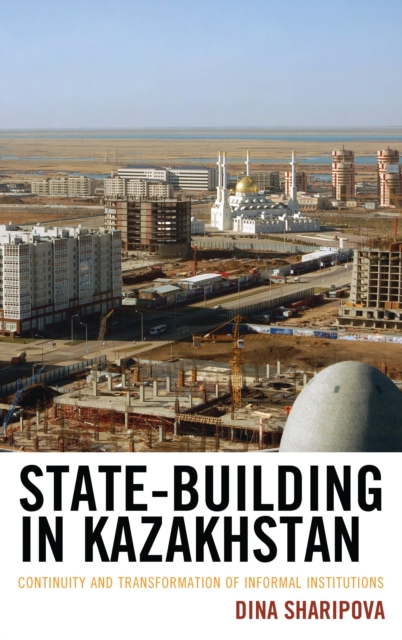
This book challenges the conventional wisdom that informal institutions—networks, clientelism, and connections—have to disappear in modern societies due to liberalization of the economy, rapid urbanization, and industrialization. The case of Kazakhstan shows that informal reciprocal institutions continue to play an important role in people’s everyday lives. Liberalization of the economy and state retrenchment from the social sphere decreased the provision of public goods and social support to the population in the post-independence period. Limited access to state benefits has, in turn, stimulated people’s engagement in informal reciprocal relations. The author investigates informal channels and mechanisms people use to gain access to quality public goods—education, housing, and healthcare. Comparing the Soviet and post-Soviet periods, the author shows that people are more likely to rely on family networks and clientelist relations rather than on help from the state to obtain scarce resources. The book provides an important contribution to the literature on informal institutions and explains the relationship between a formal welfare state and informal reciprocity.
eBook
Kazakhstan in the making
This collection is a multidisciplinary examination of modern-day Kazakhstan. It analyzes the country's fast-changing national identity, the current regime's ongoing quest for popular support, relations between the Kazakh majority and the Russian-speaking minorities, and various other issues.
eBook
Knowledge and the Ends of Empire
In Knowledge and the Ends of Empire, Ian W. Campbell investigates the connections between knowledge production and policy formation on the Kazak steppes of the Russian Empire. Hoping to better govern the region, tsarist officials were desperate to obtain reliable information about an unfamiliar environment and population. This thirst for knowledge created opportunities for Kazak intermediaries to represent themselves and their landscape to the tsarist state. Because tsarist officials were uncertain of what the steppe was, and disagreed on what could be made of it, Kazaks were able to be part of these debates, at times influencing the policies that were pursued.Drawing on archival materials from Russia and Kazakhstan and a wide range of nineteenth-century periodicals in Russian and Kazak, Campbell tells a story that highlights the contingencies of and opportunities for cooperation with imperial rule. Kazak intermediaries were at first able to put forward their own idiosyncratic views on whether the steppe was to be Muslim or secular, whether it should be a center of stock-raising or of agriculture, and the extent to which local institutions needed to give way to imperial institutions. It was when the tsarist state was most confident in its knowledge of the steppe that it committed its gravest errors by alienating Kazak intermediaries and placing unbearable stresses on pastoral nomads. From the 1890s on, when the dominant visions in St. Petersburg were of large-scale peasant colonization of the steppe and its transformation into a hearth of sedentary agriculture, the same local knowledge that Kazaks had used to negotiate tsarist rule was transformed into a language of resistance.
eBook