
Catalogue Search | MBRL


Are you sure you want to remove the book from the shelf?

{{itemTitle}}
2,730
result(s) for
"Video games Social aspects."
Sort by:

Understanding video games : the essential introduction
\"From Pong to virtual reality, Understanding Video Games, 4th Edition, takes video game studies into the next decade of the twenty-first century, highlighting changes in the area, including mobile, social, and casual gaming. In this new edition of the pioneering text, students learn to assess the major theories used to analyze games, such as ludology and narratology, and gain familiarity with the commercial and organizational aspects of the game industry. Drawing from historical and contemporary examples, the student-friendly text also explores the aesthetics of games, evaluates the cultural position of video games, and considers the potential effects of both violent and \"serious\" games. Extensively illustrated and featuring discussion questions, a glossary of key terms, and a detailed video game history timeline, this new edition is an indispensable resource for students, scholars, and teachers interested in examining the ways video games continue to reshape entertainment and society.\"-- Provided by publisher.
Book

Games, Learning, and Society
This volume is the first reader on video games and learning of its kind. Covering game design, game culture and games as twenty-first-century pedagogy, it demonstrates the depth and breadth of scholarship on games and learning to date. The chapters represent some of the most influential thinkers, designers and writers in the emerging field of games and learning - including James Paul Gee, Soren Johnson, Eric Klopfer, Colleen Macklin, Thomas Malaby, Bonnie Nardi, David Sirlin and others. Together, their work functions both as an excellent introduction to the field of games and learning and as a powerful argument for the use of games in formal and informal learning environments in a digital age.
eBook


Playing Along
This book is about play, performance, and participatory culture in the digital age. It shows how music, video games, and social media are bridging virtual and visceral experience, creating dispersed communities who forge meaningful connections by “playing along” with popular culture. Miller reveals how digital media are brought to bear in the transmission of embodied knowledge: how a Grand Theft Auto player uses a virtual radio to hear with her avatar’s ears; how a Guitar Hero player channels the experience of a live rock performer; and how an amateur guitar student translates a two-dimensional, pre-recorded online music lesson into three-dimensional physical practice and an intimate relationship with a distant teacher. Through ethnographic case studies, Miller demonstrates that our everyday experiences with interactive digital media are gradually transforming our understanding of musicality, creativity, play, and
participation.
eBook

Introduction to game analysis
\"This accessible textbook gives students the tools they need to analyze games using strategies borrowed from textual analysis. As the field of game studies grows, videogame writing is evolving from the mere evaluation of gameplay, graphics, sound, and replayablity, to more reflective writing that manages to convey the complexity of a game and the way it is played in a cultural context. Clara Fernández-Vara's concise primer provides readers with instruction on the basic building blocks of game analysis--examination of context, content and reception, and formal qualities--as well as the vocabulary necessary for talking about videogames' distinguishing characteristics. Examples are drawn from a range of games, both digital and non-digital--from Bioshock and World of Warcraft to Monopoly--and the book provides a variety of exercises and sample analyses, as well as a comprehensive ludography and glossary. In this second edition of the popular textbook, Fernández-Vara brings the book firmly up-to-date, pulling in fresh examples from ground-breaking new works in this dynamic field. Introduction to Game Analysis remains a unique practical tool for students who want to become more fluent writers and critics of not just video games, but digital media overall\"-- Provided by publisher.
Book

The art of videogames
The Art of Videogames explores how philosophy of the arts theories developed to address traditional art works can also be applied to videogames. Presents a unique philosophical approach to the art of videogaming, situating videogames in the framework of analytic philosophy of the arts Explores how philosophical theories developed to address traditional art works can also be applied to videogames Written for a broad audience of both philosophers and videogame enthusiasts by a philosopher who is also an avid gamer Discusses the relationship between games and earlier artistic and entertainment media, how videogames allow for interactive fiction, the role of game narrative, and the moral status of violent events depicted in videogame worlds Argues that videogames do indeed qualify as a new and exciting form of representational art
eBook

On video games : the visual politics of race, gender and space
\"Today over half of all American households own a dedicated game console and gaming industry profits trump those of the film industry worldwide. In this book, Soraya Murray moves past the technical discussions of games and offers a fresh and incisive look at their cultural dimensions. She critically explores blockbusters likeThe Last of Us, Metal Gear Solid, Spec Ops: The Line, Tomb Raider and Assassin's Creed to show how they are deeply entangled with American ideological positions and contemporary political, cultural and economic conflicts. As quintessential forms of visual material in the twenty-first century, mainstream games both mirror and spur larger societal fears, hopes and dreams, and even address complex struggles for recognition.This book examines both their elaborately constructed characters and densely layered worlds, whose social and environmental landscapes reflect ideas about gender, race, globalization and urban life. In this emerging field of study, Murray provides novel theoretical approaches to discussing games and playable media as culture. Demonstrating that games are at the frontline of power relations, she reimagines how we see them - and more importantly how we understand them\"-- Provided by publisher.
Book
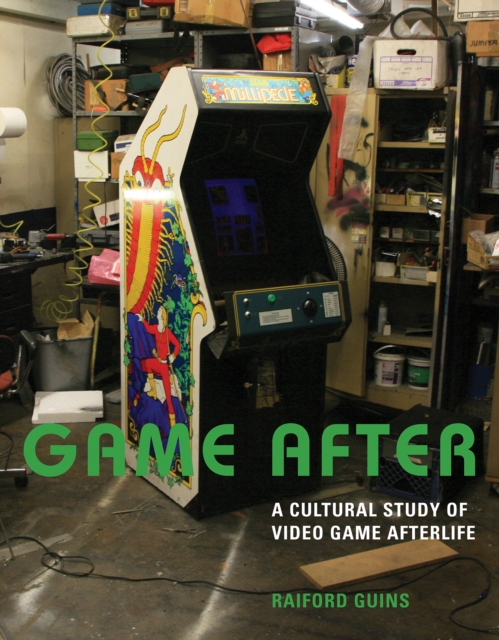
Game After
We purchase video games to play them, not to save them. What happens to video games when they are out of date, broken, nonfunctional, or obsolete? Should a game be considered an \"ex-game\" if it exists only as emulation, as an artifact in museum displays, in an archival box, or at the bottom of a landfill? In Game After, Raiford Guins focuses on video games not as hermetically sealed within time capsules of the past but on their material remains: how and where video games persist in the present. Guins meticulously investigates the complex life cycles of video games, to show how their meanings, uses, and values shift in an afterlife of disposal, ruins and remains, museums, archives, and private collections.Guins looks closely at video games as museum objects, discussing the recontextualization of the Pong and Brown Box prototypes and engaging with curatorial and archival practices across a range of cultural institutions; aging coin-op arcade cabinets; the documentation role of game cartridge artwork and packaging; the journey of a game from flawed product to trash to memorialized relic, as seen in the history of Atari's infamousE.T. The Extra-Terrestrial; and conservation, restoration, and re-creation stories told by experts including Van Burnham, Gene Lewin, and Peter Takacs. The afterlife of video games -- whether behind glass in display cases or recreated as an iPad app -- offers a new way to explore the diverse topography of game history.
eBook


Gaming at the Edge
Video games have long been seen as the exclusive territory of young, heterosexual white males. In a media landscape dominated by such gamers, players who do not fit this mold, including women, people of color, and LGBT people, are often brutalized in forums and in public channels in online play. Discussion of representation of such groups in games has frequently been limited and cursory. In contrast,Gaming at the Edgebuilds on feminist, queer, and postcolonial theories of identity and draws on qualitative audience research methods to make sense of how representation comes to matter.
InGaming at the Edge, Adrienne Shaw argues that video game players experience race, gender, and sexuality concurrently. She asks: How do players identify with characters? How do they separate identification and interactivity? What is the role of fantasy in representation? What is the importance of understanding market logic? In addressing these questions Shaw reveals how representation comes to matter to participants and offers a perceptive consideration of the high stakes in politics of representation debates.
Putting forth a framework for talking about representation, difference, and diversity in an era in which user-generated content, individualized media consumption, and the blurring of producer/consumer roles has lessened the utility of traditional models of media representation analysis, Shaw finds new insight on the edge of media consumption with the invisible, marginalized gamers who are surprising in both their numbers and their influence in mainstream gamer culture.
eBook