
Catalogue Search | MBRL


Are you sure you want to remove the book from the shelf?

{{itemTitle}}
22
result(s) for
"Sánchez-Hernández, Ariadna"
Sort by:

Exploring the Connections Between EFL Learners’ Motivation, Engagement and Pragmatic Development in Self-Access Web-Based Instruction
The present study investigates the relationship between initial learner motivation, engagement, and pragmatic development within a self-access web-based instructional environment. Focused on the development of awareness and production of English email requests to faculty, the study involved 65 first-year English Studies students at a Spanish public university. Motivation was assessed qualitatively through open-ended responses which were classified as having Pragmatic orientation, Linguistic orientation, or No orientation. Engagement was captured multidimensionally via project-linked indices of behavioural, cognitive, and affective involvement. Findings reveal that initial motivation predicted greater overall engagement, including increased time invested and deeper cognitive processing. A distinct modality gap was identified: while engagement related positively to pragmatic gains, it exerted stronger effects on awareness than production. Most crucially, profile analyses revealed that sustained engagement can override initial motivational deficits. Learners who entered the module with no initial orientation but still engaged at a moderate level significantly outperformed unmotivated, disengaged peers and achieved gains comparable to those of more motivated students. These findings underscore the mediating role of engagement in pragmatic instruction and advocate for specific motivational and engagement assessments over general scales to better account for the effects of these individual differences in L2 pragmatic gains.
Journal Article
The Effects of Self-Access Web-Based Pragmatic Instruction and L2 Proficiency on EFL Students’ Email Request Production and Confidence
The present study pursued three objectives: (i) to examine whether self-access web-based instruction could significantly improve EFL students’ ability to formulate pragmatically appropriate email requests; (ii) to determine whether L2 proficiency influenced students’ pragmatic performance and their gains following instruction; and (iii) to explore changes in learners’ confidence when evaluating the appropriateness of their own email requests. Sixty-eight first-year English Studies students at a Spanish university completed a five-week intervention integrated into their curriculum. Their L2 proficiency was assessed using the Oxford Placement Test, which categorized them into B1 (n = 22), B2 (n = 23), and C1 (n = 23) levels. Using a pre–post-test design, learners’ performance was assessed through email tasks varying in imposition, and their confidence was measured via Likert-scale ratings. Results showed statistically significant improvements across all dimensions of an analytic rubric—particularly in request appropriateness and organization—indicating that self-access instruction effectively enhanced learners’ pragmatic competence. Gains were similar across the three proficiency groups, with B2 students showing slightly higher though not statistically significant improvements. Participants also reported significantly increased confidence in evaluating their own email appropriateness post-intervention. Findings support the integration of self-access pragmatic resources into EFL curricula to develop academic communication skills in higher education contexts.
Journal Article
The Development of Pragmatic Markers in English as a Second Language: Do Age and Learning Context Matter?
The present study explores the development of pragmatic marker (PM) use by children and adult L2 English learners in two learning contexts: study abroad (SA) and at home (AH). The study involved a group of 35 Catalan/Spanish girls (aged 11 to 13) learning English AH (n = 16) and abroad in Ireland (n = 19), and a group of 16 adult students aged 19–31 learning English in the UK and Ireland (n = 10) and at their home university in Barcelona (n = 6). To test their pragmatic development, the use of PMs was prompted through pre-test and post-test semi-structured interviews. The results indicated an effect of both age and context on PM development. Children in the SA context increased their use of some PMs, whereas their peers who remained at home did not show any development. Regarding the adults, both SA and AH participants increased their use of specific PMs. These findings shed some light on a topic that has not received scholarly attention in the field of L2 pragmatics: the development of PM use by children. Additionally, they contribute to the very small body of longitudinal studies on the development of PM use during SA.
Journal Article
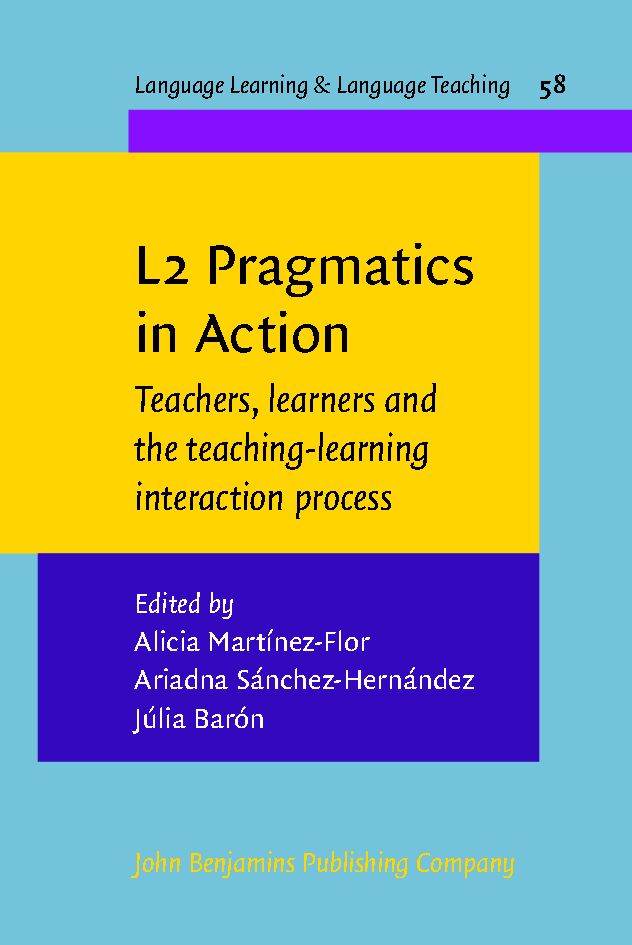
L2 pragmatics in action : teachers, learners and the teaching-learning interaction process
This is the first edited volume dedicated to both teachers and learners of second/foreign language (L2) pragmatics. It comprises a collection of studies that explore how teachers background and practices, and individual learners differences contribute to the teaching and learning of L2 pragmatics. Also included are chapters that present pedagogical approaches that bring teachers and learners together in action in the classroom setting. Written by an international team of experts, the volume examines the most relevant topics on instructional pragmatics in a variety of language contexts, including Brazil, China, Germany, Japan, Spain, the United States, and Vietnam. This global perspective represents a key contribution in the current increasingly multilingual and multicultural society. Taken together, the findings presented have diverse research and pedagogical implications, and provide new directions to explore L2 pragmatic competence. This innovative book will be a valuable resource for researchers and graduate students, as well as for language teachers and course developers.
eBook

Learning Pragmatic Routines during Study Abroad: A Focus on Proficiency and Type of Routine
The present study explores pragmatic learning during study abroad (SA) programs, focusing on gains in learner recognition and production of pragmatic routines, and considers whether proficiency and type of routine play a role in this. One hundred and twenty-two international students in their first semester of study at US universities completed a pre-test and a post-test version of a vocabulary knowledge scale (VKS) and a written discourse-completion task (DCT). Pragmatic routines elicited for recognition were categorised according to how bound they are to specific situations, while production routines were operationalised in terms of prototypicality. The results revealed that knowledge of pragmatic routines increased during a semester abroad, particularly in terms of recognition. While this increase was unrelated to proficiency, type of routine did play a significant role. Students showed greater gains in recognition of situational routines and in production of those that are highly-prototypical. The findings of the study underline the importance of SA programs for the acquisition of pragmatic routines, and suggest that exposure to routines in relevant contexts enhances pragmatic development. El presente estudio examina el aprendizaje de la competencia pragmática durante las estancias lingüísticas en el extranjero. En particular, se centra en el reconocimiento y en la producción de rutinas pragmáticas, considerando si el nivel de inglés de los estudiantes y el tipo de rutina influyen en la adquisición de las mismas. Ciento veintidós estudiantes internacionales en su primer semestre de estudios en universidades de Estados Unidos completaron un pretest y un post-test de una escala de conocimientos de vocabulario—vocabulary knowledge scale (VKS)—y una prueba de elicitación del discurso—discourse completion task (DCT). Las rutinas pragmáticas presentadas para reconocimiento se clasificaron según su dependencia de contextos específicos, mientras que las de producción según su prototipicalidad. Los resultados del estudio confirman que el conocimiento de rutinas aumenta durante un semestre en el extranjero, y en especial la habilidad de reconocerlas. Aunque el nivel de inglés no afecta en este aumento, el tipo de rutina ejerce una influencia significativa. En concreto, se observaron mayores ganancias en el reconocimiento de rutinas situacionales y en la producción de rutinas muy prototípicas. Estos resultados corroboran la importancia de las estancias lingüísticas para la adquisición de rutinas pragmáticas, y sugieren que la exposición a las mismas en contextos significativos es determinante para el desarrollo de la competencia pragmática.
Journal Article


L2 Pragmatics in Action: Teachers, Learners and the Teaching-Learning Interaction Process. Language Learning & Language Teaching. Volume 58
This is the first edited volume dedicated to both teachers and learners of second/foreign language (L2) pragmatics. It comprises a collection of studies that explore how teachers background and practices, and individual learners differences contribute to the teaching and learning of L2 pragmatics. Also included are chapters that present pedagogical approaches that bring teachers and learners together in action in the classroom setting. Written by an international team of experts, the volume examines the most relevant topics on instructional pragmatics in a variety of language contexts, including Brazil, China, Germany, Japan, Spain, the United States, and Vietnam. This global perspective represents a key contribution in the current increasingly multilingual and multicultural society. Taken together, the findings presented have diverse research and pedagogical implications, and provide new directions to explore L2 pragmatic competence. This innovative book will be a valuable resource for researchers and graduate students, as well as for language teachers and course developers. [Foreword written by Marta González-Lloret.]
Book

INTERCULTURAL DEVELOPMENT DURING SHORT-TERM STUDY ABROAD: THE ROLE OF INTENSITY OF INTERACTION ON CROSS-CULTURAL SENSITIVITY
Este estudio examina el desarrollo de la sensibilidad intercultural (CCS) de estudiantes de segundo idioma (L2) durante estancias cortas en el extranjero (STSA), y explora el papel del contacto lingüístico en el desarrollo de la CCS. Los participantes fueron 19 universitarios estadounidenses matriculados en un programa de 8 semanas en España. Antes de viajar cumplimentaron el Inventario de Sensibilidad Intercultural (ISI, Mahon & Cushner, 2014) de 4 subescalas: integración del comportamiento cultural, ansiedad cultural, flexibilidad cognitiva e inclusión cultural. En España, completaron 10 entradas semanales en sus diarios sobre sus experiencias. Al final volvieron a cumplimentar el ISI y un cuestionario de contacto sobre sus interacciones en español en situaciones diferentes. Los resultados revelaron que tras la estancia en España ganaron en desarrollo de la CCS, específicamente en integración del comportamiento cultural. Paradójicamente, los participantes experimentaron un descenso en flexibilidad cognitiva, lo que sugiere que tras su participación en el programa seguían sintiéndose como turistas y no desarrollaron una actitud positiva hacia la comunidad local. En cuanto al papel de la intensidad de interacción, se observó un efecto parcial en el desarrollo de la CCS, ya que sólo la subescala de ansiedad cultural se relacionaba con cantidad de interacción en español. En general, este estudio representa una contribución clave a los campos de la competencia intercultural y al contexto de los estudios en el extranjero, aportando datos relevantes a las decisiones que afectan a la planificación de programas y la preparación de estudiantes antes de realizar una experiencia internacional.
Journal Article